
Hulu gets Lost and Desperate (and Mickey)
They've got a mouse in the house: Hulu on Thursday announced that the scrappy streaming-video site has reached a deal with Disney in which the House That Mickey Built will take a 30% equity stake, and watching Scrubs and Ugly Betty online will take up everyone else's waking hours. The deal will include content from ABC Primetime, ABC Family, ABC Daytime, SOAPnet, Disney Channel, Walt Disney Studios and, of course, the archives thereof.
That's three of the four major networks (NBC, ABC and Fox; CBS as you'll remember went with YouTube) and over 150 content providers, for those keeping score at home. Of course, ABC also has a recent deal in place with YouTube. It's also not clear at press time what this will mean for ABC's own streaming service, which some prefer for its HD content and others dislike for its rather demanding player.

Windows 7 RC now being distributed to MSDN, TechNet subscribers
The first "real" copies of Build 7100, the Windows 7 Release Candidate -- quite likely, the only one there will be -- were officially distributed to subscribers to Microsoft's MSDN and TechNet subscribers at 11:00 am EDT / 8:00 am PDT Thursday morning. Included in this morning's distribution are the 32- and 64-bit editions of the Ultimate SKU of the operating system, plus the all-new Windows Driver Kit Release 7 for those who'll be building device drivers for the new OS using the revised driver model; the Automated Installation Kit for remote deployments using servers; and the updated Windows 7 SDK RC in x86, x64, and Itanium editions.
11:15 am EDT April 30, 2009 - Almost immediately upon the RC's public release, the response time for Microsoft's Web services became extremely slow. It's a good sign for the company in one respect: Not all of Microsoft's developers took the bait and downloaded one of last week's leaks.

Time Warner may or may not spin off AOL, says SEC filing
Early morning news reports told readers that Time Warner has begun the process of spinning off its AOL division into a separate entity. The earliest versions of those reports did not this time cite unnamed or anonymous sources, or wireless microphones attached to rats traversing the air ducts of the headquarters building, but instead this morning's regulatory filing with the US Securities and Exchange Commission.
As it turns out, that's not exactly what the filing says at all. A Time Warner analysts' briefing this morning will likely lay out the details, but here is what we know based on the source that was actually cited: Time Warner's board of directors has not reached a decision with regard to whether it wants to spin off the AOL unit to TW's shareholders or to anyone else, although the "Company" (read: executives) believe that such a move is probable. However, everyone acknowledges that there may be other possibilities in the works.
Here is the complete passage in question:
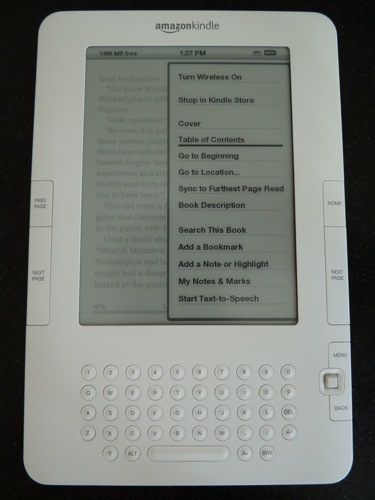
Kindle 2 and the unintentional acquisition of knowledge
Amazon's Kindle 2 has received a great deal of acclaim for improving upon many of the shortcomings of its predecessor: shrinking its size, improving its usability, and adding a handful of new features such as rudimentary web browsing and the contentious text to speech function.
What's difficult to quantify is the effect it has on the user; that is, the degree to which it simplifies or improves one's life. Since I've had mine, my reading has gone from two books a month to eight, but because the majority of the books I read would best be classified as "light reading," I feel like the impact it has had on my personal improvement is negligible.
Mint.com spices up advice offerings, while Prosper.com gets a second wind
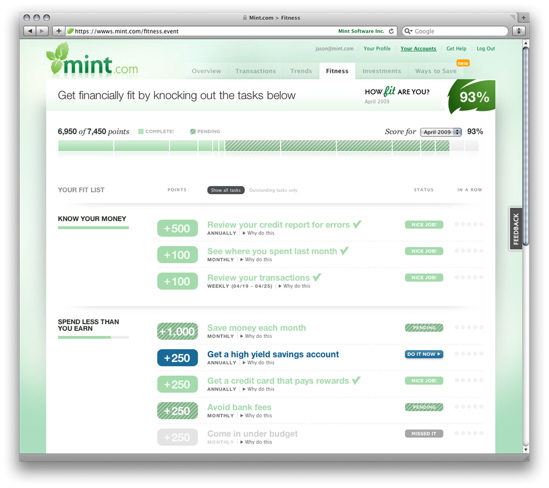
As of this week, ten percent of the members of Mint.com's personal-finance site are gaining beta access to a slick new tool that evaluates their financial picture and guides them through the months- or years-long process of getting financially fit. Meanwhile, for those for whom financial fitness requires some help, one of the Web's first microloan sites is back in the saddle after a six-month quiet period.
The Financial Fitness feature works as much like a personal trainer as a financial advisor -- not just suggesting wise paths down which you can take your money, but standing there with a clipboard and a checklist and a scale. The model's deliberate, according to fonder and CEO Aaron Patzer: "Like any goal -- from weight loss, to video game domination, or getting a promotion -- specific, actionable plans help people stay on track in the short term, and achieve more in the long term."

New scares loom over open source license lawsuits
Within the short "tradition" of open source lawsuits, users have typically needed to worry their heads only about breach of contract concerns. But last summer, in a case called Jacobsen v. Katzer, the US Court of Appeals for the Federal Circuit opened up copyright claims as a new route for people looking for financial damages.
Open source developer Robert Jacobsen sued Matthew Katzer and Kamind Associates, producers of commercial software used with model trains, alleging that Katzer and his company violated copyrights around the Java Model Railroad Interface (JMRI), an open source software project licensed under what's called the Artistic License.

Microsoft's browser-tying case may or may not be heard by the EC
This morning, Microsoft issued its formal, sealed response to the European Commission's January Statement of Objections, which was the EC's first step toward formally charging the software maker with objectionable conduct by bundling Internet Explorer with Windows. But in a correction of press accounts early this morning, both Microsoft and the European Commission confirmed to Betanews today that the company only issued a request for a hearing before the EC in order to preserve its right to be heard at a later date, and that Microsoft has not decided whether it actually will present its case orally.
"Parties responding to a [Statement of Objections] are required to indicate by that response whether they will request a hearing or preserve their right to one," Microsoft corporate spokesperson Jack Evans told Betanews. "That doesn't mean Microsoft will ultimately press for a hearing...The company has requested a hearing to preserve its right to have one at a later date, but has not yet made that determination."

Firefox 3.5 Beta 4 beats IE8 in Microsoft's own load times test
Last month, Microsoft published a white paper suggesting that, as first adopters installed the final build of Internet Explorer 8, they judge the real performance of the new browser based on what they feel when they use it. Specifically, the authors of the paper (PDF available here) advised users to load their favorite Web sites and feel how much less time it takes to see results. But since many Web sites take only microseconds to load anyway -- perhaps beyond the range of everyday human feeling -- they went on to suggest that folks take videos of their Web sites loading, and use the time index cues to tell the story of whether they should feel pages loading faster or not.
Betanews took Microsoft up on its suggestion...kind of. No, we didn't set up a video camera. But we did set up a clean virtual machine with an adaptation of WebMonkey's Browser Load Time Stopwatch, to see just how many microseconds we should be feeling if our feelers felt that sensitively. At the time, our tests concluded that the latest edition of Mozilla's production release of Firefox available at that time, version 3.0.7, could load 25 selected pages from comScore's Top 50 Web sites (plus Betanews thrown in for good measure) 13% faster on average than the final IE8, and Firefox 3.1 Beta 3 loaded those pages 31% faster than IE8.

Acer CEO announces support for Android
Acer has been quite candid about its move into the smartphone sector, and is expected to launch around ten new handsets this year, many of which will be rebranded E-Ten designs from the mobile phone maker Acer acquired in late 2008.
The company launched eight phones at a conference in Singapore last week, almost all were powered by Windows Mobile, but Acer has expressed increasing interest in Android-powered handsets, causing speculation that the company would be coming forward with one in the near future.

Why the inclusion of Gracenote 'Blu-ray' in iTunes 8.2 beta is nothing
Thanks to the fine-toothed comb that the Mac faithful run over their updates, readers of MacRumors noticed a passage contained within the iTunes 8.2 beta "About iTunes" window that references DVD and Blu-ray.
Because iTunes does not support the playback of DVDs or Blu-ray discs, the rumor mill's first train of thought went directly to Blu-ray Macs, and then to DVD ripping in iTunes. But before you too head down that bumpy road, let's look at the context of which the discs were mentioned.

Service Pack 2 for Vista and WS2K8 released to manufacturing
In what's turning out to be a busy week for Microsoft, the company announced last night that the code has been finalized for Windows Vista and Windows Server 2008 Service Pack 2 -- a unified code base that upgrades both operating systems. This after the only release candidate for SP2 was released for final testing on March 4.
In a Betanews check Wednesday morning, SP2 was not yet being distributed to MSDN and TechNet subscribers, although we can probably expect to see it turn up there in the next few days.

Meet the Obama technology team
The twenty people named to the President's Council of Advisors on Science and Technology (PCAST) bring together hundreds of years of research, four MacArthur grants, the most interesting guy at Microsoft, the most interesting grownup at Google, experts on geriatric medicine and evolutionary biology and the Stock Exchange and climate change, and three Nobel laureates. And some astronomers, because those guys have all the fun.
PCAST, founded in 1990, exists to advise the President and Vice President in matters of science, technology, and innovation. President Obama announced the lineup this week at the National Academy of Sciences. Brief biographies of all twenty are available on PCAST's site, but a few groupings are worth noting here:

AMD: We didn't say anything about Nvidia licensing
Last week, after AMD's conference to reporters last Wednesday updating its roadmap for server CPUs, we reported that the licensing situation for Nvidia and Broadcom chipsets for use in AMD-based servers looked bleak. This afternoon, AMD spokesperson Phil Hughes contacted Betanews to say that the company made no comment with regard to licensing, and continues to make no comment.
"We haven't made any comment with regard to licensing," stated Hughes. He reiterated Server Business Unit Vice President Pat Patla's comment that AMD has only made a decision to go with AMD-branded chipsets for use in motherboards built for new Opteron processors. But when we asked Hughes whether licensing played any role in AMD's decision to only use AMD chipsets and not extend licenses to Nvidia or Broadcom, Hughes repeated that the company has made no comment with regard to licensing, only that it has chosen to use AMD chips for this purpose.

Sun sets quietly behind dim Q3 report
What can you say after you've said "Oracle made us an offer?" Nothing worth saying to analysts, apparently, as Sun on Tuesday canceled its Q3 earnings call. Still the earnings reports must be released, and one feels one ought to look.
Shall we start with the good news? Billings were up a combined 4% year-over-year in the Total Software, Open Storage, Solaris-based SPARC CMT Servers, and X64 Servers categories, and those billings in turn accounted for 40% of total billings, up 10%. Total Software and Open Storage billings were up 28% and 63% year-over-year respectively, and SPARC CMT Servers billings were up 3%.

Verizon named a suspect in Microsoft's 'Pink' mystery
As we inch closer to the anticipated marketing launch that will reveal to the public exactly what the project code-named "Pink" is, Verizon has reportedly been in talks with Microsoft to secure a contract for the device central to the project.
Rumored to be the touchphone that will finally catapult Windows Mobile into competition with the Apple iPhone, HTC G1, BlackBerry Storm, and Palm Pre, "Pink" is believed to be the product of Danger Inc. makers of the Sidekick OS and part of Microsoft's new Premium Mobile Experiences team. The team is led by Roz Ho, formerly the General Manager of Microsoft's Macintosh Business Unit, which developed and marketed Office for Mac.