One less WMV customer: Verizon V Cast now powered by Real's Helix
RealNetworks announced yesterday that Verizon's V Cast Video service has transitioned over to the Real Helix media delivery system, in a move which puts Real in charge of two major carriers' multimedia platforms.
The short-form video on demand service has transitioned over to the platform upon which Cingular Wireless' Cingular Video was built. That service was later to be renamed "CV" (where "C" now stands for cellular) under the ownership of AT&T.

Report: Hybrid movie and game Blu-ray discs coming to PS3
A report from Sony hardware marketing director John Koller yesterday points to the release of "dual format" Blu-ray discs this year. That is, they'll be both a full-length movie, and a complete associated video game title.
John Koller, Director of Hardware Marketing at Sony Computer Entertainment, told Videobusiness yesterday that they are "actively pushing" for combination movie/game Blu-ray discs on the PlayStation 3 console. "There are a lot of developers who say, 'We have this game based on a movie...wouldn't it be great to marry these concepts?' We will definitely see this stuff this year," Koller said. Thanks to the density of the medium, a full-length HD movie and associated PS3 game could easily fit on a single Blu-ray disc.

Southwest Airlines in-flight Wi-Fi test begins
Over one year ago, Southwest Airlines announced its intention of bringing in-flight wireless internet to its passengers.
Yesterday, Yahoo said the tests will take place on a single plane starting this month, with three more equipped by March, all running on the same Row 44 system they noted last year. What does Yahoo have to do with it, you ask?

Livenation and Ticketmaster antitrust investigation confirmed
No less than one day after announcing their merger, Live Nation and Ticketmaster have come under investigation by the Antitrust Division of the Department of Justice.
This morning, Justice Department spokesperson Gina Talamona told the Associated Press that the department will be thoroughly investigating the deal between the world's largest ticket seller and the world's largest concert promoter.The resulting entity from the merger would be even further-reaching than extant major record labels.

Blockbuster Total Access to include video games
While the main difference between Total Access and Netflilx was the ability for Blockbuster subscribers to return their movies to a physical store if they chose, today the gap between the two services increased.
Blockbuster's Total Access program is the video store's answer to Netflix's by-mail DVD trade. Today, Blockbuster announced it will be renting video games in the Total Access program, putting them in competition with not only Netflix, but Gamefly as well.

Level 3 posts overall improvement
Level 3 Communications, owner and manager of one of the Internet's largest backbone networks, announced in December that it would be laying off 450 of its employees, or roughly eight percent of its total workforce. However, it managed to finish out the year in a better place than it previously was.
Today, the company reported that its full year earnings have improved by 20% against 2007. Level 3 posted a net loss of $91 million in the fourth quarter the previous year, but in 2008 was $44 million in the black.

Dell expands computer recycling program
Number one U.S. computer maker Dell has been building a nationwide recycling program for nearly five years, and efforts look to have picked a considerable amount of steam.
Today, Dell announced that its partnership with Goodwill Industries called Reconnect has been expanded into six more states: Arkansas, Iowa, Maine, New Hampshire, Oregon and Vermont. The program now counts over 1,000 Goodwill locations as recycling centers and is actually expecting to add jobs to handle Reconnect's growth.

Amazon Kindle: not a gamechanger...yet
Digital distribution has infiltrated media. We saw MP3s take over the music business, and we're seeing streaming take over the film and TV business, but will it happen to the book business too?
Who better to ask than an executive at a site dealing in the trade of good old fashioned paper books? Betanews spoke with Eric Ginsberg, the VP of marketing at startup Bookswim.com, a company whose business model is identical to the one pioneered by Netflix. At Bookswim, subscribers build a queue of books, receive them in the mail, and send them back when they're finished reading.

Music industry tectonic shift: Ticketmaster and LiveNation to merge
The big record labels are not only being pummeled by the digital music distribution model, but the looming threat of the even bigger "mega label." The merger of Live Nation with Ticketmaster could create the biggest mega label yet.
Live Nation is a promotion company which goes a step further than others because it acquires venues and signs artists. In 2006 it purchased House of Blues, and in 2007 debuted the Unified Rights Model, which controls recording, merchandising, fan sites, ticketing, broadcasting, sponsorship and marketing rights of its artists. Conceivably, an artist can be "signed" to Live Nation, and never play a single show outside of a venue owned or sanctioned by the company. Live Nation calls this its "global concert pipe," and a "vertically-integrated concert platform."

Computing in India, or the disappearance of the $10 laptop
How many Web sites have to repeat a story before it finally, at long last, becomes the truth? Not enough, as Tim Conneally has learned, in this story about how far the omission of a zero can take a news story.
I wanted to wait until the hype of the "$10 laptop" died down before I dove into the subject, because it was such an appalling mixture of doe-eyed optimism and sloppy reporting, that I simply could not touch it without turning it into an indictment of journalism as a whole. Instead, we look at what $10 really will get you.

Google gets in on the energy business
Google is developing a tool for home energy consumption monitoring, without taking its collective mind off of proselytizing open protocols and standards and user data security.
Utility companies generally form regional monopolies, but evolution in regulatory policies has opened a door for software companies such as Google to get involved. The gradual deployment of "smart meters," -- network-connected power meters capable of maintaining and sharing detailed information about energy consumption -- is one of the major areas of development. Since 2004, for example, the Los Angeles Department of Water and Power (LADWP) has deployed more than 9,000 smart meters provided by a company called SmartSynch.

Major label venture TotalMusic calls it a day
A project by major record labels Sony and Universal sought to change the distribution method of digital music. But over the weekend, a key executive unofficially declared that the plug has been pulled.
In a blog answer to the TechCrunch assessment that Total Music was "sinking fast", Jason Herskowitz, VP of Product Management at Total Music, confirmed the project's termination, saying, "I regret that we didn't get to show you guys more about what we built -- but in these extremely hard economic times (particularly for those in the music industry) it's hard to blame them from pulling the plug on a still-highly-speculative offering."

Google launches Sync for iPhone and Windows Mobile
Google has released a tool that allows Google calendar and Gmail contact data to be synced with iPhone and Windows Mobile devices. Similar to the Blackberry application Google released last year, Google Sync integrates a user's Google calendar data with the phone's native calendar. It also works with Google Apps accounts, but administrator approval must first be granted.
There are currently some limitations to the application. The iPhone, for example, cannot sync more than five calendars, and contact information cannot hold multiple numbers for fax, mobile, or pager headings, and each contact is limited to 3 email addresses.
Hynix to scale DDR3 DRAM down to 40 nm
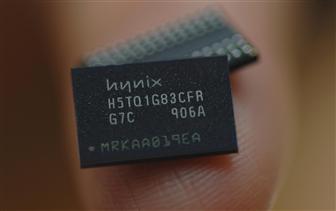
Forget the legal headaches with SDRAM, Hynix announced over the weekend that the "three dimensional transistor" fabrication technology allows for gigabit DDR3 DRAM chips to now be made in the 40 nm size class. Mass production of these 40 nm chips from Hynix is expected to begin in the third quarter of 2009.
ZoneAlarm Router gets updated
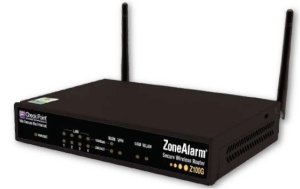
Check Point software's ZoneAlarm Secure Wireless Router Z100G version 8.0 has been released today. The company's antivirus and firewall-enabled wireless router is just over two years old, and has been updated to include VStream antispam, a firewall monitor and status dashboard, built-in DNS server, and support for Xbox LIVE hosting.
The updated Z100G ("G" as in "802.11g") maintains the same premium pricetag that its predecessor carried, and will retail for $149.95.