
Uptake on IE8 slows to a crawl
If the latest figures from global network analytics firm NetApplications can be trusted as reliable samples -- and they certainly have in the past -- the general Web users' interest in Microsoft Internet Explorer 8 may have tapered off appreciably this morning. Over the weekend, the level of Web traffic monitored by NetApplications attributable specifically to the new version of the browser, peaked at 2.52% by 4:00 pm EDT yesterday.
For what is currently a voluntary upgrade, that two-and-a-half percent could certainly be a high number. That's quite a bit higher than Google Chrome, which although flirting with the 2% mark early in its release history, hovers today at closer to the 1% mark. By comparison, as much as 22% of last weekend's traffic was attributable to Mozilla Firefox 3.0 versions.

Senate could move cybersecurity from DHS to a cabinet-level post
One reason the US federal government may feel less and less secure about its technology is that there is no federal standard, maintained by the executive branch and mandated from the highest level, dictating what "security" should actually be. This according to Sen. Jay Rockefeller (D - W.V.), who last week joined with Sen. Olympia Snowe (R - Me.) in the first stage of drafting legislation that would separate the whole issue of cybersecurity from the Dept. of Homeland Security, creating a separate office whose leader reports to Pres. Obama.
"At the risk of sounding alarmist, I know the threats we face. Our enemies are real, they are sophisticated, they are determined and they will not rest," stated Sen. Rockefeller in his opening statement, in hearings on the cybersecurity topic last Thursday before the Commerce Committee which he chairs. "I do not believe it is only the job of the Intelligence Committee or our national security and defense agencies to protect us from the threats we face. This committee can and must play a very proactive role in keeping Americans safe. Let me be very clear: I will not wait for a crisis to take action now. Today's economic climate simply does not allow room for error."

Cloudera open source start-up offers Hadoop cloud software for 'mere mortals'
Well backed Silicon Valley start-up Cloudera has now released a free, private cloud-oriented distribution of a Linux software environment first built by major Web enterprises for "big data."
"Hadoop offers capabilities for capturing, storing and analyzing data that are unmatched. But it's something that enterprises have shied away from until now," said Michael Olson, a former VP at Oracle and now CEO and co-founder of Burlingame, CA-based Cloudera, in a briefing with Betanews.

Can Mozilla escape a premature endgame for Firefox?
It's an undeniable fact that most businesses that transact with their customers through the Internet are wrestling with how to build a viable business model for themselves. Even the most successful enterprises are frankly struggling to ensure their long-term survival, and Mozilla is certainly among them. Its principal product is given away for free, and Firefox's lifeline stems from a percentage of revenues from searches generated though -- all of a sudden -- its own hottest competitor in the Web browser field today, Google.
Yesterday's release by Microsoft of Internet Explorer 8, with its visibly demonstrable speed and performance boosts, is bringing speed and performance back into the public discussion of what a Web browser can be. And there, Web users are likely to discover that while Firefox still outperforms IE8, it's chasing competition on the forward end of the racetrack. Google Chrome -- a browser created by many of the same individuals who are also working on Firefox -- will probably lead Firefox 3.5 in performance even as performance becomes the main value proposition for the new edition of Mozilla's browser.

IEEE begins work on new 1900.4 standards
The Institute of Electrical and Electronics Engineers (IEEE) announced today that work has begun on two new heterogeneous wireless network standards that fall under the 1900.4 category that was approved just two months ago.
IEEE 1900.4 is also known as "The Standard for Architectural Building Blocks Enabling Network-Device Distributed Decision-Making for Optimized Radio Resource Usage in Heterogeneous Wireless Access Networks."

Region woes hose Obama gift to UK prime minister
It's either a minor diplomatic gaffe or an incredibly nuanced commentary on the current state of international copyright protec... nope, definitely a gaffe: The 25 classic DVDs given to British prime minister Gordon Brown when he recently visited President Obama turned out to be more DRM than drama.
According to the report in the Telegraph, when Mr. Brown returned to 10 Downing Street and tried to relax with the movies, his player returned a wrong-region message and would go no further. It's an embarrassment, atop the original fuss made when the gift was contrasted with Mr. Brown's thoughtful and historically rich gift to Mr. Obama. On the bright side, wouldn't it be something if an incident like this one clarified thinking on certain long-deplored aspects of digital rights management? Or at the very least, caused Vice-President Biden to have to explain why he thinks DRM is a reasonable thing to do to law-abiding -- let alone law-making -- citizens and lawfully purchased products?

Slow, but steady usage share growth in IE8's first day
The early numbers from Web analytics firm NetApplications indicate a slower than expected, but steady uptick in usage share for Microsoft Internet Explorer 8, a product which was introduced at noon yesterday on the East Coast. It's not being pushed as an update to the Windows operating system, so trading up for now is still a voluntary affair for users.
Still, if NetApplications' numbers are accurate -- based on the browser traffic it receives from Web sites it analyzes professionally, compared against the Web as a whole -- about as many new users have tried IE8 a day after launch as tried Google Chrome the day after its launch. Worldwide usage share as of 3:00 pm EDT was pegged at 1.90% and climbing. That's just slightly ahead of Google's initial uptick the day after it was launched, according to the firm's numbers.

Here Lies SpiralFrog (2007-2009)
SpiralFrog, the ad-supported music service launched by Universal Music Group and EMI in 2007, is now defunct.
To say SpiralFrog started off on the wrong foot would be an understatement. The service's launch was delayed by nearly a year due to an internal coup that resulted in the departure of the entire executive team. Then, beta testers reported a very unfriendly system of that commanded the user to authenticate each download within a 60-second span after it was completed, or else the download would be negated. This made the service impossible to use passively.

Skydiving through the cloud: Windows Azure gambles with 'Full Trust'
When Microsoft first unveiled its Windows Azure cloud-based platform last October, the company made clear it was not some kind of virtual hosting service -- in other words, not a place to house virtual implementations of Windows Server, like Amazon EC2. More to the point, Azure was designed to be a staging service for the deployment of server-based distributed applications, for clients without the data center capacity to deploy it themselves or without the cash on hand necessary to acquire that capacity.
But in its initial description, those distributed applications were essentially .NET managed apps, which don't exactly encompass the gamut of enterprise apps throughout the world. By "managed," I mean the use of a real Common Language Runtime -- in this case, within Microsoft's cloud -- to interpret code from a program or script, using a .NET language like C#. The operating system in Microsoft's cloud truly is Windows, and it manages the .NET platform in a similar way to any other version of Windows residing on Earth's surface.

TomTom countersues Microsoft in Linux patent battle
At the end of February, Microsoft sued personal navigation device maker TomTom for violations of eight of Microsoft's patents, three of which deal with file system and memory management issues within the Linux operating system of TomTom devices.
The Dutch company responded this week by countersuing Microsoft in the Virginia District Court for violating three TomTom patents. The countersuit seeks not only damages, but entreats the court to block Microsoft's legal actions.

New clouds floated by NetSuite and SAS
NetSuite's SuiteCloud launch and the SAS Institute's announcement of a 38,000-square-foot cloud computing facility followed the day after Sun's introduction on Wednesday of its own cloud initiative.
NetSuite's SuiteCloud, rolled out on Thursday, is a cloud platform in a similar vein to Salesforce's Force.com. SuiteCloud offers a developer's network; a program for building applications and add-ons that will work with NetSuite's software-as-a-service (SaaS) environment; and an online marketplace for posting developers' SuiteCloud applications.
Windows Mobile 6.5 drops its 'honeycomb'
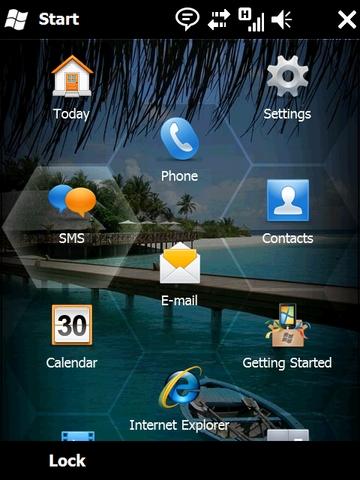
At MIX 09 in Las Vegas, Microsoft showed off its latest version of Windows Mobile 6.5, which has experienced a number of UI design tweaks.
The most noticeable change since the OS debuted last month is the elimination of the on-screen honeycomb on the home screen. While the layout remains essentially the same, the icons have grown in size, and the hex-grid pattern has been removed. Microsoft Product Manager Loke Uei Tan said that users who were testing the UI in real life found that it wasn't quite "finger friendly," so it has been tweaked with that in mind.

A new recession hallmark: the pay-as-you-go iPhone
Next week, AT&T is expected to begin selling Apple's iPhone in the US without the required two-year contract.
A company spokesman told the Associated Press that the devices will cost $599 and $699 for the 8 GB and 16 GB models respectively, which normally cost $199 and $299 with the two-year contract. These iPhones will reportedly not be unlocked, and will still require an AT&T iPhone account to operate.
Much ado about undo: A new Gmail feature literally lasts five seconds
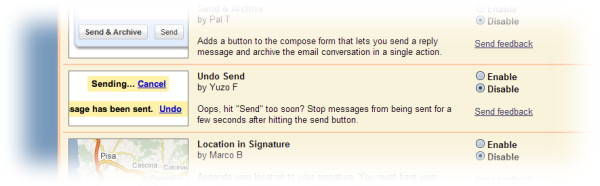
In perhaps another sterling demonstration of the effectiveness of Google's own product announcements by way of its blog posts, the world awakened this morning to an experimental capability in Google's Gmail that, if you think about it, you wonder why no one's thought about it before: An independent developer with the handle Yuzo F is distributing a Gmail add-on that gives users five seconds after clicking on the Send button to click on an Undo link that stops distribution from going forward.
"This feature can't pull back an e-mail that's already gone," writes Google UX designer Michael Leggett this morning, "it just holds your message for five seconds so you have a chance to hit the panic button. And don't worry -- if you close Gmail or your browser crashes in those few seconds, we'll still send your message."

Great minds think alike... on hacker exploits
Ah, the CanSecWest season -- spring is springing, Pwn20wn is smiting browsers, and the fearsome Invisible Things Lab team of Joanna Rutkowska and Rafal Wojtczuk have debuted another attack on SMM (system management mode) memory. Thing is, so has researcher Loic Duflot; in his case, right at the CanSecWest conference. The public disclosure was coordinated for Thursday, but the exploit itself was discovered independently by both teams.
Rutkowska's got the whole story on her site. Invisible Things and Duglot's team are all good eggs, so Intel was informed about the exploit well before CanSecWest attendees got the details. The exploit itself (PDF available here) allows for privilege escalation from Ring 0 to the SMM on various newer motherboards with Intel CPUs. "Informing Intel," by the way, turns out to be the weirdest part of the story -- turns out that not only has the company known about the SMRAM-related security gap since 2005, they've mentioned it in a patent application.