
Pioneer to exit plasma displays, lay off 10,000 workers
Hit by expectations of further financial losses, Pioneer Corp. has announced 10,000 job cuts, plant closings in the US and UK, and plans to leave the plasma display market.
With demand falling for both its plasma displays and car electronics equipment, the Japanese electronics maker now predicts that its net loss for the current fiscal year ending in March will total ¥130 billion ($1.4 billion), in comparison to a previous estimate of ¥78 billion.
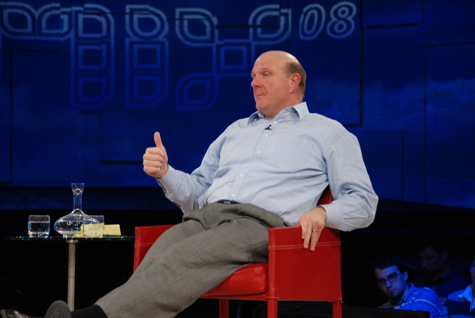
Ballmer writes Congress in support of stimulus package
The public printing of the latest version of H.R. 1, the American Recovery and Reinvestment Act of 2009 (commonly known as the "stimulus bill"), breaks down a $7 billion allotment for investment in the US' broadband infrastructure:
For an amount for `Broadband Technology Opportunities Program', $7,000,000,000, to remain available until September 30, 2010: Provided, That of the funds provided under this heading, $6,650,000,000 shall be expended pursuant to section 201 of this Act, of which: not less than $200,000,000 shall be available for competitive grants for expanding public computer center capacity, including at community colleges and public libraries; not less than $250,000,000 shall be available for competitive grants for innovative programs to encourage sustainable adoption of broadband service; and $10,000,000 shall be transferred to `Department of Commerce, Office of Inspector General' for the purposes of audits and oversight of funds provided under this heading and such funds shall remain available until expended.

Sirius XM is in play, at least in the press
In the absence of hard information on a big business topic, it isn't exactly true to say the press always resorts to speculation. In many cases, parties that are incidentallly related to the topic -- and who may wish to be not so incidental in the near future -- often plays into the press' need to have some substance with which to fuel the story, in exchange for a little spotlight.
In the case of Sirius XM Satellite Radio, nothing is being said officially by either the broadcaster or by the company said to be in talks with it to help it through a trio of huge, pending debt obligations, satellite TV provider (also Sling Media parent, and one-time parent of Dish Network) EchoStar. But just like during last year's Microsoft + Yahoo takeover bonanza (the result of which, you'll recall, was less than nothing), folks who want to be involved -- and who may have an interest in appearing to show up legendary Sirius XM CEO Mel Karmazin -- are making it least appear as though the radio company is in play.

Verizon ingeniously foils Alltel's 'My Circle' plan after all
Fans of the soon-to-be-defunct Alltel Wireless "geeks in shirts" advertising campaign will remember the debut of the 2006 "My Circle" calling plan, where subscribers could choose 10 friends or family members to include in their "calling circles." Folks who were a little older than the guys who appeared in the "Food Court" ad from that campaign -- which helped establish Alltel's entire marketing focus thereafter -- will recall that "calling circles" wasn't a phrase coined by Alltel.
It was MCI that established "calling circles" in 1991, in a breakthrough marketing campaign called "Friends & Family" that helped save the company during its landmark long distance battles against AT&T, and which established database marketing as a serious tool and even a competitive weapon.

Sega and its new trademarks: What's its game?
Sega Sammy is closing many of its remaining Japanese arcades, and Sega of America announced nearly 30 layoffs last month. So why would Sega Corporation be registering new arcade-hardware-related trademarks?
A report earlier this month in Siliconera noted that the company has trademarked two names, "Ringedge" and "Ringwide," along with a new circular logo featuring rings. The trademark application states that the new names will be used for arcade game boards, standalone video game machines, and/or arcade game machines with built-in screens.
RIM earnings prediction lower; time to talk apps?
RIM's Wednesday announcement to investors that it'll reach only the low end of its earning forecast may carry a clue to how the company plans to maneuver its way through the next few months of drama.
The company's fiscal quarter and year end on February 28, so the numbers executives are seeing are not entirely blue-sky figures. The quarter includes not just the December holidays but the first full quarter of results on sales of the Storm, the iPhone-competitive touchscreen phone offered so far only by Verizon Wireless. It was also the first full quarter for sales of the BlackBerry Bold -- carried in the US by AT&T -- and the Pearl Flip (RIM's first clamshell-style phone).

Shortcovers 'Kindle killer' e-reader under way for smartphones
While hardware makers have failed to produce an "iPhone killer," a major book seller is now readying a software application for iPhone, BlackBerry and other smartphones, that will be marketed as a "Kindle killer."
Although the Shortcovers application surely won't be the only e-reader out there for smartphones, its parent company, Indigo Books and Music, just so happens to be the biggest book retailer in Canada.
Amazon EC2 cloud to add IBM software images
IBM today announced its intention to enable customers of its Passport Advantage license program to deploy IBM and Tivoli applications using Amazon's EC2 cloud computing platform. But rather than develop those applications on its own, or create pre-packaged WebSphere applications in the cloud, it will immediately allow for developers to use Amazon Machine Images to build applications that may later be tested on a broader customer base, when Amazon releases IBM software on its cloud platform in the coming months.
The intention is to give developers access to Lotus Web Content Management, DB2, Informix Dynamic Server, and WebSphere Portal and sMash, as well as underlying SUSE Linux Enterprise software. Amazon already offers Windows Server 2003 images; this plan will make possible a competitive Linux-based offering that already has leading commercial middleware and database software ready to go.

While AMD banks on Abu Dhabi, Intel waves a $7 billion US flag
In what may very well be an intentional jab at its competitor's survival plan that relies on foreign investors, Intel yesterday began touting its own $7 billion investment plan as an indicator of its "faith in the US."
"When we face a crisis -- let's be honest -- our habit is to hunker down and hold fast to what we have and what we know: the jobs, the businesses, the institutions, and the ways of life we are familiar with and don't want to lose," stated Intel CEO Paul Otellini, in a speech to the Economic Club in Washington, DC yesterday. "It is a perfectly understandable reaction when uncertainty becomes a part of our lives. But I see this economic crisis differently. Our institutions and paradigms have become unfrozen by this economic crisis. We have a once in a lifetime opportunity to re-shape how things will look and behave as growth resumes.

Beloved toy takes on inexplicable electronic aspect
For every wonderful gadget that solves a problem you didn't even realize you had, the universe requires that there exist a gadget that solves a problem nobody has. Apparently TechnoSource is in charge of filling that role this week, and they're using a beloved old toy as their funnel.
The Rubik's Cube an absolutely iconic geek toy; if you remember the original and the craze it inspired, how much did you love watching people lying about their ability to solve a problem in 3D geometry? It also separated the world into theorists (those of us who solved the cube by twisting and turning) and the practical-minded (those of us who solved the cube by breaking it apart and reassembling it in the correct configuration) -- possibly in a way not entirely complimentary to the practical-minded. (Fine. The Gordian Knot told me to tell you to bug off.)

Southwest Airlines in-flight Wi-Fi test begins
Over one year ago, Southwest Airlines announced its intention of bringing in-flight wireless internet to its passengers.
Yesterday, Yahoo said the tests will take place on a single plane starting this month, with three more equipped by March, all running on the same Row 44 system they noted last year. What does Yahoo have to do with it, you ask?

Ed Colligan talks PalmOS, Pre, porcupines
The Palm Pre may not be in users' hands yet, but the demand for information doesn't seem to let up. Ever. At a Palm event today, CEO Ed Colligan threw the crowd a few bones... and threw the bones crowd some good news.
PreCentral's lively bloggers captured the excitement the blow-by-blow. There were a few confirmations of things we've already heard -- for instance, Palm apps will be available both through an official, curated store and via third-party developers. Colligan also elaborated on plans to bring the phone to other carriers and other countries (yes, all of the above are planned; the US could see the Pre available from other carriers in 2010).

Livenation and Ticketmaster antitrust investigation confirmed
No less than one day after announcing their merger, Live Nation and Ticketmaster have come under investigation by the Antitrust Division of the Department of Justice.
This morning, Justice Department spokesperson Gina Talamona told the Associated Press that the department will be thoroughly investigating the deal between the world's largest ticket seller and the world's largest concert promoter.The resulting entity from the merger would be even further-reaching than extant major record labels.

Netflix and Wal-Mart sued for 'injuring' consumers with DVD prices
Hot on the heels of similar lawsuits against Netflix and Wal-Mart in other states, a new court action in West Virginia charges that the two companies colluded over dinner to drive DVD prices "artificially higher."
A newly filed suit by a West Virginia law firm alleges that Netflix and Wal-Mart have broken antitrust laws and caused "damage" to past and current Netflix customers in the US by divvying up various segments of the online and retail DVD market between themselves.

Shorty Awards ceremony on tap for Twitter tonight
The Grammys, the Oscars... the Shorties? February is the month for awards shows, and this evening in New York the Twitter community will reward its own in 26 categories of excellent at the Shorty Awards, to be held in still-sort-of-hip Brooklyn.
The awards were voted on by the Twitter community, and even the finalists (the winners have already been announced) get recognition for garnering love in the months-long nomination process. As one might expect, winners attending the ceremony (whether in person or via video) will give a speech which may be no longer than 140 characters, in the Twitter fashion.