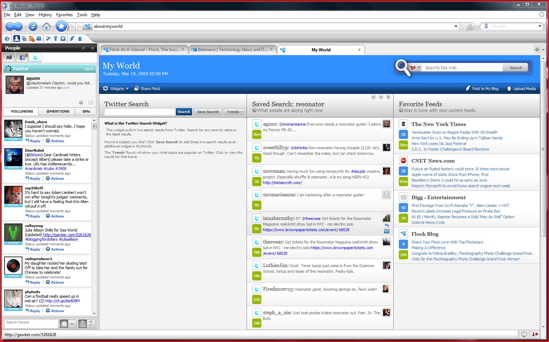
New iteration of Flock browser bolsters Twitter, multi-service support
Of all the specialized browsers out there, Flock is perhaps the one best suited to the social-networking scene, with support for a constellation of services such as Twitter, Facebook, MySpace, Flickr, and so on. To date it's been a nice way of keeping an eye on one's daily flood of information, but serious interaction required that you pop open a browser window. (Such a burden.)
You might find you never need to do so again with the 2.5 version, just released for Windows, Mac, and Linux. Those who closely follow streams from highly prolific twitterbugs may need to go to the main browser window from time to time, but for most purposes, the Twitter reader in Flock rises to the level of the very best standalone readers. (And their new non-Twitter toys aren't so shabby either.)

Napster: What you should know before plunking down five dollars
There's no doubt that five dollars a month for a music subscription is about as dirt cheap as you can get, so Napster is right on when it comes to attractive pricing. Five dollars for five DRM-free MP3s and unlimited streaming of Napster's catalog per month is a price seated squarely on the "why not?" point.
But this is the point where you have to be wary, because you could end up buying more of what you already have.

Imagine, a 'Firefox 4' without browser tabs
Insofar as Web applications have become a fact of many everyday users' lives and work, the Web browser has come to fulfill the role of a de facto operating system -- which is why browser performance is a more important topic now than ever before. Now, this most important class of application could be at a turning point in its evolution, a point where history appears to repeat itself once again.
During the era between Windows 2.0 and 3.1, a minimized window was an icon that resided in the area we now consider the "Desktop;" and even today, many Windows users' Desktops don't perform the same role as the Mac Desktop that catalyzed Windows' creation. Even Windows 7 has tweaked the concept of what a minimized window does and means; and in the Web browser context, a tab represents a similar type of functionality, giving users access to pages that aren't currently displayed.

The technologists' (read: 'geeks') guide to the weekend
There are many bold and beautiful aspects to geekdom, but weekends aren't one of them. Many of us -- most of us -- lay aside our workplace tech tasks and go home to our friends and families and their computer travails. Or we head for movies that send us into paroxysms of fact-checking angst ("As if they'd have given the explosive charges to only Olson and not Kirk or Sulu as well -- worst logistics ever!"). Or we dig into an open-source project or a volunteer effort that looks just like our work taskload. Or we don't take the weekend at all.
And geeks, that's okay. Know who you are and what makes you happy. The secret to geek happiness isn't getting away from it all; it's being able to survey it all from your chosen perch. Which happens to be made of ones and zeros and silicon and DIY and logic and fierce intelligence.

April showers bring May comScore numbers
Here's food for thought: Twitter isn't just more popular than professional wrestling, though that's something of a shock. It's more popular than baseball. Seems un-American, doesn't it.
It's more popular than MLB.com, anyway; the April comScore numbers are out, and the microblogging service is the 56th most popular site around (as far as unique visitors go), compared to MLB.com's 87th-place ranking. But all three sites are, along with the 236th-ranked stompin' matches World Wrestling Entertainment site, among the top-gaining properties as measured by the Reston, Va.-based ratings service.

Nokia's file sharing site gets de-prioritized
Nokia's Ovi Share has been put into stasis. Ovi Share was built from Redmond startup Twango which Nokia purchased in 2007. As a part of its online services restructuring that the company announced in late April, Ovi Share will continue to exist, but with a considerably dimmer future.
A Nokia representative was quoted by Reuters today as saying the service is just "planned to be maintained in its current state," with no further investments being put toward development as the company restructures its services department.
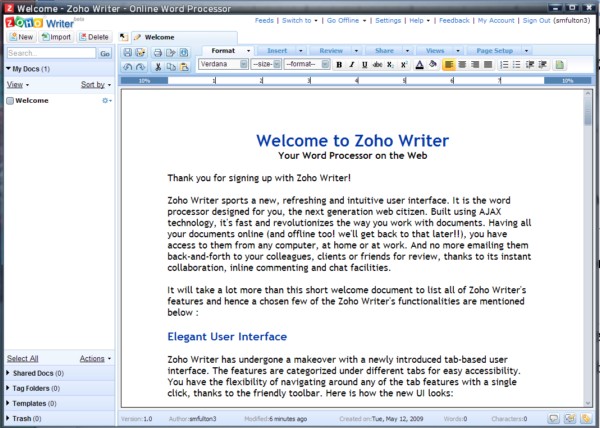
The Web without the browser: Mozilla's Prism enables true Web apps
Download Mozilla Prism for Windows 1.0 Beta 1 from Fileforum now.
Mozilla Labs has been devoted to building ideas into viable code that may or may not become products someday. For a year and a half, one of its tasks has been to build a framework for deploying Web-based applications straight to the desktop, while introducing though not necessarily mandating a new methodology or set of practices for sites to follow. In other words, if an application is already live in a browser like Firefox, let's take it out of the browser motif and move it to the desktop.

Lenovo abruptly drops ThinkVantage 'big blue button' support
It was announced in late March, but only as Lenovo owners get around to updating their systems are they becoming aware that ThinkVantage System Update (TVSU), the power behind the "big blue button," has been discontinued, eliminating the line's beloved automatic-update capability.
One-click driver update capability has been a longtime feature of the ThinkPad line, which include a large programmable button (labeled "Access IBM" on IBM-era machines and "ThinkVantage" on the later Lenovo models) set up for that purpose. Clicking the button after boot-up fired up the TVSU process, which downloaded many if not all of the driver updates required for that particular machine.

Wakoopa survey reveals the software geeks use most
Ever wondered who the heck uses AOL's proprietary software in 2009, or if anyone's seriously still on Yahoo? A first-ever survey from Wakoopa holds the intriguing promise of looking primarily at the computer habits of People Like Us. For now, anyway.
Wakoopa, which provides a social-networking and application-search space for software users, garners its data through a (voluntary) desktop tracking program that clocks which apps users use and for how long, along with apps users recommend and share with each other. So far, over 75,000 users have installed the tracker.
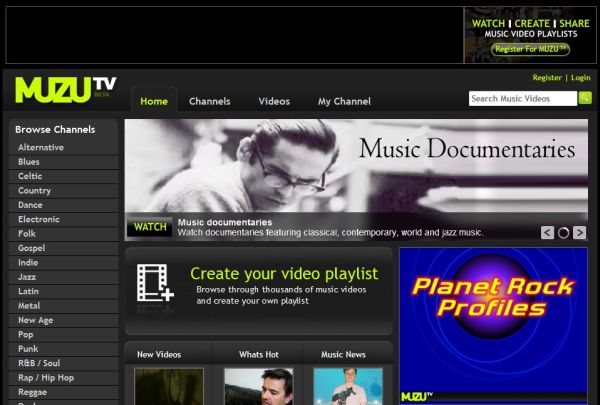
Muzu strives for fair music video compensation
Since launching in beta last July, Ireland-based music video site Muzu.tv has secured a decent amount of recognition for its monetization priorities. The site gives 50% of the net ad revenue generated by an artist's content back to the artist (or label) without any exclusivity contracts.
Banner ads and in-video advertisements are embedded in an artist's content in the Muzu player, which is itself embeddable in sites like MySpace, Facebook, and Twitter. Anybody or any band can create a channel on Muzu dedicated to their personal music, and monetize their video content. While monetization has been somewhat problematic on YouTube, the option to make money there does exist.

EA does Apple folk a Sim-ple kindness
Electronic Arts reported the results of its recently concluded fourth quarter on Tuesday as rumors fluttered concerning a possible buyout by Apple. EA also discussed the progress of its digital-delivery efforts, which company executives say are entering a new phase.
The Apple-buy rumor was going around this morning about Twitter as well, and didn't merit discussion on the hour-long earnings call. But there is good news for Mac and iPhone users, who for the first time will have versions of the newest edition of The Sims available to them on the first day of sale for the hotly anticipated title: The Sims 3 will launch on June 3, and the "Let There Be Sims" ad campaign should start flooding your consciousness in the next few days.

CBS focuses its online radio properties
It's like the golden age of radio for the Internet generation. The same company that in 1927 formed a nationwide network from 16 affiliate radio stations announced it has spun off the single largest online radio service to date. CBS has formed a new business unit called the CBS Interactive Music Group, which rounds up more than 100 sites and 400 stations and combines them with AOL Radio, Yahoo LaunchCast, and Last.fm under a single governing body.
CBS says that in March, CBS Radio had over 6.5 million listeners who streamed a combined 83 million hours worth of audio. Taken alone, it sounds like a massive number, but when compared to the consumption of audio through sites such as Pandora and Jango, the grandiosity promptly dissolves. According to siteanalytics.compete.com, cbsradio.com enjoyed only 97,150 unique visitors in March while radio.aol.com only had 41,108.

Adopt a line of code: The makers of Miro have a unique funding model
The multiplatform video downloader-and-viewer combo formerly known as Democracy Player is taking a cue from Sally Struthers and offering you, the Windows or Mac or Linux viewer at home, the opportunity to adopt a line of code in their software. "If enough of our users adopt lines of Miro code," says co-founder Nicholas Reville, "we can create an organization that is funded from the bottom-up and not dependent on the top-down."
Miro's parent organization, the Participatory Culture Foundation, has received grants for its work over the years from the Mozilla Foundation, the Open Source Application Foundation (Mitch Kapor's project), the Knight foundation, and similar celebrants of open source and open democracy. Times being what they are, the funding's not what it once was, and so in the wake of its recent Miro 2.0 release (which, according to Reville, tripled the product's user base) the PCF is thinking creatively about funding its creativity.

Copyright Office holds hearings on proposed DMCA exemptions
Every three years, copyright activists see a glimmer of light in the dark tunnel of the Digital Millennium Copyright Act. That's when US Copyright Office throws open its exemption process, in the ongoing effort to make the 1990s-era rules fairer and better adapted to modern usage. Whether that's a successful effort or simply another leap in front of a train... well, what would a bunch of activists be if they didn't even try?
To that end, the Copyright Office heads to Stanford on Friday for public hearings on the formal comments received by that office, and will continue the Rule Making process -- the fourth since the DMCA was approved -- in Washington DC next week. The nineteen comments received have been grouped into eleven documents.

Microsoft's deep-rooted Vine isn't just another social network
Let's get something clear up front: Whatever you've heard elsewhere, Microsoft doesn't intend for their Vine service to take over your Twitter or your Facebook or your texting or any of your other social networking tools. They've got bigger fish to fry.
Back in 2005, as we watched Hurricane Katrina upend our faith in America's emergency response system, some Microsoft folk started asking what software development might bring to the table in future crises. Tammy Savage, general manager for Microsoft's public safety initiatives, says that the original Vine team spent a lot of time thinking about "all aspects of crisis, from preparation to recovery -- all kinds of organizations, asking what Microsoft might uniquely be able to provide."