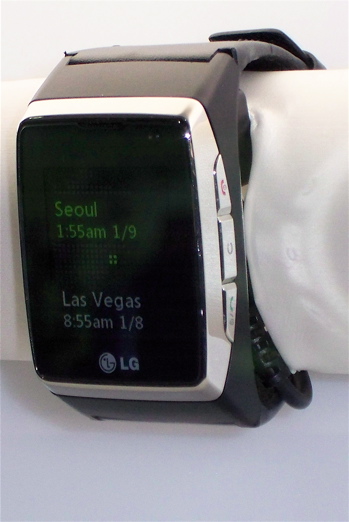
LG feeds wrist watch talk wish
Is it that at any other CES, we'd all be chirping about the advent of a working, non-hideous wrist phone? Or are we all just too jaded to believe? Either way, LG may have lost a perfectly reasonable wrist-mounted mobile phone in the stampede.
LG is a mighty big company, in the vicinity of which we are told Life's Good. What that means, practically speaking at a madhouse such as CES, is that there among the washers and dryers and huge flat-panel screens and touchscreen handsets and consumer diversions of every kind in their suburban-home-sized "booth," LG is apt to tuck in a few little flights of whimsy. A weary reporter appreciates the change of pace, LG appreciates the attention, and so it's all, as half the name suggests, Good.

More PCs in 2009 to sport Switchable Graphics, says Intel exec
In 2009, a lot more notebook PCs from Lenovo and other big manufacturers will implement Intel's game- and video-friendly Switchable Graphics, predicted Michael Trainor, chief technology evangelist at Intel.
In a demo, the technology evangelist showed how the Centrino 2-based technology lets users switch between Intel's own built-in graphics and a graphics card from ATI, a division of Intel competitor AMD.

HD in the long term: Sony's view on video creation
At the Studio Visionaries panel at CES on Friday, a cast of entertainment industry experts gathered to chat about the challenges that the high-definition era brings to the art of video and movie production, as well as re-production.
"A lot of the displays they're showing at CES this year, OLEDs and others, are in the 1,000,000:1 and some manufacturers are even advertising the 10,000,000:1 contrast ratios. The color reproduction on these screens is higher than anything we've seen in the past," said Chris Cookson, the President of Sony Pictures Technologies and former CTO of Warner Brothers.

Nikkei: Toshiba next in line as suitor for Fujitsu HDDs
The Nikkei business news service in Japan is reporting this afternoon that Toshiba is wrapping up talks to acquire the hard drive manufacturing division of Fujitsu, for what so far is an undisclosed sum.
It's no secret to anyone that Fujitsu wants to sell its hard drive operations; it made that much clear last October in its overtures to Western Digital, also carried out with the aid of Nikkei as its bullhorn. The crown jewel of Fujitsu's business there could be its 2.5-inch form factors for media players and small devices like netbooks. But a year ago, Fujitsu decided not to go forward with plans to manufacture even smaller form factors, which would help it break through to the MP3 player market.
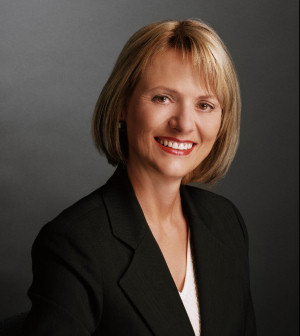
Upper-case and straight lace: What Carol Bartz might bring to Yahoo
There is nothing the least bit low-key about Carol Bartz, the longtime Autodesk executive and former Sun Microsystems key executive who is widely considered to replace Yahoo co-founder Jerry Yang as CEO.
Carol Bartz presided over Autodesk as its president/CEO/chairwoman for 14 years since 1994, before stepping down in 2006. Prior to that time, Bartz served in the executive ranks of Sun Microsystems, DEC, and 3M. Not only might she be a dramatic change from the character of the laid back, often timid Yang, Bartz could be the polar opposite of Yang's predecessor, former Warner Bros. executive Terry Semel.
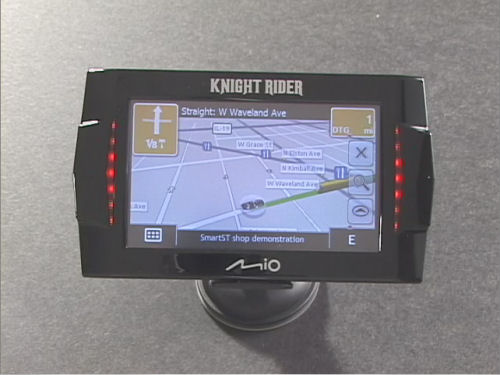
Experts: GPS alone just won't cut it for location-based cell phone services
Location-based services (LBS) -- delivered to people on cell phones depending on where they're situated at the moment -- are now on the way to becoming more commonplace.
Yet GPS -- a technology sometimes viewed as just about synonymous with LBS -- just won't be enough, by itself, to make LBS work, according to some of the movers and shakers in the nascent industry.

Intel's convertible Classmate is only the second in a netbook PC series
Intel's second Classmate netbook for kids, introduced at CES, will be followed by more Classmate PCs, not necessarily devised in a "lunchbox" style, said Mark Parker, global launch manager for Intel's Classmates.
In an interview with Betanews, Parker noted that Intel produces the reference design for the Classmate netbooks, which can then be implemented by OEM partners in a variety of ways for use among students in developing nations.

Google Quick Search gets dev release, may replace Quicksilver
In Google's Mac blog last night, the team announced the developer preview of Google Quick Search for Mac (OS X 10.5+), what they call a much more experimental version of the app for iPhone.
The application acts as a quick launcher, a browser location bar, and a search field which allows the user to search for files or text on his own computer or on the Web. It even has one boxes for word definitions, mathematical equations, and weather conditions.
Early reaction to Genachowski for FCC Chairman
The man who was hired to help President-Elect Obama choose the next chairman of the Federal Communications Commission apparently saw this as an introspective affair. The former counsel to FCC Chairman Reed Hundt, former right-hand man to IAC chief Barry Diller, and present managing director of venture capital firm Rock Creek Ventures, will evidently be the new FCC chairman, pending his appointment by the new President.
The early reaction from both the cable and broadcasting lobbies is quite positive. American Cable Association chief Matthew Polka released this statement this morning: "The role of the FCC has never been more significant to more Americans, and we wish Mr. Genachowski well in taking on today's historic challenges. The next several years will present opportunities and obstacles in the technology and communications industries, including the coming DTV transition and the Government's effort to deploy broadband in underserved areas. ACA and its members are eager to work with the new Chairman and all the Commissioners of the FCC to ensure the unique challenges of smaller cable operators and their subscribers are understood and accounted for. Mr. Genachowski's record of accomplishments and reputation within the industry make him a good choice as Chairman, and we congratulate him."
Requiem for an 'N'
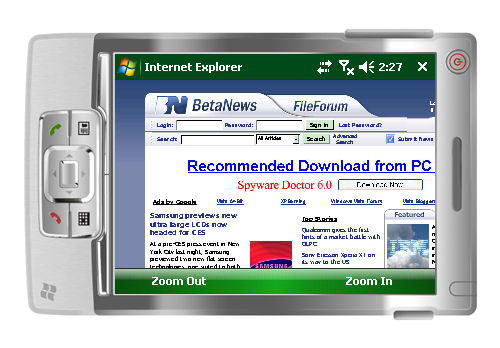
Many of you longtime BetaNews...oops...Betanews readers will have noticed starting last week with our CES 2009 coverage that we not only got fatter over the new year (contrary to everyone else with designs on losing weight) but we got a trim up top. Yes, just like myself, there's a little less bushiness on our head this year, and we went lower-case with the "n" in our name.
Now, does this mean anything? In this era of great and stirring symbolism, is there some dramatic statement that goes with the lowering of our "n?"

Behavioral trackers join in promising to behave themselves
We received word this morning of the formation of a coalition of associations, if you will, whose joint purpose will be the establishment of a set of principles for companies in the online advertising business. The promise of this new group of groups, as yet unnamed, will be to develop a set of guidelines for the use of behavioral monitoring tools.
And it's obvious from the get-go that a message is being set to the incoming administration, which could only possibly be more pro-active about consumer protection policies than the current one. It's a very polite message, but what it boils down to is, please, incoming FTC chairperson, leave us alone and let us take care of our own affairs.
Hawaii throws the DTV switch on Thursday
While the incoming Obama administration is considering suspending the countdown for the nationwide switch to digital television, the 50th State is preparing to actually throw the switch on Thursday.
Hawaii's standard-strength broadcasters will power down their analog signals on January 15, in the first statewide test of the DTV transition. However, recently fine-tuned regulations stipulate that low-power (LP) analog broadcasters do not have to power down even after the nationwide February 17 deadline. That affects Hawaii more than most states, since several of the smaller islands are served by LP stations. One such station on Kau'ai, KESU Channel 6, is actually a radio station since the audio portion of Channel 6 has always been available on 87.7 MHz (that's true everywhere in the country). But KESU sometimes supplements its audio signal with a picture, making it one of the nation's only "semi-TV" stations, and it'll be allowed to keep its unusual format.
Violent video game labeling bill enters Congress
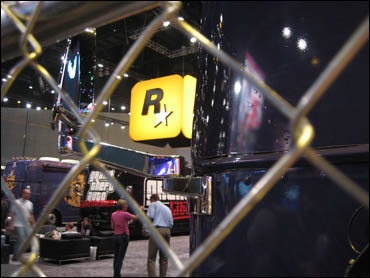
Last Wednesday, legislation was introduced in the House that would make the Electronic Software Ratings Board (ESRB) affix a health warning label on T-rated games that links their violent content to real-life aggression.
Called The Video Game Health Labeling Act of 2009 (H.R. 231), and sponsored by Congressmen Joe Baca (D - Calif.) and Frank R. Wolf (R - Va.), the legislation calls for violent video games to be labeled with a sticker that says "WARNING: Excessive exposure to violent video games and other violent media has been linked to aggressive behavior."

Was Genachowski FCC nod a done deal pre-CES?
The Washington Post and other mainstream pubs reported yesterday that Obama transition team member Julius Genachowski is on tap for the new head of the FCC, but canny observers spotted an open bag and a leaping cat last Saturday at CES when CEA head Gary Shapiro cracked wise to ongoing chair Kevin Martin about giving Obama's old Harvard Law Review colleague "some advice."
Martin said that he'd tell Genachowski that "If you try to go back to some of the rules that were in place in, oh, 2001, you will depress the telecommunications industry. And you have to be prepared to make hard decisions." Observers of the civil liberties scene wonder if the "rules that were in place" include the restrictions against unauthorized wiretapping, but one supposes that the first crisis he's got on his hands would be the DTV switchover -- whether or not it happens as scheduled on February 17. (Martin stated at CES that he opposes any delay in the switch.)

From the ME: Betanews releases Alpha
"This is an old team," began Edward R. Murrow in his very first See It Now broadcast for CBS Television, "trying to learn a new trade."
Now, over the past few years, I've been guilty of telling folks that Betanews is not a blog, in the same spirit as telling your neighbor trying to borrow your sports car to haul furniture that it's not a truck. A few reasons for that: I don't want Betanews to become one of these peanut-galleries for the practice of would-be journalism -- of essentially replicating stories seen or printed elsewhere and calling it "coverage." We won't be doing that here, and thus ends my list of the things that Betanews Alpha is not.