
Cloudy forecast? Gmail outage shouldn't cast such a chill over Web apps
Will this week's Google Mail outage frighten you out of shifting more of your computing solutions into the cloud?
On balance, it shouldn't, as no technology is perfect and failure is part of the landscape whether we keep our stuff in a data center, in a box under our desk, or on some unseen Web server on the other side of the country. But any failure of this magnitude offers up a prime opportunity to discuss -- and hopefully improve -- the weaknesses that can still bite us.

YouTube may start renting movies, and the MPAA may finally approve
The Wall Street Journal is reporting this evening the internet's most popular video streaming destination YouTube is now in talks with movie studios to offer rental streams of new release movies which could potentially be released day and date with their DVD and Blu-ray counterparts.
The site already works with a number of content owners to host ad-sponsored streams of classic television shows and films, but the site has not yet attempted the rental model with these studios. Details are scant at this point, at the WSJ only cites information provided by unnamed sources "familiar with [YouTube's] plans." A $3.99 rental price is reportedly being discussed because that is the cost of a Standard Definition new release movie rental on Apple's iTunes and Amazon Video on Demand.

Google calls Gmail outage 'minor issue', but thousands beg to differ
Has Google issued an apology about today's Gmail outage, or is the company trying to downplay the issue?
We're not really sure.
Gmail is back up after two-hour outage
After refusing connections all morning, Gmail officially went down for the count this afternoon. For more than an hour the service was completely gone, but Google has returned Gmail's status to a "Service Disruption."
This morning, a notice from Google was sent out to users which said, "Google Mail service has already been restored for some users, and we expect a resolution for all users in the near future. Please note this time frame is an estimate and may change."

A reluctance to Bing: UK Yahoo portal partner makes first switch to Google
When Microsoft made its deal last month with Yahoo to provide the search infrastructure for its home page, using technology from Bing, it left open and non-exclusive the fate of several deals the one-time #2 search provider had already made, especially with carriers. Specifically, does Bing become the default search provider for services that had previously made a deal with Yahoo? The answer appeared to be no.
Today, that suspicion was roundly confirmed, as one of the world's largest cooperative portals with Yahoo -- one which still bears the Yahoo brand -- quietly but obviously switched its search box to one that was "powered by Google." In a move first discovered by the UK-based blog Connected Internet, BT's Web portal BT Yahoo became a carrier of Google search rather than Bing.

Verizon calls Comcast's bet with Web-based FiOS TV beta
Two months ago, Comcast announced a limited beta trial of an online TV service involving networks of Time Warner's Turner Broadcasting division, where Comcast subscribers may be treated to earliest availability of post-airdate programming from networks including TBS and TNT. This morning, Verizon announced the launch of an almost identical trial, involving exactly the same networks, in a deal that makes one wonder whether it's Turner that's in the driver's seat here.
As part of Turner's "TV Everywhere" initiative, select FiOS fiberoptic service subscribers will be offered first crack (perhaps at the same time as Comcast customers) at online availability of shows like Raising the Bar, Saving Grace, and The Closer. Rather than seeing those shows first through online portals such as TNT.tv, logged on users to Verizon Online will receive invitations to join the carrier's limited trial.

Skype doubles connection fees for many international calls
Skype's connection fee for placing calls to landline and mobile phones in certain countries will increase 100% on September 6th, the company's site now says.
For Skype users who are not on an unlimited calling plan, calls that connect to landline or cellular numbers incur a one-time connection fee and a per-minute charge.
Yahoo promises it will still innovate search
In a conference call yesterday live-blogged by Search Engine Land, representatives from Yahoo gave a live demonstration to reporters and analysts of new features of their principal Web applications that they believe will attract new users. Included on their list were ways that Yahoo plans to improve search.
This after Yahoo signed away its search infrastructure to Microsoft in an historic deal late last month, which many perceive as Yahoo opening its floodgates to Bing. In an effort to minimize the appearance of the deal having any impact on Yahoo's search strategy, the company's senior vice president for search, Prabhakar Raghaven, told reporters Yahoo can still innovate with regard to the experience users receive from search. Maintaining the search engine itself, however, was a battle Yahoo could no longer afford to fight.

Yahoo, Microsoft team with rival trustbuster against Google Books settlement
An attorney who was at the heart of the US Dept. of Justice's original 1994 antitrust case against Microsoft, arising from its proposed takeover of Quicken manufacturer Intuit, will find himself spearheading a coalition against Google's book scanning policies that includes both Microsoft and Yahoo, spokespersons from both companies confirmed to Betanews this morning.
It was attorney Gary Reback who first called Microsoft to task for using its "embrace and extend" policy in an abusive fashion against competitors, often representing those competitors in legal action, as was the case with Borland International and Sybase in the mid '90s. Currently, he is the author of a book called Free the Market! Why Only Government Can Keep the Marketplace Competitive. His latest confrontation is against Google, whose proposed settlement with book authors and publishers would give Google "non-exclusive" rights to scan their books contents and reproduce them online in the Google Books service. Already, Google has been scanning books that are available in public libraries, and making excerpts of those books available to users -- excerpts, as opposed to the books in their entirety.
New Windows Live Movie Maker debuts, says good-bye to XP for good
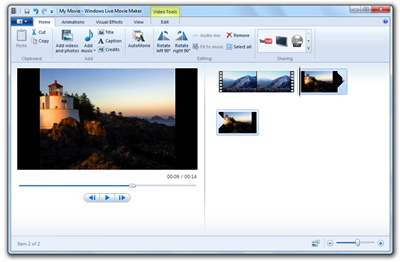
The Windows Live team announced this afternoon that Windows Live Movie Maker, the free video editing software component of Windows Live Essentials has come out of beta and is available for download.
Windows Live Movie Maker opened in beta last year, and has been designed to provide a quick and easy method of cutting video clips rather than a full editing suite.

ComScore: Bing the only search to gain US share in July
Usually when a new online product unveils an upgrade, its audience numbers see a bump for the first month, before subsiding and evening out. Last month, Bing's first usage share numbers from analysis firm comScore showed a little bump, but not much of one -- yet Microsoft made as much out of it as it could.
The news this month -- the first to show month-by-month progress since the changeover from Windows Live -- may actually be more encouraging for Microsoft: It gained half a point of usage share among US users for the month of July over June, at the same time when Google and Yahoo combined lost about as much.

Moonlight 2.0 beta tries to show off Silverlight 2.0 compatibility
Though it's been in private testing for some time, the Silverlight 2.0 work-alike system for Linux built by the open source Mono Project is now ready to present itself to the general public. This afternoon (after a few fits and starts), Moonlight 2.0 Beta 1 was released for general testing, with one of the runtime module's ambitious new features being the enablement of different media codecs, including Mono's own rendition of open-source Ogg Vorbis, Ogg Theora, and BBC Dirac.
Although multiple video codec support is slated for inclusion by Microsoft in Silverlight 3, Mono team lead developer Miguel de Icaza said today that he decided to implement the media pipeline feature from Silverlight 3 into the 2.0 specifically "to play back media files that use the open codecs or to plug your own media codecs." De Icaza only expressed his interest in tackling this bit of functionality just last March.

A browser war veteran turns wannabe
Marc Andreessen is a brilliant guy. His Mosaic browser, which eventually morphed into Netscape, introduced us all to the concept of surfing and ushered in the Internet as we know it. His new way of looking at online services -- which seems ho-hum today but was radically transformational 15 years ago -- freed us forever from the tyranny of arcane, unfortunately named services like Archie, Veronica, Jughead, and Gopher. In taking Netscape public, he set the stage for dot.com-era IPOs that created countless tech billionaires-as-rock-stars and defined an era when technology's potential was seemingly limitless. Let's call him brilliant and visionary, then.
However, even geniuses have their bad days...sometimes, they have many. Netscape was eventually wiped off the relevance map when Microsoft finally woke up to the Internet reality and paved over the landscape with Internet Explorer. The Internet bubble burst as the perverse logic that drove much of it -- eyeballs, "stickiness," and the ridiculous notion that bricks-and-mortar were headed for permanent and complete obsolescence -- was finally and thankfully replaced by the old rules of business that dictated you needed to generate revenue, and that revenue needed to exceed your costs.

Bing vs. Google rematch: Who's getting better, quicker?
Two months ago, Microsoft unveiled its revamped Bing search service, touting it as a "decision engine." There were some genuine new advantages which we did discover, but not everything appeared ready for Bing's first outing, and we were told to expect improvements to some features "in the coming weeks." Not months, weeks.
So this is August, and (do forgive me) what hath Bing brung? In our June series of Face-offs, the final score was Google (4), Bing (3) -- not necessarily a runaway, but good enough for the champion to not feel immediately threatened. With Google testing improvements to its search engine, we wondered if we'd find any evidence of tweaking on Bing's side as well. We've decided to put both services through the same paces a second time to see which service is the one that's really gunning for a rematch.

Office vs. Web apps: Breaking the 0-0 tie
The story so far: We're in the initial phase of the Microsoft Office 2010 Technical Preview, a period of private and public testing that could last for the better part of a year. So far, the biggest complaint we're seeing emerge is that so little is changing, that it's becoming more difficult for Microsoft to make the value proposition for why businesses and individuals should upgrade from Office 2007 or even 2003. In the absence of viable, existing reasons why the new Office will be better than the old one, a couple of Microsoft employees launched a Web site this week, asking people to come up with their own reasons and vote up each other's best responses.
Right now, the number one suggestion users have for "making Office better" is the restoration of an old feature that existed in Office XP. The #3 suggestion for Word: Give users the option to bring back the Office 2003 menu bar. (You can just hear Carmi Levy cheering that suggestion.) So to recap, from both Microsoft and its users, nothing new yet, but plenty of pleas to bring back old stuff that was just fine.