
David Cameron's Facebook page reported for posing a 'credible threat of violence' over ISIS
The UK's decision to start a military campaign in Syria to fight ISIS has dramatically divided opinion. Support and opposition is not split neatly down party lines, but a vote this week led to almost immediate airstrikes being carried out.
Taking to social media, Prime Minister David Cameron -- or his representatives -- used his official Facebook page to crow about the fact that vote went the way he wanted it to. This has had something of an interesting side effect. Facebook users are reporting the page for threatening violence.

A third of businesses use mobile banking to make payments
Not only does every other top manager make payments from corporate accounts via mobile banking, but it was also discovered that over 30 percent of companies use mobile devices to access corporate bank accounts and to make financial transactions.
Those are the result of a recent joint survey conducted by Kaspersky Lab and B2B International.
Hackers hide malware inside Dropbox accounts to target media organizations
A new form of malware that targets mass media agencies has been discovered by researchers at the US-based security firm FireEye. The malware was detected in Hong Kong where it was being used to target a small number of media agencies with the initial targets of the attack being newspapers, radio stations and television studios.
The malware leaves a user vulnerable by offering a backdoor to their system. The way in which this is achieved is unique because its command and control or C&C server is hidden inside Dropbox accounts. FireEye was able to trace the malware back to a group of hackers by the name admin@338, who is believed to have ties with the Chinese government.

My fridge is listening to me
It seems oddly fitting that this week -- a week scarred by the bizarre and violent mass murder in San Bernardino -- that I received a LinkedIn invitation to connect with someone who listed this as their job description:
Install, maintain, and repair GPS, Wi-Fi, and security camera systems on tour buses. In 2010, working with grant money from Homeland Security, I installed security systems on a fleet of tour buses and I have been maintaining those systems since then. In 2011, I helped install multi-language listening systems on tour buses and have been the lead maintenance technician. Currently, I am project manager for upgrading a fleet of 50 tour buses with new GPS systems using Homeland Security grant monies. This requires coordinating with engineers of service providers to solve unusual, complex problems.

JD Wetherspoon's customer details leaked after cyber attack
Personal details of hundreds of thousands of JD Wetherspoon customers have been accessed and leaked following a hack of its database. The cyber attack affects more than 650,000 customers, the UK pub chain has announced.
The leaked data includes names, birth dates and email addresses, as well as the partial credit and debit card details of some customers who bought gift vouchers. Although the attack occurred back in June, JD Wetherspoon has only just gone public about it.

Barbie says hello to more security flaws
Hot on the heels of last Friday's news of the potential of the Wi-Fi enabled Hello Barbie doll to be hacked, new research has uncovered security issues with the mobile app associated with the doll and with its connections to cloud servers.
Application security specialist Bluebox working with independent researcher Andrew Hay has revealed that the app can be modified to reveal confidential information including passwords.

New privacy platform protects enterprise communication
Enterprise customers are increasingly concerned about the security of their mobile communications, as well as the ability to deliver auditing and compliance information.
Silent Circle, the Swiss company behind the privacy focused Blackphone, is launching its Enterprise Privacy Platform a set of secure software, services and devices designed to deliver privacy to business and government organizations of all sizes.
Instart Logic and Verisign team up to fight DDoS attacks
DDoS activity is at its highest for two years according to Verisign's Q3 2015 DDoS Trends Report, and as the number and sophistication of attacks increases, companies are recognizing the need for better security.
Application delivery specialist Instart Logic has announced a partnership with Verisign to offer customers an advanced DDoS scrubbing capability.
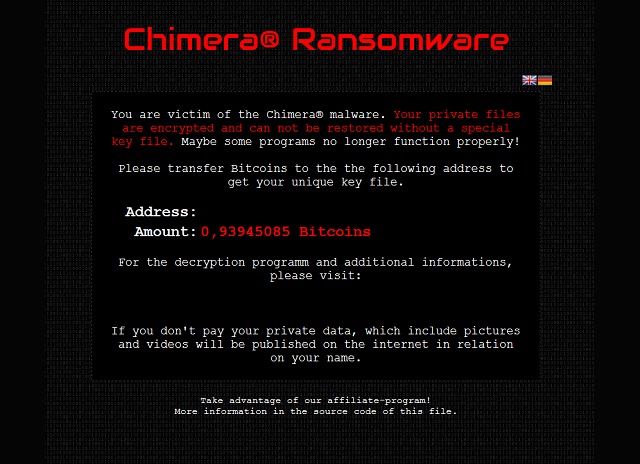
Chimera crypto-ransomware threatens to share your private files online
Crypto-ransomware is one of the latest trends in the world of malware. Encrypting and holding files to ransom provides a way to extort money from victims, but a new example takes things one step further.
Chimera not only locks users out of their files until a ransom is paid, but also threatens to release unencrypted copies of the files online if payment is not made. Security company Trend Micro says this is the first instance of this type of threat. Interestingly, Chimera also seems to be part of an affiliate program.
Facebook will stop tracking Belgian web users who shun the social network
Privacy issues in relation to Facebook make frequent appearances, but they tend to focus on instances of the social network using the browsing and account data of logged in users. However, a recent court case in Belgium highlighted the fact that the site was tracking people who accessed public Facebook pages either without a Facebook account, or without logging into one.
This change has a couple of implications for people. Firstly, it means that people who are trying to stay off Facebook's radar will be better able to do so, but it also means that previously accessible content will only be available to those willing to log into their account. Facebook is complying with the Belgian court order that was handed down last month, but the company is not happy about it and intends to fight back.

Hackers make DDoS threats to extort Greek banks
A group of hackers is trying to extort money from three Greek banks and is threatening the financial institutions with DDoS attacks unless they comply.
The group, which goes by the name Armada Collective, has asked the three banks which weren’t named, to pay a ransom in Bitcoin or face a distributed denial of service attack.
Accidental DDoS takes down Google's European cloud
Google got accidentally DDoSed by an unnamed European network carrier, sending its cloud service offline on the old continent for about an hour.
The incident occurred last Monday, but it is only now that Google has decided to explain exactly what happened.

Security is a major concern for cloud migrations
When it comes to migrating to the cloud, 65 percent of companies are concerned with security, a new survey by Netwrix has unveiled.
Moreover, 40 percent worry about the loss of physical control over data in the cloud. In particular, 69 percent of companies fear migration will increase the risk of unauthorized access, while 43 percent worry about account hijacking.

Popular free mail services still use vulnerable versions of SSL
New research from information security company High-Tech Bridge reveals that the security of some of the most popular mail services, including Gmail, Outlook and Yahoo is lacking.
The company used its SSL checker service to test the popular email services for 31 different criteria, including the most recent SSL/TLS vulnerabilities and weaknesses, compliance with PCI DSS requirements, and compliance with NIST guidelines.

Two-thirds of companies don't regularly test their disaster recovery plans
More than 60 percent of companies in the UK and Germany say that they either test their disaster recovery plan either less than once a year, or don't test it at all.
This is among the findings of research conducted by data recovery specialist Kroll Ontrack which finds that a mere nine percent of companies test their plan every one to five months and another 29 percent every six months to a year.