
2001: An Apple Odyssey
It's not uncommon for bloggers and journalists to get hung up on the present. For Apple, there's big noise about soaring stock price, even considering economic recession, and increasing demand for iPhone. But the past defines the present. For Apple, products or services launched in a single calendar year -- and the consistent execution that followed -- define current successes, including iPhone.
I contend that next to 1984, when Apple launched Macintosh, 2001 was the most important year in the company's history.
Five reasons why Google's Jaiku is more boring than Twitter
The Helsinki Institute for Information Technology (HIIT) today announced the impending publication of the results of its microblogging study. In a peek forward, the Institute revealed that most respondents using Google-owned "lifecasting" service Jaiku are either very bland, or are not using the service properly.
According to the Institute, the five most common status updates on the service are:
For AMD, keeping it too simple may be too stupid
The "Keep It Simple, Stupid" rule works in business as well as in everyday life, primarily because it forces us to focus on the one or two basic issues we need to make the right decision. My kindergarten teacher shortened it to "KISS," perhaps in the interest of simplicity. When you're driving a car: Know where you are, know where you're going. Leader of the free world: Keep your hands clean, know what you're aiming at. Reprogramming your iPod/in-vehicle audio system interface: Pull over, let the semi pass you.
More data, please

The EC's charges: Did Intel really threaten Dell if it shifted toward AMD?
If the European Commission's antitrust case against Intel seemed completely clear and convincing up to now, this morning's publication of its formal provisional explanation of its charges (PDF available here) -- actually delivered last May 13 but only made public today -- muddies the waters somewhat. For while there is indeed some smoke, and certain excerpts would imply the existence of a gun from which the smoke emanated, the presence of far more smoke from various other sources not only un-resolves some questions, but adds some new ones to the mix.
Most surprising of all is the EC's explanation of rebates Intel allegedly provided to Dell Computer in exchange for limited exclusivity, the existence of which has actually not been denied. A thorough read of the evidence explained by the Commission reveals that the rebate program was apparently conceived by Dell, not Intel. And although e-mails between redacted Dell executives did warn of possible retributions by Intel had their deal not been kept as promised, those same e-mails indicate Dell had other reasons of their own to pursue exclusivity.

Like HP, Dell also acquires a Perot empire for enterprise services
Though Dell has extended its brand to consumer electronics of all sorts, the company's latest drive is straight into enterprise services, a segment of the IT market which has helped HP retain a competitive edge on Dell in hardware sales.
Today, Dell announced it will be acquiring Perot Systems in a $3.9 billion all-cash transaction expected to be completed in January.

Justice Dept.: What right does Google have to e-book exclusivity?
In a court filing that seriously jeopardizes a proposed settlement of the e-book publishing dispute between Google and members of the Authors Guild and other publishing groups, the US Dept. of Justice has raised serious allegations that the settlement as it stands now may violate the country's antitrust law. The keyword here is "may," as that final determination "may" be up to a judge.
The main problem is this: Google would like to be able to electronically publish a wide variety of titles, including out-of-print works whose publishers or former rights holders may not even exist anymore. The keyword here is still "may." The settlement as proposed is clearly between those publishers that do exist and Google; but can Google necessarily claim the right to unilaterally assume that all those who didn't respond, aren't necessarily present?

Preview of Windows 7 netbooks, PCs from Asus, Samsung, and ViewSonic
In a flashback to the more prosperous years before the current "deep recession," hordes of truly enthused journalists crowded dozens of vendors' booths at a revitalized Pepcom pre-holiday event in New York City last week, waiting for their turns to get up close and personal with forthcoming consumer electronics wares.
ViewSonic, a company known until now mostly for its monitors, introduced a total of four new PCs at Pepcom's press event Thursday night.
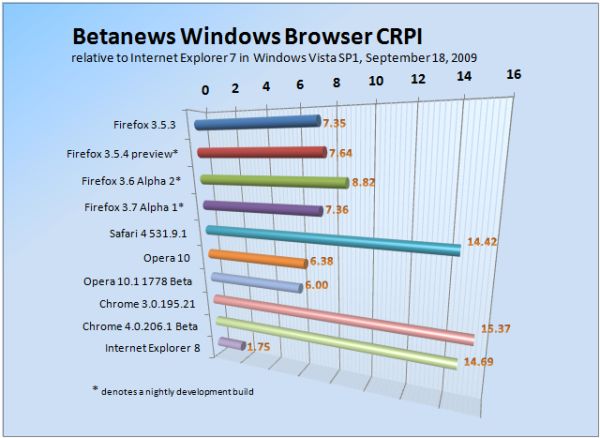
All-new test results: What browser will you use to run Web apps?
Three laptop computers, all of them cool-looking, all with well-respected brands, all have the features you want, all sell for the same price. This isn't going to be a toy for you; it will be, for at least the next few years, the engine for your work and your livelihood. How do you make a purchasing decision? You check online to see which one is the better performer, and which one other customers prefer.
Five Web browsers, all of them cool-looking, all with well-respected brands, all have the features you want, all of them...are free. But this isn't going to be a newspaper reader or a Twitter feed carrier for you; it will be, for at least the next few weeks, the engine for your work and your productivity. Sure, you'll install all of them. But which one will you install as your default, and which one will you trust with your everyday applications?
The Betanews Comprehensive Relative Performance Index: How it works and why
After several months of intense research, helped along by literally hundreds of reader suggestions, Betanews has revised and updated its testing suite for Windows-based Web browser performance. The result is the Comprehensive Relative Performance Index (CRPI). If it's "creepy" to you, that's fine.
We've kept one very important element of our testing from the very beginning: We take a slow Web browser that you might not be using much anymore, and we pick on its sorry self as our test subject. We base our index on the assessed speed of Microsoft Internet Explorer 7 on Windows Vista SP2 -- the slowest browser still in common use. For every test in the suite, we give IE7 a 1.0 score. Then we combine the test scores to derive a CRPI index number that, in our estimate, best represents the relative performance of each browser compared to IE7. So for example, if a browser gets a score of 6.5, we believe that once you take every important factor into account, that browser provides 650% the performance of IE7.

FCC chair lays down groundwork for net neutrality rules
At the Brookings Institution in Washington, DC today, Federal Communications Commission chairman Julius Genachowski discussed the Commission's plans for preserving net neutrality with the addition of two new tenets to the FCC's existing open Internet principles.
"Why has the Internet proved to be such a powerful engine for creativity, innovation, and economic growth?" Genachowski asked, "A big part of the answer traces back to one key decision by the Internet's original architects: to make the Internet an open system."
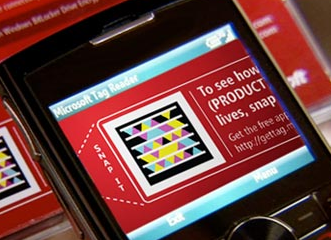
Could Microsoft Tag augment Windows Mobile reality?
Microsoft is promoting its Tag barcode system over at its PressPass this week. The PR is a big marketing pitch showcasing brands like Ford and Proctor & Gamble; it's a sensible approach for the technology. But I see another: Making augmented reality more real, and in so doing recover Microsoft's botched handset strategy. AR isn't new, but it's all the geek rage now that iPhone has a compass: BBC, CNET News, Robert Scoble and Telegraph UK, among many others.
A quick AR primer: Augmented reality is essentially the overlay of additional visual information onto something real. American football is great example, where during TV broadcasts yellow lines and other information overlay the field of play. What? You thought those lines were really there? You experienced augmented reality.

Windows Mobile + Palm: 2005-2009
During yesterday's quarterly earnings call, Palm CEO Jon Rubenstein confirmed that webOS is going to be the sole operating system coming from Palm as the company goes ahead.
"Due to importance of webOS to our overall strategy, we've made the decision to dedicate all future development resources to the evolution of webOS. Which means that going forward, our roadmap will include only Palm webOS-based devices," Rubenstein said.

Google to FCC: Apple and AT&T lied
The text of a letter from Google to the US Federal Communications Commission dated last August 21 -- the un-redacted contents of which were only made available today -- directly contradicts information given by Apple and iPhone partner AT&T, regarding the apparent rejection of a key Google mobile app from Apple's iTunes App Store.
Google Voice is a beta project which allows several phone lines to be united under a single new number, accessible from any phone. Earlier this year, Google submitted to Apple an app that would make the service usable on the iPhone. The fiasco over Apple's rejection of the Google Voice application from the App Store came to a head when the FCC began a formal inquiry into whether the relationship between AT&T and Apple is fair and encouraging to innovations in communication.

WiMAX not living up to customers' expectations
In the midst of my own Comcast outage today, I began to contemplate the alternatives to my current cable Internet connection and the satisfaction of customers elsewhere. Being a Baltimore native, I'm fortunate enough to have a number of options at my disposal, including WiMAX. It's a technology that I've frequently covered here at Betanews, and one which we've been following for a long time.
For a little while, we had a WiMAX connection in our headquarters and I was using it without even being aware of a difference. I probably wouldn't have even found out if Nate hadn't asked me what wireless network I was connected to one day and informed me that it was actually our Sprint/Xohm WiMAX test line.

Free Office Web Apps: Brilliant ploy or desperate move?
The problem with sleeping giants in recent years is that "terrible resolve" hasn't necessarily gotten them very far. Of course, this applies outside the information technology industry as well. But not even the Internet -- the biggest revolutionary IT technology since the personal computer -- is creditable to any one major player or allied force. Historians will note that almost every company or group to attain success through the Internet did so either 1) completely by accident, and/or 2) without any substantive plan as to what to do with that success once it attained it.
But the last great "sleeping giant" episode in the history of the IT industry was one of absolute, intentional, and steadfast resolve. The landscape of our lives and work has been shaped by this chain of events. It was triggered by WordPerfect, and the terrible resolve was manifest in Microsoft Office. I watched from very close range as, within a span of mere months, the axis powers that commanded respect and even awe -- WordPerfect, Lotus 1-2-3, dBASE, and Harvard Graphics -- deflated to mere also-ran status. Their manufacturers, in an often comical display of poor timing and miscommunication, self-destructed.
As a result today, when you ask businesses worldwide why they use Microsoft Office, the majority of responses you'll get say it's because it's the productivity suite for Windows. And when you ask those same businesses why they use Windows, the answer is because it's the operating system that runs Office.