
NPD: 2008 was a bad year for operating systems
Market research company NPD released its non-game software sales figures for 2008, which showed a nearly 10% overall decline, with operating systems taking the greatest hit, selling 40% less than the previous year.
While the data does not take enterprise software deployments into account, the numbers are quite dramatic when considering the lifespan of the operating systems in the consumer market. Though due consideration can be given to the various Linux operating systems, any changes within their 1% collective market share would have only a minimal effect on the health of the OS market overall.
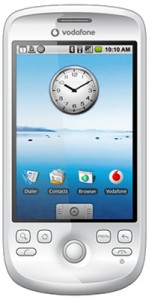
HTC rolls out 'Magic,' the world's second Android phone
HTC today unveiled a second Android phone to follow the G1/Dream. It's a tablet-style device called "Magic," first announced for several European markets although not yet for the US.
Set for availability this spring, HTC's Magic is slimmer than HTC's original Dream phone, but it adds new features driven by new "Cupcake" firmware.

A fighting chance for EchoStar against TiVo
Today marks the resumption of what has become a remarkable showdown between satellite TV provider EchoStar and its one-time subsidiary Dish Network, and store-and-forward TV pioneer TiVo. Last October, in what appeared to be the final chapter of a long story, the US Supreme Court declined to hear EchoStar's appeal of a judgment declaring it and Dish in violation of TiVo's patents regarding its "Time Warp" functionality. The $105 million settlement fee has already been accounted for by TiVo.
A hearing scheduled for today in US District Court in Texarkana was originally supposed to feature EchoStar's presentation of a software-based "workaround" that would enable its and Dish's set-top boxes to implement a live recording feature similar to Time Warp, but without using TiVo's methodology. But last month, the US Patent and Trademark Office decided it would re-examine the validity of TiVo's patent -- a decision which doesn't necessarily call into question the validity unto itself.
FCC white space device rules to take effect next month
The FCC's final Report and Order regarding the use of radio spectrum (including the portion freed up after the DTV transition) was made public today, revealing that the guidelines for developing white space devices will take effect March 19.
These guidelines are regarded as the first step toward the actual production of new communications devices that capitalize on the newly vacated spectrum. Though the document was finalized in November, before the DTV transition was delayed,
Jake Ward of the Wireless Innovation Alliance informed Betanews this afternoon that the actual rulemaking will likely be unaffected by the transition's delay.

iPhones will be among first to get Yahoo Mobile service
Yahoo's announced Mobile service for smartphones, which goes into beta today, will be available in March for iPhones, but not until May for hundreds of other models running Windows Mobile, as well as other major brands.
Those brands that will have to wait it out include Motorola, Nokia, RIM, Samsung and Sony Ericsson.

Microsoft and Red Hat ink a 'one-dimensional' Linux deal
Microsoft has signed a virtualization interoperability pact with Red Hat, but officials contend that it's quite different than the controversial deal inked between Microsoft and Novell, another big Linux distributor, a few years ago.
At a press conference on Monday, Microsoft's Mike Neil described the new deal with Red Hat as "more one-dimensional," and the older one with Novell as "more multi-dimensional."

Agreement: Some radio broadcasters will pay some performers' royalties
With terrestrial radio stations now facing the possibility of Congress lifting their historic exception from paying royalties to performers for over-the-air broadcasts, they could use a break. Yesterday, they got one in the form of an agreement with the National Association of Broadcasters for lower performers' royalties when a station operates a simulcast or separate streaming outlet over the Internet.
The rate originally established for stations during 2009 and 2010 will be reduced by 16%, to $0.0015 per recording streamed, gradually increasing to $0.0025 (one quarter of one cent) per streamed recording by 2015. Though this may lessen the burden for terrestrial stations some, it may also be perceived as a concession by broadcasters that performers do deserve something from airplay. If subsidiary airplay deserves compensation, then why not the primary channel as well.
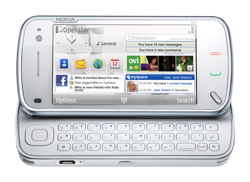
Nokia buddies up with Skype
Today, the world's top cell phone manufacturer and top soft phone client announced they have partnered to bring Skype to Nokia's N-series of handsets.
Nokia's N97, which the company yesterday pegged for launch in June, will be the flagship Skype-enabled N-series device. The N97's address book will incorporate Skype contacts and enable presence for both voice and instant message chats when the device is connected to a 3G signal or Wi-Fi.
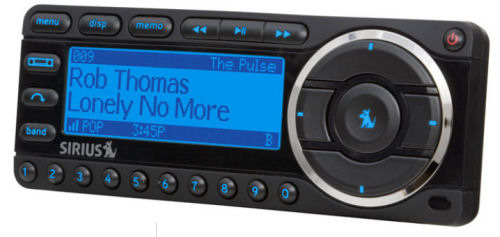
Liberty Media deal may keep Sirius XM solvent
When XM and Sirius Satellite Radio merged last year, the acquirer took on financing debt from XM that it didn't expect. Now a white knight may have emerged to help the merged entity meet obligations due now.
Very few analysts doubt the ability of the satellite radio market to grow and flourish; the problem facing Sirius XM is not that its own market is declining. According to an October 2008 prospectus from Morgan Stanley (PDF available here), some $400 million in convertible senior notes at 1.75% interest are due this year, carried over from XM along with nearly $600 million in various other debts, including "revolving credit." And some $300 million in 2 1/2% convertible notes from the Sirius end are due...well, now.

Half of charges against Pirate Bay dropped
Only into its second day, the criminal copyright infringement case against file sharing site The Pirate Bay has already begun to crumble.
Exposing a clear misunderstanding of how .torrent files work, the prosecution was forced to drop all charges except those of "making available," a term common among all file sharing suits.
HTC unveils its second Android device
Today at day two of GSMA in Barcelona, HTC officially unveiled the sequel to the G1 Android phone, called the HTC Magic. The device will be launched in Europe on Vodafone this Spring.
The HTC Magic retains the distinctive "kicktail" that has become the identifying design trait of the G1, although the chassis is much thinner and sleeker than its predecessor. HTC was able to lighten up the device by eliminating the membrane keyboard of the G1 and replacing it with the touchscreen keypad found in the "Cupcake" Android update. HTC also made sure to remind us in its brief premier video (found below) that we can "make a flick" with the new Android device, since the Cupcake update also unlocks video capture mode.

Pirate Bay copyright infringement trial begins, founders plead 'not guilty'
Today marked the first day of the criminal copyright infringement suit against The Pirate Bay that was initiated in Sweden one year ago by Warner Brothers, Columbia Pictures, Sony BMG, EMI, Universal, Metro Goldwin Mayer and 20th Century Fox.
The Pirate Bay's founders, Peter Kolmisoppi, Gottfrid Warg, Carl Lundstrom and Fredrik Neij, all claimed "not guilty," and Swedish prosecutors laid down the framework of the suit. The main accusation is that The Pirate Bay was in fact a commercial site with Carl Lundstrom as chief shareholder and financier, where income was drawn from advertising.
Can mobile phones finally replace point-and-shoot cameras?
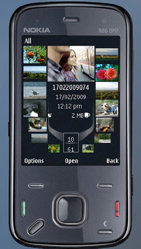
Today is without a doubt the day of highest pixel density in mobile phone history. Top three handset manufacturers Nokia, Samsung, and Sony Ericsson all unveiled additions to their 2009 cellular phone lines that are heavily stacked in the imaging department.
Nokia announced its N86 touchscreen dual-slider, the company's latest addition to its premium N Series. The HSDPA device runs Symbian S60 3rd edition (feature pack 2), and features a 2.6-inch OLED display. The N86's big gun is its 8-megapixel (3280 x 2464) camera, which comes with dual LED flash, Carl Zeiss Tessar optics, and a 1/1000 second mechanical shutter, a feature not commonly found in phones.
Windows Mobile 6.5 made official, but not for older devices
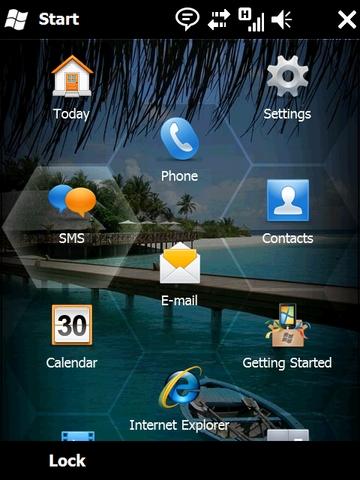
At the Mobile World Congress in Barcelona, Microsoft gave a grand tour of the new iteration of Windows Mobile, along with My Phone, the company's MobileMe equivalent.
Microsoft CEO Steve Ballmer in November semi-officially confirmed that Windows Mobile 6.5 would be released in the second half of 2009, after a long run-up with rumors and speculation about Redmond's progress in the touchscreen OS field. What wasn't "officially" noted at the time was that devices running older versions of Windows Mobile would not be able to upgrade. Rather, it will only be available as the pre-installed OS on new devices.
Sprint adds mobile broadband to 'Everything' plan for $150 per month
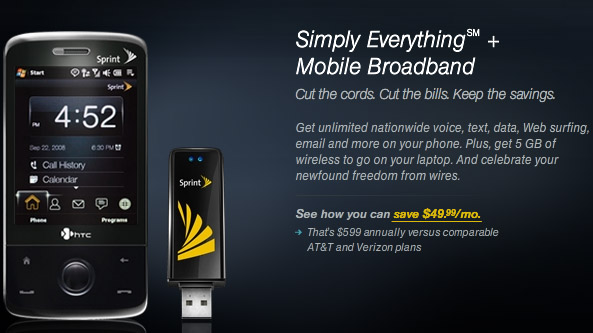
Claiming it offers a savings of $599 compared to AT&T and Verizon, Sprint has unveiled a version of its unlimited "Everything" plan that includes mobile broadband for both businesses and consumers. The plan will cost $149.99, and include everything its existing $99.99 unlimited voice and messaging plan offers, along with 5GB of 3G access using a laptop.
Sprint charges $59.99 for mobile broadband on its own, so the bundle amounts to a savings of $10 per month. The company says existing customers can upgrade to the new plan without extending their contract; new activations will require a two-year agreement in exchange for a free USB 3G broadband device.