Here it comes: .NET for the iPhone
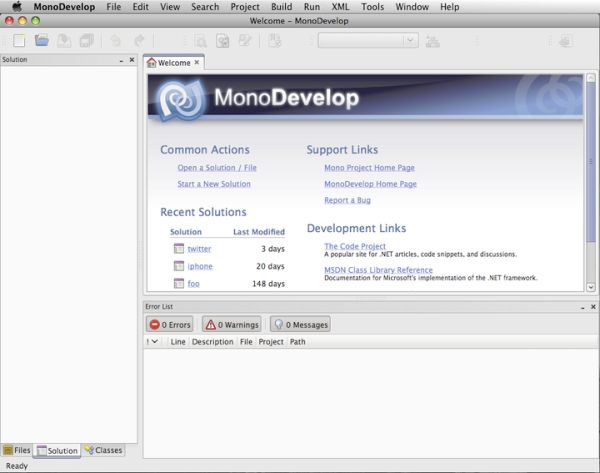
The big payoff for Novell's investment in an open-source version of a platform created by its rival in the operating system category, Microsoft, may come in the unlikeliest of places: Today, Novell begins shipping the 1.0 edition of MonoTouch, its commercial software development platform that extends the .NET Framework and the C# language...to Apple's iPhone.
Although this effort is itself an extension of Mono, the open source .NET extension for Linux and Mac that's funded by Novell, MonoTouch is somewhat different: First, it includes an exclusive, Mac-based development environment for iPhone. Second, it requires the iPhone SDK, which means MonoTouch is being marketed for registered Apple iPhone developers. Third, it ain't free -- a five-developer license costs $3,999.

Sprint + T-Mobile: The odd couple of wireless
Unnamed sources have told the UK's Daily Telegraph that mobile network operator T-Mobile may be making a bid for Sprint some time in the "next few weeks."
If German-owned T-Mobile indeed goes ahead with such a bid, it will be a virtual repeat of its actions in the United Kingdom last week, when it announced its merger of operations with Orange Telecom. The two companies are the third and fourth largest wireless providers in the UK, just like Sprint and T-Mobile in the US.

Jury verdict against Microsoft overturned in precedent-setting ruling
At one time, French networking systems producer Alcatel-Lucent -- the caretaker of patents once belonging to AT&T's Bell Laboratories -- stood likely to receive infringement payouts from Microsoft that may have collectively exceeded $2 billion, including for licensing MP3 technology from what some believed was the wrong authority. But the MP3 ruling was reversed in August 2007; and today, the second largest jury verdict against Microsoft -- and still one of the largest in history -- has also been struck down by a federal appeals court.
Today, the Federal Circuit panel of judges ruled in Microsoft's favor, overturning a jury award of over a third of a billion dollars, in a case involving infringing an old Bell Labs patent for a technique for users selecting a date from an onscreen calendar. Last spring, the US Patent Office overturned the validity of that patent anyway.

Can 'Government 1.0' manage an upgrade?
It just keeps getting easier to participate in policymaking in the United States, but that may lead to some problems not far down the road.
Today, the FCC debuted a National Broadband discussion site built on the Ideascale crowdsourcing platform which lets users read, discuss, and rank FCC issues in the same fashion as services like Digg and Yahoo Buzz.

Dear AT&T: Don't let Apple make you look bad any more
ISuppli knows what's going on with Apple and AT&T. Based upon its analysis of wireless technology deployments, the market research firm predicted today that Apple will keep its exclusive iPhone deal with AT&T when re-negotiation time comes around next June.
"The main reason Apple is likely to stick with AT&T beyond 2010 is the relatively wide usage and growth expected for the HSPA air standard used by the carrier for 3G data," Francis Sideco, principal analyst for wireless communications at iSuppli said. "FCC investigation notwithstanding, Apple has no reason to move away from its highly successful exclusive deal with AT&T, which has already generated strong growth in iPhone sales and is expected to fuel a continued expansion in the coming years."

You saw this coming: Revised Twitter terms of service enables ads
A typical publishing business requires a business model before it can establish the type of service that can generate an audience. By anyone's standards, Twitter has never been a typical publisher. Venture capitalist Jason Calcanis -- who offered to pay a quarter million dollars for prominent placement on Twitter -- has been on record throughout last year and up until last May as saying a real online business must first build an "audience of scale" -- something on the order of 10 million unique users -- before it can actually start building a business model for monetizing the strength of that audience.
Well, Twitter is probably there now, but the first signs of what kind of monetization we're likely to see for it appears to be more categorical than architectural. As its first true sign to the world that it's "going that way," the publisher unveiled its new Terms of Service late this week, with a new and vague paragraph asserting its rights to place ads somewhere within the service, at some time.

China to begin reviewing all song lyrics for 'inappropriate' content
Song lyrics found to be vulgar, violent, or in otherwise poor taste are now facing removal from Chinese Web sites, the Chinese Ministry of Culture has announced.
Starting December 31, every piece of music on Web sites hosted in China needs to be approved by the Ministry of Culture before it can be made available to the public. Even songs which are not in Chinese must be translated and submitted to the government.

Stadium event source of first signals of Silverlight-bearing 'Bing 2.0'
The initial rollout of Bing search has been moderately successful -- it's recaptured a few points of market share for Microsoft at a time when Windows Live Search had not seen a share gain in several years. Yesterday at a company shindig thrown at Safeco Field in Seattle -- which featured entertainment from comedian Seth Meyers, bands, and an expected audience of 40,000 -- the biggest news to be tweeted from excited guests at the event (plus a few analysts who picked up the private stream remotely) concerned a possible near-term rollout of Bing 2.0.
One tweet from Microsoft software engineer Sushil Choudhari yesterday read, "Saw the demo of Bing 2.0, super imressive! Watch out its release next week!!" [sic]

The wireless carrier conundrum: Perpetuating the myth of connectivity
I'd hate to be a wireless carrier. Customers don't like you, regulators are constantly sniffing around the edges of your operations and you're perpetually faced with the Hobson's Choice of investing billions in new network capability or risk falling behind other, similarly vilified competitors. In short, you can't win. And the recent spate of negative publicity surrounding the real-world experiences of customers using 3G-capable smartphones suggests this situation won't improve anytime soon.
It's their own fault

Microsoft, Mono developer form open source/commercial cooperative
Perhaps Microsoft's most effective competitive effort to date against Linux has been its recent moves directly into the open source arena, fuzzifying the boundaries between open source and commercial software efforts and playing more like a participant than a conqueror. If it does anything at all, it makes efforts to continue characterizing Microsoft as an evildoer look like recent right-wing efforts to paint the Obama administration as the re-emergence of Joseph Stalin.
Those broad-brushstroke efforts will become even more difficult after today, now that the company has announced it has funded an independent organization -- an offshoot of its Codeplex counterpart to Linux' SourceForge -- to nurture and facilitate efforts for private software companies, including itself, to contribute intellectual property to open source development efforts.

Symantec launches Norton Security 10 and Quorum technology
With ID theft reaching increasingly alarming proportions, Symantec this week rolled out a battery of new tools geared to helping PC users fight victimization, at a press event Wednesday in New York City.
The company's latest round of heavy artillery includes new Quorum technology, integrated into the now available Norton Internet Security 10 and Norton Antivirus 10, plus a free tool known as the Norton Online Risk Calculator.

Google: Open news publishing 'need not mean free'
In a response this week to a questionnaire from the Newspaper Association of America earlier this week, obtained by Harvard University journalist Zachary M. Seward (PDF available here), Google told newspaper publishers it is implementing an infrastructure extension to its Google Checkout service, for implementation sometime within the next 12 months, that may enable news sites and other publishers whose content is located via Google to receive payment for that content from users.
It's being called a "micropayment model," and it's similar in concept to the one being proposed by the Journalism Online coalition, which is led by former executives from Dow Jones and The Wall Street Journal, and endorsed by their parent company News Corp. And like the Journalism Online model, publishers may make their products more attractive by coalescing and offering them in bundles, according to the most rational interpretation of Google's questionnaire response.

A new effort to extend the cloud to the iPhone
The iPhone has proven to be a strong content creation tool, with applications that allow the user to create graphics and presentations, record video, sequence audio, or draft compositions. But while it gives users plenty of tools to create, it doesn't exactly have a uniform tool to let users manage, move, and share their creations: some apps are integrated with some services, others are integrated with different ones...some aren't integrated with anything at all.
Cloud-based storage and collaboration service Box.net claims to provide an answer to this problem, but it needs the apps behind it to make it come true.

Adobe Flash in a race against Silverlight for the most DRM
Largely by virtue of its support from YouTube, which some say supplies four-fifths of the Web's streaming video, Adobe Flash is the de facto delivery standard for video through Web pages. While content creators have been urging Google and other video hosts to implement better controls over how unauthorized content can become so freely distributed, Adobe is now working on a way to enable those creators to post or host their own Flash video, in a way that they and only they are in control of the distribution process -- including, who gets to see those videos and for how much.
The next edition of Adobe's rights management server, now called Flash Access 2.0, was unveiled today at a broadcasting conference in Amsterdam. This while Silverlight -- perhaps Flash's most direct competitor in the functionality department, but still representing a very small slice of the global viewer base -- demonstrates its next version as well, with very similar goals. Today, Adobe said its next version of the Flash Player will be required for Web users to view videos that content owners produce specifically for customers.
Motorola debuts Cliq, with social media-based Android UI
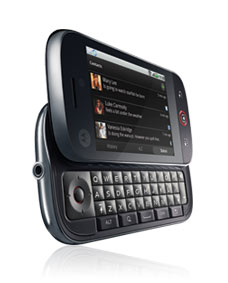
Not to be confused with HTC's Android-based Tattoo, which was known as "Click" before it was released, Motorola today debuted the latest T-Mobile Android called Cliq.
As expected, Cliq is an HVGA touchscreen QWERTY slider with quad-band GSM, WCDMA/EDGE/GPRS and HSPA 7.2, A-GPS, Wi-Fi and Bluetooth 2.0 connectivity. It offers up to 32GB of storage via microSD, but the speed of processor and amount of RAM were not announced today.