
New reporting tools help manage machine learning risks
Machine learning operations and management software specialist Algorithmia is launching new, advanced reporting tools to help enterprises govern the use of ML models in production environments.
The top ML challenge currently facing organizations is governance according to the company's recent machine learning trends survey. This found 56 percent of IT leaders rank governance, security and auditability issues as a major concern.

Fixing software bugs is the top developer pain point
New research from code improvement platform Rollbar finds that fixing software bugs and errors is the top pain point for 44 percent of developers.
This is not helped by inadequate tools, with a large majority (88 percent) feeling that traditional error monitoring falls short of their expectations.

Microsoft reveals roadmap for WinUI 3.0 which will transform the look of Windows 10 apps
Microsoft has set out its plans for WinUI 3.0 which is due to ship later this year. Described as the "modern native UI platform of Windows", WinUI is the C++-based library of controls and Fluent styles that empowers developers to create a new breed of apps.
The company has shared details of the roadmap for WinUI, explaining how version 3.0 will expand into a full UX framework. It is part of Project Reunion which sees Microsoft bringing together a unified set of tools and APIs to make it easy to develop apps for different Windows 10 devices.

Rookout improves visibility into third-party code
Increasingly developers are reliant on code modules that weren't created in house and when it comes to debugging applications this third-party code can present a problem.
Now though debugging platform Rookout is announcing new functionality that makes it easier for developers to debug other people's code.

Software industry turns to crowdsourced security during the pandemic
Among the many things that have changed in 2020 it's proved to be a record year for crowdsourced cybersecurity adoption, according to Bugcrowd.
Enterprises across all industries have been implementing crowdsourced cybersecurity programs to keep up with the evolving threat landscape. Bugcrowd has seen a 50 percent increase in submissions on its platform in the last 12 months, including a 65 percent increase in Priority One (P1) submissions, which refer to the most critical security vulnerabilities.

Software usage data improves product decisions and cuts revenue loss
Software suppliers are showing an ongoing interest in collecting and understanding usage data to help with both change management and use-based pricing models.
A new report from Revenera reveals that 60 percent collect usage data today and more than 75 percent will do so in the next two years.
Sonatype helps development teams handle code dependencies
Because so much of modern development is reliant on modular components, developers often face the issue of dependency upgrades that break the functionality of their application.
In order to help teams manage this problem Sonatype is launching an Advanced Development Pack that changes the way dependencies are handled.

New development environment streamlines the creation of business apps
Low-code techniques help businesses to develop applications quickly, but in some cases they can lead to added complexity.
With the launch of OXIDE, an Integrated Development Environment (IDE), JourneyApps is seeking to combine the speed and efficiency of low-code platforms with the flexibility and power of professional development, all in a single platform.

New platform helps streamline DevOps processes
DevOps has boosted the speed of development, but this very advantage can lead to problems and errors making their way through to production without being spotted.
California-based DeepFactor is launching a new Continuous Pre-Production Monitoring platform that combines security, performance and behavior monitoring into one solution that is completely integrated into the DevOps pipeline.

Why log management is essential to successful implementation of DevSecOps [Q&A]
DevSecOps, the integration of security into DevOps processes, is in increasingly common use. Logging and log management play a critical role in helping to put DevSecOps principles into practice by ensuring that developers, IT operations staff, and security teams have the visibility and communication pipelines they need to prioritize security at all stages of the DevOps delivery cycle.
We spoke to Ryan Staatz, systems architect and head of DevOps at LogDNA to discuss how log management fits in the toolchain of technology and practices that create a successful DevSecOps initiative.

New open source API bug detection tool improves application security testing
Software development today usually involves the use of third-party APIs, libraries or frameworks that are complex, rapidly evolving, and sometimes poorly documented.
Security testing solutions company GrammaTech is launching its new Swap Detector, an open-source checker that detects application programming interface (API) usage errors.
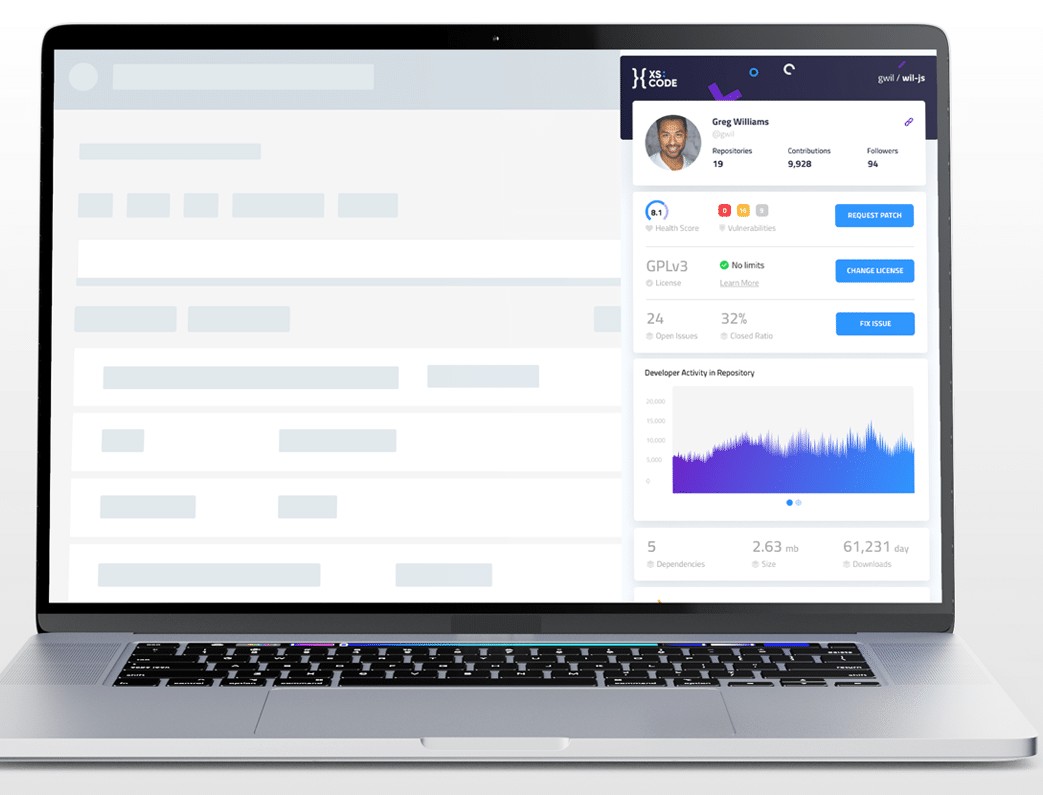
New Chrome extension provides security check on open source code
Developers frequently make use of open source components in order to speed up projects and save them having to reinvent tasks. But this can lead to the introduction of hidden security risks.
Now though open source marketplace xs:code is launching a new, free Chrome extension, xs:code Insights, which provides users with intuitive, in-depth analytics on open source repositories, including repository score, security analysis, maintenance and activity status, reviews, ratings and more.

Microservices take off as businesses taste their success
The use of microservices is succeeding for 92 percent of organizations according to new research from learning resources company O'Reilly.
It surveyed over 1,500 software engineers, systems and technical architects, engineers, and decision-makers from around the globe and finds that 77 percent of respondents have adopted microservices.

New platform combines application and infrastructure risk management
Vulnerability management specialist RiskSense is launching a new version of its platform that harmonizes threat analysis, prioritization and risk scoring across both network-based assets and applications.
RiskSense aggregates and normalizes outputs from multiple data sources including SAST, DAST, open source software, containers, pen testing and bug bounty programs. This approach enables organizations to easily pinpoint and fix vulnerabilities in their attack surface regardless of where they arise.