
Major companies lag in adopting domain security
A majority of companies in the Forbes Global 2000 have been slow to adopt domain security measures that could help prevent them from ransomware attacks.
A new report from CSC finds 57 percent of the Global 2000 are relying on off-the-shelf consumer-grade domain registrars who offer limited security mechanisms to protect against domain and DNS hijacking.

Europe leads the broadband speed table
Western Europe dominates the global internet speed table, containing eight of the top 10 fastest countries in the world for broadband.
Analysis of over a billions speed tests by comparison site Cable.co.uk shows if you want really fast speeds you need to move to the Channel Island of Jersey which tops the chart with an average speed of 274.27Mbps.

Over two million web servers still running on vulnerable legacy software
More than two million web servers worldwide are still running on outdated and vulnerable versions of Microsoft Internet Information Services (IIS) software according to research from CyberNews.
With 12.4 percent of the market worldwide IIS is the third-most-popular suite of web server software, used to power at least 51.6 million websites and web applications.

False flags and internet censorship: A cautionary tale
The Internet went down in Mauritius -- and you should be afraid.
Homes, businesses, and even mobile/wireless users were unable to access much of the online world on Monday thanks to what government IT managers are calling an "external cyberattack from multiple locations."

Google reins in the madness and brings some sanity to Chrome's address bar
Over the years Google has made sweeping changes to Chrome, introducing all manner of features and options. The constant stream of Beta, Dev and Canary builds of the browser are proof of the constant development that is going on, and some of the work has been rather controversial.
One move that was widely opposed was the decision to stop showing full URL of a web page in the address bar (or Omnibar if you want to use Google's nomenclature). Introduced almost a year ago, Google said the experiment was an attempt to help people spot spoofed URLs, but it caused widespread annoyance and confusion. Now the company has seen sense and is opting to show full addresses once again.

Who will scrutinize the scrapers?
Web scraping allows the collection of data from third-party web sources. Data harvesting like this is one of the key pillars of the internet, but while it can be useful it also has the potential for harm.
The Cambridge Analytica scandal of 2016 first brought this type of activity to the wider public's attention but, as of today, there is still no regulatory body to govern its widespread use.

32 percent of Americans are unaware of email tracking
A new survey from email service OnMail reveals that 93 percent of Americans think it's important that companies don't track their email, however, 32 percent don't know that leading email providers do it for advertising purposes.
Interestingly this view is remarkably consistent across age groups with 93 percent or more across all groups believing it's important that businesses don’t track the types of email you open.

GlobalSign celebrates 25 years as a certificate authority
Identity solutions provider GlobalSign today celebrates the significant milestone of 25 years as a Certificate Authority (CA).
The company has grown from just a few employees in 1996 to become one of the world's top CAs -- as well as the longest operating -- with over than 550 employees in more than a dozen countries.

There's a Starlink waiting in the sky -- it may not blow your mind though
Elon Musk's Starlink is a project aimed at delivering fast broadband via satellite to rural areas left behind by fiber rollouts.
But research from Ookla, the company behind Speedtest.net, suggests that its performance is somewhat variable, much faster than fixed broadband in some areas but a lot slower in others.

UK launches new watchdog to promote online competition
Online platforms make it easier for people and businesses to stay in touch, but a small number of companies dominate the market which can lead to less choice and higher prices.
In the UK today sees the launch of the Digital Markets Unit (DMU) intended to create a new pro-competition regime to cover platforms with considerable market power.
Slack rolls back controversial messaging feature within hours of its introduction
Messaging platform Slack yesterday rolled out a new feature called Connect DM that made it possible to send direct messages to anyone using the service -- regardless of whether they are part of the same company or workspace.
We say "made it possible" in the past tense because Slack was very quickly forced into something of an embarrassing partial u-turn. The company somehow failed to notice the potential for such a feature to be abused, and it was down to users and media outlets to point this out. Within hours, a key change was introduced to Connect DM to help eliminate spam and abuse.

47 percent of workers spend their own money fixing home working technical issues
Tech issues at home can be frustrating enough when you're trying to stream a movie or set up a video call with the family, but they're even more of an issue if you're trying to work from home too.
New research from comparison site InMyArea.com looks at how tech issues are affecting the home workforce. It finds that 47 percent of employees have spent their own money to solve technical problems, with 20 percent spending $100 or more.

Consumers worry about privacy but don't want to change their habits
A survey released to coincide with Data Privacy Day reveals that although 80 percent of consumers are concerned about their data privacy, few are willing to change their habits.
The study from Entrust, based on responses from 500 adults in the US and 500 in the UK, shows 64 percent of consumers are willing to some degree to share personal information with an app in exchange for more relevant, personalized and/or convenient services.
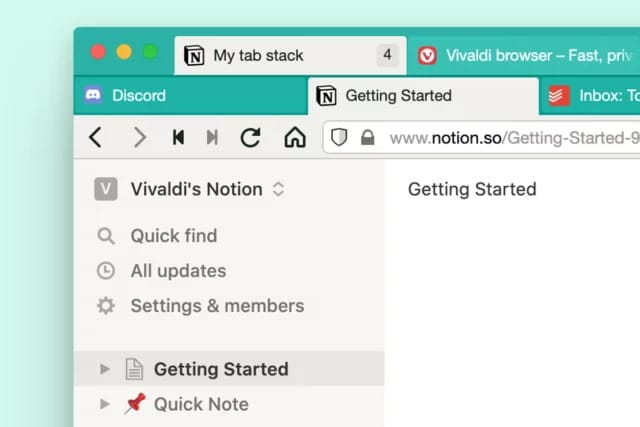
Feel the need for two layers of tabs in your browser? Vivaldi has you covered
It is very difficult for web browsers to be able to honestly make the claim that they have an exclusive feature these days -- the likes of Chrome, Edge, Firefox et al have started to become all but indistinguishable from one another. Looking to stay ahead of the pack, however, Vivaldi has launched a new feature which is unique.
While the likes of Google have been experimenting with tab grouping and pinning to make room for more open tabs in a browser window, the latest version of Vivaldi has taken a new approach. With the new release you have two layers of tabs to play with, doubling your browsing opportunities.

Users flock to decentralized social media platforms in the wake of Trump ban
The fallout from Donald Trump's ban from Twitter and suspension from Facebook, and Amazon's de-platforming of Parler continues as large numbers of users have been signing up to alternative social networks.
Many of these like Gab and Mastodon are decentralized in that they run on their own servers rather than relying on the public cloud so they are not at the mercy of larger businesses.