
Facebook's latest News Feed update gives local news a boost
Facebook recently promised big changes to the way its News Feed works, and Mark Zuckerberg has now revealed that the social network will start to place a greater emphasis on local news. At least it makes a change from constantly banging on about fake news.
It's part of the company's desire to increase civic engagement, with the Facebook CEO saying that there is a direct link between reading local news and people getting involved in helping out with local causes. The changes are coming to the US first and will then spread to the rest of the world.

Ahead of GDPR laws, Facebook publishes privacy principles and promises to educate users
Facebook has published its privacy principles for the first time, ahead of the European Union's general data protection regulation (GDPR) which comes into force on May 25 -- although the company is pitching it as being part of Data Privacy Day.
On top of this, the social network has also detailed plans to use videos to educate its users about privacy. The videos will explain how to control who has access to personal data, as well as how to manage the data Facebook uses to control the ads it shows users.

Why consumers love shopping online
While the majority of shopping is still done offline, it's the internet retailers that are growing at a three times faster rate.
Online retail portal Shopping.fm has produced an infographic comparing the online and brick and mortar shopping worlds. It looks at what people buy where and what factors drive their decision to shop online.

Facebook to roll out new privacy tools ahead of European GDPR laws
Facebook has faced numerous complaints and accusations when it comes to privacy, and nowhere has this been more obvious than in Europe. In response to European Union plans to change the laws concerning the privacy of personal data, the social network is on the verge of rolling out a new privacy center to users.
The upcoming General Data Protection Regulation (GDPR) is designed to give people more control over their personal data, and it is due to come into force in May. Facebook's response means that its millions of global users will all benefit from additional privacy controls.

Getting a good Google ranking is a long game
Whenever a business gets a new website it wants to see it ranking highly in search results. But getting to the top in Google and other search engines is a long game, according to SEO company Ahrefs.
UK web design company The Website Group has produced an infographic based on the Ahrefs research. It shows that -- based on random keywords -- the top 10 ranking pages on Google are on average more than two years old.

Twitter kills anti-Nazi bot Imposter Buster that tried to expose racists
A Twitter account designed to alert users about racist accounts has been shut down by Twitter. Imposter Buster was a bot created by journalist Yair Rosenberg in an attempt to expose racism on the platform.
But while many people welcomed the activities of Imposter Buster -- which would automatically join in the conversations of high-profile racist users in an attempt to expose their trolling of ethnic minority users -- Twitter saw things differently and slapped the bot with a permanent ban.

Patreon scraps plans to introduce new charges, and apologizes to users
Artists' and creators' platform Patreon has scrapped controversial plans to introduce a new pricing structure after a vocal backlash from users.
The site -- used by many artists and creators to raise money -- had planned to add a service charge to pledges placed by patrons. While the new pricing structure would have reduced fees paid by artists, there was a fear that fewer pledges would be made due to fees having to be shouldered by those pledging money. CEO Jack Conte has now apologized and says that the company will work on a better system that does not unfairly impact upon smaller payments.

Disqus has been acquired by marketing firm Zeta Global
Interacting with BetaNews -- and countless other websites -- means making use of the Disqus commenting system. Today the firm has been acquired by "marketing technology company" Zeta Global.
Disqus says that "we still are and will remain the same Disqus that you know and use," but there will be concerns from users that the company is being taken over by one with a vested interested in marketing and, therefore, user data.

How cyber crime could be improving the internet
War always sparks innovation, and over the years conflict has led to improvements in technology and the acceleration of development in things like radar and the jet engine.
So, is the war against cyber crime driving technologies that will improve the internet? Security education site Cyber Security Degrees thinks so and has produced an infographic to prove it.

Sneaky websites continue to mine cryptocurrency even after you close them
With the massive rise in popularity -- and value -- of cryptocurrencies such as Bitcoin, it's little wonder that people are seeking out ever more imaginative and sneaky ways to mine coins without having to invest in dedicated hardware.
Websites that mine for cryptocurrency in the background, making use of visitors' CPU time, are nothing new -- the Pirate Bay has been caught red-handed, for instance, using a Monero miner in the form of the Coinhive JavaScript Miner. But now researchers have discovered that some websites are using a drive-by mining technique that allows them to continue cryptomining even after the site is closed.
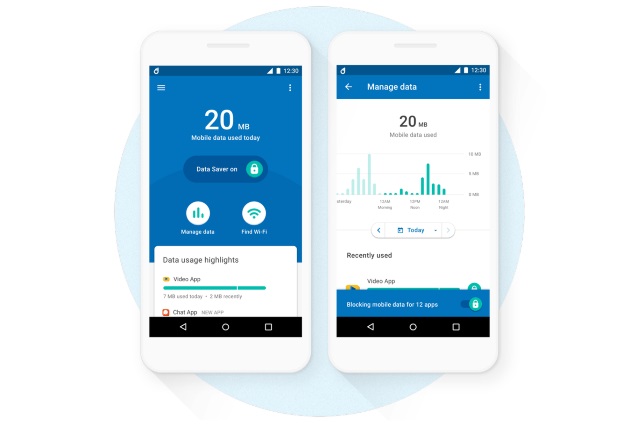
Google launches Datally for Android, a tool to monitor and control mobile data usage
For many people -- particularly in certain parts of the world -- mobile data is an expensive commodity. If you're someone who likes to keep an eye on exactly what's using up all of your allowance -- and take control of it -- Google's new Android app, Datally, can help.
Datally has been designed to not only reveal which apps are using up data, but to provide a way to rein it in. Formerly known as Triangle whilst in beta, the app lets you block background data usage on a per-app basis, and makes it much easier to access data-related settings.

Microsoft Edge beta for Android gains password syncing and more
Microsoft has just given mobile users a more compelling reason to use Edge as their web browser -- and heaven knows one was needed. The latest update to the mobile browser brings a genuinely useful feature: password syncing.
The announcement that Edge was coming to Android and iOS came somewhat out of the blue, and now it seems that Microsoft is intent on making it a real contender for the mobile browsing crown. Password syncing is the headline addition to the browser, but it's not the only thing that's new.

Facebook launches AI-powered suicide detection tool
Facebook has long offered a range of support options to help those considering suicide. Today the social network launches an automated AI-powered tool that aims to spot suicidal posts before they are reported.
Relying on the reports of people who spot worrying posts is just one of the ways Facebook has tried to provide a safety net for people who are struggling, and by adding artificial intelligence to the mix, the company will be hoping to speed up detection and offer help more quickly when it matters most.

UK broadband companies banned from advertising misleading top speeds
The advertising of broadband services has long been fraught with complaints and controversy, but a new rule change should help to bring this to an end.
Following an investigation by the Advertising Standards Authority (ASA), ISPs will no longer be able to advertise high "up to" speeds. Instead they will have to advertise the average speed achieved by at least 50 percent of customers at peak times. Previously, the rules permitted the advertising of headline speeds enjoyed by just 10 percent of people, and the ASA found that many broadband customers were disappointed with their connection speed.

Privacy: Use of session replay scripts means many websites essentially have built in keyloggers
The idea that what you do online is not a secret is something that we have all -- just about -- come to terms with. That said, most people still expect a modicum of privacy, and they certainly don’t expect literally every keystroke they type to be logged by the websites they visit.
But, say researchers at Princeton University, this is exactly what is happening. Hundreds of the most popular websites are using "session replay scripts" that record every single thing a visitor does. They are designed to monitor how visitors interact with a site to help gather information that could improve page design, and the incredibly extensive data that is collected is sent off to a third party for analysis.