
Study finds AI slop videos spreading fast across YouTube -- and there's a lot of money being made


Anyone who spends time on YouTube knows low quality AI generated videos are flooding the platform. A new global study by Kapwing looked at just how this slop and brainrot content (as it's known) is spreading across different countries and, perhaps more interestingly, how the biggest AI channels compare with traditional creators for both reach and earnings.
The report, which looked at more than fifteen thousand YouTube channels, arrives at a time when people are still arguing over the creative and ethical value of AI in video production. Film schools now teach classes on the use and ethics of generative tools, and brands are experimenting with AI in their creative work -- with mixed results.
Although some creators are using AI tools to improve their videos, others rely on quick prompt driven content that needs little effort and is designed mainly to bring in views quickly. These clips are showing up more and more often in YouTube's recommendations.
To understand how widespread this type of content is, Kapwing reviewed the top one hundred trending channels in every country available on playboard.co. It then identified which of those channels relied on AI generated videos and pulled their view counts, subscriber totals, and estimated annual earnings from Social Blade.
The combined dataset shows how large the audience for this material has become and the countries where it’s most visible.
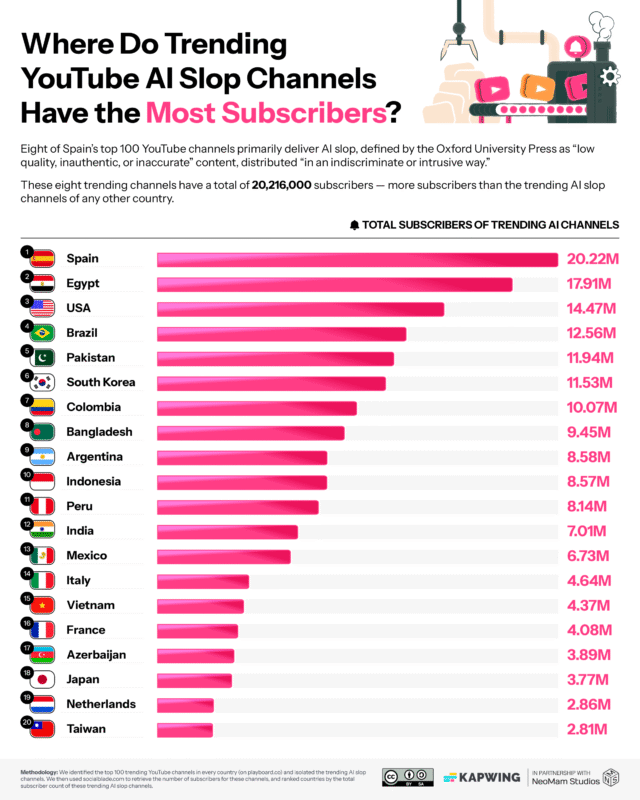
Spain’s trending slop channels have the highest combined subscriber count. South Korea leads for total views with more than eight billion recorded across its trending AI produced channels. India’s Bandar Apna Dost is the most watched individual channel in the study with more than two billion views and estimated yearly earnings above four million dollars. In the United States, the channel Cuentos Facinantes has the largest subscriber base of any slop channel in the report.


Kapwing also wanted to understand what a brand new user might see on YouTube Shorts. They created a fresh account and the team recorded the first five hundred videos that appeared. Roughly a third of those clips were identified as brainrot, showing just how quickly this type of content can take over a new feed.
The full report, which you can access here, includes data and visuals that show the overall scale of AI produced video.
What do you think about the rise of AI slop and brainrot videos? Let us know in the comments.



