
Mozilla is dropping support for sideloaded extensions in Firefox
Mozilla is clamping down on browser add-ons in Firefox, and has announced that it is discontinuing sideloaded extensions in the browser.
The reason given for dropping support is that Mozilla believes that sideloaded extensions cause problems for users, and also that they do not offer users enough control. The company has set out details of the timetable for introducing the new policy.

Mozilla's new Lockwise app will free your passwords from your web browser
Like many users, we prefer to use Google Chrome or Mozilla Firefox over either Edge or Safari. Problem is, if you use a third-party browser to store your logins and passwords, move to your iOS device and they aren’t stored in your keychain.
Recent iOS changes have enabled third-party password managers to be granted access to any login on your device, so for this reason Mozilla has launched Lockwise which will separate your stored Firefox passwords from your browser.

Firefox 70 unveils major privacy reporting tools, promises further performance improvements
Mozilla has released Firefox 70.0 for desktop, along with Firefox for Android 68.2 and Firefox ESR 68.2.0.
Despite the landmark version number, Firefox 70’s most visible change is a refreshed icon and new welcome screen. Better support for your OS’s system dark mode is also unveiled, while Enhanced Tracking Protection (ETP) has now been made the default for all platforms and users.

Mozilla accelerates Firefox to a four-week release cycle
If you're the impatient type, the current six to eight weeks between major new builds of Firefox may have been agonizing. Mozilla feels your pain, and it is stepping things up a notch.
Eager to get new features out to users faster, Firefox's release schedule is being accelerated significantly. The change isn't happening immediately, but from the first quarter of next year, you can expect to see a major new build of Firefox every four weeks.
Malwarebytes launches free safe browsing extension for Chrome and Firefox
People are spending more of their time and managing more of their lives on the internet, so it's little wonder that the web is a rich hunting ground for cybercriminals and scammers.
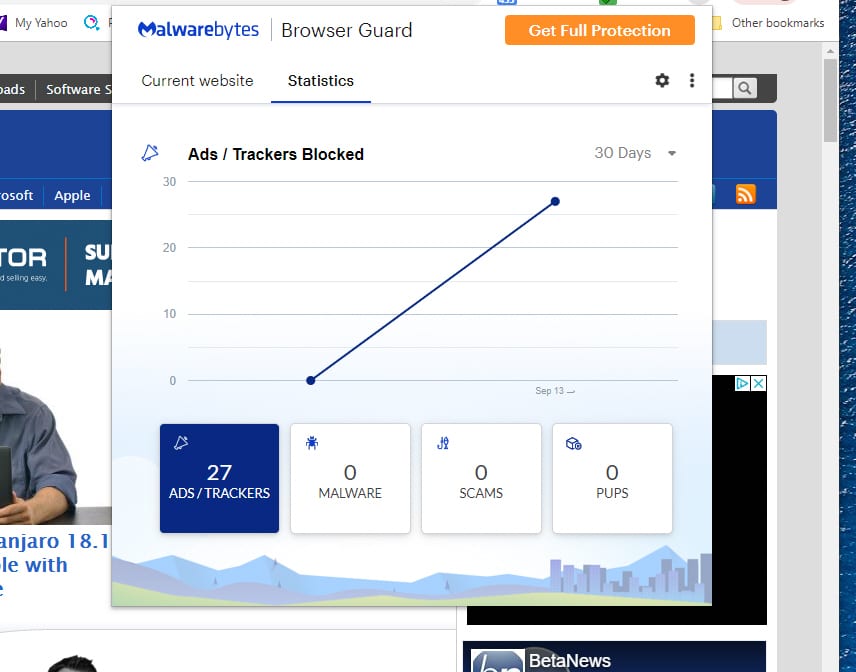
In order to make using the internet safer, Malwarebytes is launching Browser Guard, a free browser extension aimed at safeguarding consumers from scammers, and allowing them to browse up to four times faster.

Firefox Quantum 69 strengthens default anti-tracking protection, can block all autoplay content
Mozilla has released Firefox Quantum 69.0 for desktop, along with Firefox for Android 68.1 and Firefox ESR 68.1.0.
The new release switches on Enhanced Tracking Protection features by default, extends block autoplay to cover all videos (not just those with sound) and improves performance on Windows 10 machines. The Android release marks the browser’s move to the ESR channel.
Firefox will improve battery life for MacBook users
macOS users who have been disappointed with the power consumption of Firefox have something to look forward to. Developers say that power usage has been dramatically reduced in the latest nightly build, meaning that when the release goes public, MacBook owners can expect to see a jump in battery life.
There have long been complaints about Firefox Quantum sapping batteries, and now it finally seems as though the problem has been addressed.

Hate the new-look Twitter? Here's how to get the old version back
People are often resistant to change, particularly when it feels like change for the sake of change -- and this is certainly the feeling that abounds with the recent redesign of Twitter.
While some Twitter users have been working with the new look for some time, it only rolled out globally a couple of weeks ago. Predictably, the reaction has been mixed, but the redesign has certainly not been met with universal praise. If you're one of the many who hate the way things are now, you'll be frustrated to learn that Twitter does not give you a way to revert back to the old look. But where there's a will, there's a way...
Firefox Quantum 68 and Firefox ESR 68 released with focus on add-on management improvements
Mozilla has released Firefox Quantum 68.0 for desktop, along with Firefox for Android 68.0 and Firefox ESR 68.0.
The new release promises improvements to extension discovery and security, improves dark mode in reader view, widens its protections against cryptomining and fingerprinting, and adds BITS update support for Windows, allowing Firefox to update even when the main application has been closed
Mozilla set to offer ad-free browsing in Firefox for $5
Advertising is the lifeblood of many websites, but at the same time it is something that few people are fans of. To stave off income-killing ad-blockers, an increasing number of sites offer per-article or per-month subscriptions that give people the chance to enjoy content free of ads while still supporting the sites they love.
Mozilla has a different idea -- "Ad-free internet by Firefox". The result of a partnerships with multiple online publishers, the idea is that a single, low subscription fee gives you access to a number of sites with the ads removed.
Firefox embraces Microsoft BITS to install updates
Starting with Firefox 68, Mozilla's web browser began to use Microsoft BITS (Background Intelligent Transfer Service) to deliver updates -- the same technique that is used by Windows Update.
With the arrival of Firefox 70, BITS will be utilized with a dedicated update agent in place as a proxy rather than simply being part of the browser itself, allowing updates to be more easily installed.
Firefox needs an urgent firefix!
If you're a Firefox user, now is the time to update your browser. A zero-day vulnerability has been discovered which is being actively exploited in targeted attacks.
The security hole was revealed via Google's Project Zero, and it affects ALL versions of Firefox. In short, if you have not updated to Firefox 67.0.3 or Firefox ESR 60.7.1, you need to do so right now.
Security software is causing Firefox users to lose saved passwords
Firefox users are reporting that their saved passwords have been lost, with the problem seemingly caused by antivirus software rather than being an issue with Firefox itself.
Antivirus software such as Avast and AVG appears to be corrupting the file in which Firefox stores passwords, rendering it unreadable. Thankfully, passwords can be recovered, but -- for the time being --- they will be corrupted again when you restart your computer.
Firefox unveils new-look logo and introduces new parent brand
Firefox has revealed its redesigned branding, including a new icon for its web browser, as well an introducing the logo for the new Firefox parent brand, some 18 months in the pipeline.
As well as a new look, the icon features an updated color palette which is not just about aesthetics, but also accessibility. There's also a new, modern typeface, as well as what's being described as a "new shape system".
Firefox Quantum 67 delivers better performance, protection and smattering of new features
Mozilla has released Firefox Quantum 67.0 for Windows, Mac and Linux, along with Firefox for Android 67.0.
The new release is a major one, boasting several performance improvements, a significant number of new features and tighter security and privacy with the ability to block both cryptominers and fingerprinters