
How to activate Windows Defender Offline in Windows 10
Windows Defender, Windows 10’s built in antivirus tool, will keep your PC safe from numerous threats, but it’s not on a par with dedicated third-party anti-malware solutions.
Microsoft is working to make it more useful however, including adding offline capabilities that will allow you to run a system scan at bootup, and without an internet connection. That will make the tool much better at detecting and removing malicious software. Windows Defender Offline is not available to all at the moment, but you can still try it out.

IT security executives tell boards what they want to hear
A new report reveals that just four out of 10 IT and security executives feel the information they provide to the board of directors is actionable and that they often tell them what they want to hear.
The report from threat intelligence company Bay Dynamics also shows that only 39 percent believe they are getting the help they need from the board to address cyber security threats.

82 percent of company boards are concerned about cyber security
According to a new study, data security is now on the agenda in most boardrooms. Yet only 14 percent of information security chiefs report to the CEO.
The report by the Information Systems audit and Control Association (ISACA) and the RSA Conference also reveals that 74 percent of security professionals expect a cyberattack in 2016 and 30 percent experience phishing attacks every day.
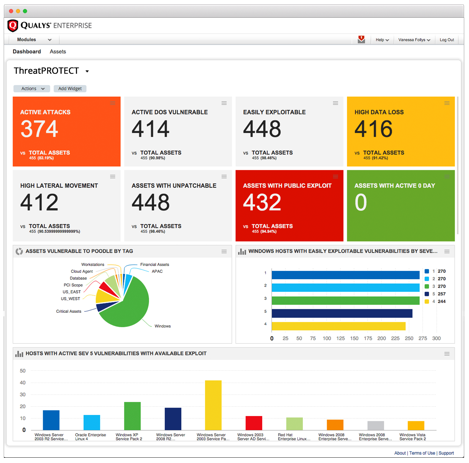
New service helps organizations visualize and prioritize security threats
Active vulnerabilities can present a serious threat to organizations, which is why many are turning to intelligence solutions to spot and manage security issues.
Cloud-based security and compliance specialist Qualys is announcing a new service as part of its Cloud Platform. Called Qualys ThreatPROTECT, it provides customers with an interactive dashboard to help them understand security threats at-a-glance.

Snapchat gets compromised, but user data should be safe
There's no small amount of controversy that swirls around Snapchat, as people swear it's used for all sorts of bad things. In truth, it probably isn't, people just send messages and images, most of which aren't the least controversial. But now the company has another problem, though this one doesn't involve anything lurid.
Instead it's actually the company's employees who were compromised and the service is attempting to apologize for this breach.

Tor Project says Google, CloudFlare and others are involved in dark web surveillance and disruption
With privacy concerns and the threat of surveillance from the likes of the NSA, more and more people are turning to the dark web and Tor. The anonymous, encrypted network has become a haven for not just illegal activity, but also for those who simply don’t want what they do online to be tracked and traced.
But now the Tor Project has voiced concerns that CDN and DDoS protection service CloudFlare is monitoring Tor traffic by introducing CAPTCHAs and cookies. CloudFlare is not alone: similar accusations are levelled at Google and Yahoo which are described as 'larger surveillance companies'. Concerns about interference with Tor traffic have been raised by project administrators in a ticket entitled "Issues with corporate censorship and mass surveillance".

Comodo Dome offers cloud-delivered security solution
Cloud and hybrid environments along with mobile access bring lots of challenges surrounding securing networks.
One way of addressing these is to provide security from the cloud which is what Comodo is doing with its new cloud delivered secure web platform, Comodo Dome.

IBM and Check Point team up to offer threat prevention
Cybercrime is big business, netting $445 billion in annual profits according to the United Nations. To combat it enterprises need to be able to detect risks and have the tools to prevent attacks.
Check Point Software and IBM Security have announced an expanded alliance which will allow the two companies to share threat intelligence, as well as a broad set of product integrations and expanded investment across IBM's consulting and managed security services.

Kaspersky declares war on Lazarus hacking group
Oooohhh, things are about to get really interesting in the cyber-security world. Kaspersky Lab has just declared war on the infamous hacking collective Lazarus Group, and it’s bringing its friends to the fight.
Together with Novetta and "other industry partners", Kaspersky Lab has announced the formation of Operation Blockbuster targeted at disrupting the activity of the Lazarus Group.

Microsoft stands with Apple against the FBI
Microsoft will join Apple against the FBI and U.S. Justice Department, filing a friend-of-court—or amicus—brief in a case going to court tomorrow. The government wants Apple to create a special version of iOS, referred to by critics as FBIOS, to break into an iPhone 5c security feature. The device manufacturer argues that compliance would set a precedent that would give law enforcement carte blanche with other mobile devices.
Brad Smith, Microsoft's chief legal counsel, says the company "wholeheartedly supports Apple"—a statement that eradicates any potential confusion caused by cofounder Bill Gates. In an interview with Financial Times two days ago, Gates supported the government's demands. I responded, calling his position a "catastrophic occurrence that demands current chief executive Satya Nadella's official response. There needs to be clear policy about government backdoors and the position with respect to the San Bernardino shooting iPhone". The company's position is now unequivocally clear—presuming the legal filing fits with "wholeheartedly".

GRE tunneling: Keeping human traffic unaffected during DDoS attacks
Picture a standard subway ride during rush hour. The car, of course, is crammed full. Some of those subway riders are pleasant commuters, and some are subway villains like pickpockets and purse-snatchers. Now imagine someone has invented a private subway that quickly and efficiently connects you and other pleasant commuters to the subway station in your neighborhood. You don’t have to deal with slowdowns, unexpected stops, or any of the risks associated with being lumped in with the aforementioned subway villains.
Now stop imagining, because someone has invented such a blissful sort of system. It’s just that instead of being a form of transportation it’s a method of directing legitimate human traffic to a website while it’s being protected from a DDoS attack. Not the best news for your commute, but great news for your website.

Ping Identity offers flexible real-time access for digital enterprises
Legacy identity management solutions can struggle to keep up with the current interconnected world where systems may be both local and in the cloud.
Security company Ping Identity is launching a new Federated Access Management product designed to offer lightweight, open and hyper-connected identity technology for the modern digital enterprise.

Baidu's browser leaks sensitive information
The browser provided by Baidu (China's answer to Google), leaks all kinds of personal data. Researchers at Canada’s Citizen Lab tested the browser and concluded it "collects and transmits a lot of personal user data back to Baidu servers that we believe goes far beyond what should be collected, and it does so either without encryption, or with easily decryptable encryption".
The Android version of the browser is even worse: "Data collected and transmitted in the Android version without any encryption includes a user’s GPS coordinates, search terms, and URLs visited. The user’s IMEI and nearby wireless networks are sent with easily decryptable encryption".

New platform offers endpoint protection for Linux servers
Most of the internet is powered by Linux servers, so it's not surprising that they’re increasingly a target for attack. In particular recent attacks have focussed on using compromised systems to distribute malware to other systems.
Many Linux systems rely on traditional signature-based threat detection which leaves them vulnerable to zero-day attacks. Endpoint security company SentinelOne is announcing a new solution aimed at protecting enterprise data centers and cloud providers from emerging threats that target Linux servers.

Netskope launches threat protection for enterprise cloud apps
Use of cloud apps, including unauthorised 'shadow' IT, is booming, but it leaves a gap in the protection provided by traditional perimeter security.
To plug this gap cloud access security broker Netskope is launching a threat protection solution for the cloud. Netskope Active Threat Protection combines threat intelligence, static and dynamic analysis, and machine-learning based anomaly detection to enable real-time detection, prioritized analysis, and handling of threats that may originate from cloud apps.