
Microsoft and Google (don’t really) want to tell you more about government data requests
Sounds nice, doesn't it? Two big names have listened to the concerns of the people that matter -- their customers -- in the wake of the NSA debacle, and want to share more information with the public about precisely what information the government is asking them to hand over. If only it were that simple.
In a blog post on TechNet, Microsoft General Counsel Brad Smith reveals that both Microsoft and Google filed lawsuits back in June to try to force the government to permit them to publish details of data requested under Foreign Intelligence Surveillance Act (FISA) orders. Smith says they [the two companies] believe they have a "clear right under the US Constitution to share more information with the public".

Facebook 'proposes' changes to the way it handles your data
Just a couple of days ago Facebook was in the headlines after being ordered to pay out $20m for putting user data to work in advertising campaigns. Now the site is proposing a set of changes to the documents that govern the way user data is handled as well as determining who has access to it.
At least some of the suggested changes come as a direct result of the court ruling including re-writing the Statement of Rights and Responsibilities. The new document includes a clearer explanation of the fact that in using Facebook users are granting permission for their name, profile picture and content to be used "in connection with ads or commercial content". It is good to see, however, that "when you limit your audience, we’ll respect that choice".

Facebook reveals details of government data requests from around the world
We’ve known for a while that governments around the world have been gathering data about Internet users, monitoring online communication via instant messaging, email and much more. Numerous websites and social networks have received requests from government bodies for information relating to their customers and users. Now, Facebook reveals for the first time just who has been asking for data.
The Global Government Request Report covers the first six months of 2013, and is introduced with the words "Transparency and trust are core values at Facebook". Although the report is not especially detailed -- it is likely that it was not legally possible to be -- it does show which countries have asked for data, the number of requests each country made, the number of user accounts inquired about, and (perhaps most interestingly) the percentage of requests that Facebook was legally obliged to comply with.

Internet Explorer is the latest browser to get the Adblock Plus treatment
It might come as a surprise, particularly if you are a Chrome, Opera or Firefox user, but Adblock Plus has not been available for Internet Explorer until now. Microsoft's web browser is the latest to gain the option to block advertisements. An experimental version of the plugin was released for IE a couple of months ago, but today sees the release of the official, final version.
The add-on has been a long time coming to Internet Explorer, and fans of the browser are likely to welcome it with open arms. If you've used the extension in other browsers, you'll have a good idea of what to expect -- although the name is something of a give-away.

Did Edward Snowden cause the shutdown of secure email service Lavabit?
Privacy has been a red hot topic for the past couple of months -- ever since the whole PRISM story hit the news, or shall I say slammed into the news. Nobody likely denies the government the right to attempt to keep citizens safe. In fact, we expect this from it. However the revelations made many uncomfortable thanks to the extremes that were being taken, and resulted in the conversation over whether Edward Snowden was a hero or enemy of the state.
Since the news broke, speculation about the form of communication used between Snowden and writer Glenn Greenwald of The Guardian has been running around the internet, but today those rumors came to an end when Greenwald tweeted this: "Amazing: Lavabit -- the email service used by Snowden -- shuts down rather than comply with US orders".

Twitter tracks your tweets so advertisers can monitor sale performance
Twitter teams up with Datalogix (DLX) in a new program that enables brands to track the impact that their tweets have on sales. Referred to as "offline sales impact", the program can be used to see just what effect promoted and regular, "organic" tweets have on the number of units shifted from shop shelves.
The precise process involved is not revealed, but the program sees Datalogix send Twitter a list of hashed email addresses which is then compared to a list of email addresses associated with Twitter accounts.

Could Twitter's verified accounts be the answer to stopping tweet threats?
We've talked about Twitter and the subject of policing the Internet quite a bit recently. It's not just us. Countless websites, newspapers, blogs and TV news channels have debated just what can be done to stop the problem of online abuse.
Part of the problem is that Twitter is -- as is the case with much of the Internet -- largely anonymous; or at least that's what most users think. They must think that, or they would not behave so stupidly and recklessly online. The reality is that, unless someone has taken measures to cover their tracks through proxy servers or other masking techniques, it's not really all that difficult to link an online message to, if not an individual person, at least an individual machine -- with the help of ISPs and other parties.

Keep control of the files you share with SmartRM
You’ve come up with an important business proposal, and want to share your ideas with someone else. You could just mail them a PDF document with the details, but if the deal falls through, there’s no way to control what happens to the file later.
Protect that document with the free SmartRM, though, and it’s a very different story. You can decide who opens it, when, how many times, whether they can print it, and more. And if there are problems, then you can restrict or block access in just a few seconds -- even after you’ve sent them the file.
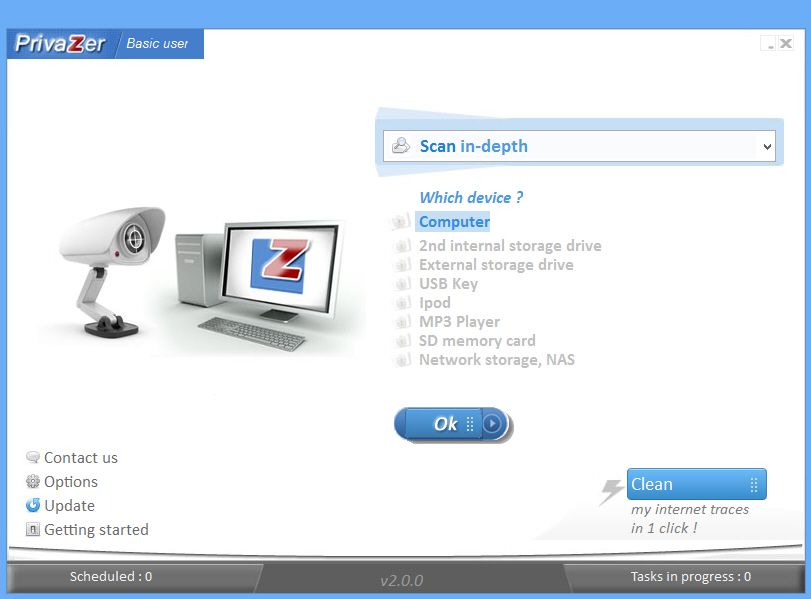
PrivaZer improves Chrome cleanup, extends browser support
Goversoft’s excellent privacy and system cleanup tool PrivaZer has today been updated to version 2.0.0, with a range of additions and improvements making it now more thorough than ever.
Enhanced Chrome cleanup sees the program now wipe the browser’s omnibox history, for instance, along with its stored passwords, download history and journals.

Government censorship -- no matter how well-intentioned -- can never be a good thing
My colleague Mark Wilson wrote an interesting article on Sunday about the futility of ISPs and governments trying to block pornography. If you’ve been following the news you’ll know the UK government intends to make accessing adult content on the internet "opt in". That's perfectly legal adult content by the way -- not just the nasty stuff.
Mark also worried about where such a move could lead, saying, "In filtering out porn, how could I be sure that whoever is doing the filtering is not also blocking access to other things, be it through a sense of morality, or by simply miscategorizing something?" Which, it turns out, could be truer than he knew.

On the futility of blocking porn and torrent websites, Immunicity style
Pornography has been in the news a great deal, and David Cameron's bid to make online porn "opt-in" has sparked a fierce debate in many quarters. The apparent aim of the proposed measure is to protect children and the responsibility has been moved squarely to the door of ISPs, just as with access to torrent sites. But is this fair?
The Internet is an important element of democracy. It should be a tool for free speech, free access to information and the ability to communicate worldwide free of charge. Freedom is at the heart of it. Creating a two-tier Internet in which some people are able to access all content, and others can only access a portion of it flies in the face of what the world wide web is all about. It is also dangerous.

Mozilla: Browsers could share your interests with websites
Your web browser records everything you do on the web. It knows where you go, it knows where you’ve been, what your favorite websites are, and it likely even knows your passwords. But fortunately it doesn’t share that information with the world. At least not yet.
Mozilla, the non-profit behind Firefox, is proposing to change that. The organization wants your browser to be able to tell websites the sort of things you’re into, allowing those sites to serve up personalized content tailored just for you.

Suck it up -- you're still going to get spied on after House votes for continued NSA surveillance
A move to close down NSA surveillance of US phone records bites the dust after a vote at the House of Representatives. The closely fought battle ended with a nail-bitingly tight vote that saw 217 votes against limiting the Agency's data collection abilities and 205 for.
Republican Justin Amash looked to end the indiscriminate collecting of phone records that was brought to light by whistleblower Edward Snowden. Rather than looking to simply stop the NSA's actions, the proposed amendment took a slightly different approach and aimed to block funding instead.

TCHunt can uncover hidden TrueCrypt volumes on your drives
TrueCrypt is an excellent encryption tool, a very good choice for anyone who wants to protect their most confidential files. If you use its ability to save your documents in hidden containers, though, it’s worth keeping in mind that these aren’t quite as secret as you might think: TCHunt, a free Windows tool, can identify (though not decrypt) them in just a few seconds.
The program comes in the form of a compact (244KB) executable, with no extras and no installation required; you can just download and run it.

Curious what the NSA gleans from your Gmail? Now you can see for yourself
Ever since Edward Snowden leaked what seems to be the mother lode of the decade, the internet has been fervently abuzz with speculation about Prism. The (aptly named) program was setup by the United States NSA (National Security Agency) to work hand in hand with internet giants to cull over mountains of data related to users of numerous services from Facebook to Gmail to Hotmail. Whether or not this information is accurately being used for its intended purpose -- thwarting terror attacks -- is still up for debate. But one thing we do know for sure is not only the type of data being plucked, but more importantly the overarching power this data yields.
It seems the crafty folks at MIT haven't been sitting back and watching this drama unfold. They've gone ahead and launched a representative cloud tool called Immersion that is very accurate in its portrayal of the inner workings of your entire digital life (or at least, the one contained to your Gmail account). National Journal's Brian Fung first covered this astonishing project, and it was since picked up similarly by eWeek.