
Three-quarters of Mac owners don't use anti-malware software
Early results from our "do you have anti-malware installed on your primary computer" polls are in, and there's some change from the ones conducted last May. More respondents on Mac and Windows use security software, but the split remains polarized: 75 percent of Mac users don't, while 90 percent of their Windows counterparts do. Welcome to the wonderful world of Apple denial. There are no pesticides to save this crop.
Responses are unusually low to both polls. I should know better asking anything over the Easter holiday weekend and start of Passover. I'm re-embedding the polls, hoping to jack up the numbers -- 315 for Mac and 358 for Windows, as I write. But the polarized results are consistent enough with the previous polls, when 86 percent of Windows PC users answered yes and 81 percent of Mac owners no. The difference between the polls is within reasonable margin of error, particularly considering respondents aren't qualified. Responses also could represent increased anti-malware usage in both camps.
Trend Micro DirectPass hardens your passwords
Trend Micro has launched DirectPass 1.0, an online password management tool for Windows. Trend Micro DirectPass, which also comes as a free app for iPhone and iPad and Android, includes online password manager, automatic form filling, secure notes taker and built-in secure browser for accessing sensitive websites securely.
Trend Micro DirectPass enters a crowded market, with established tools like Lastpass and KeePass being joined by the likes of Norton Identity Safe Beta. While Symantec’s offering is free, DirectPass will require an annual subscription for unlimited password storage.

Take your mouse out for a spin and Feel the Wheel
If you’ve ever thought Windows really should make better use of your mouse wheel, then Feel the Wheel will probably be of interest. It’s a tiny portable tool, and we do mean tiny, a 4.5KB download, which allows you to resize windows or tweak their transparency with the mouse wheel alone.
To give this a try, grab your copy of the download file, unzip it somewhere safe, double-click FeeWhee.exe and a high-pitched beep will tell you it’s loaded.
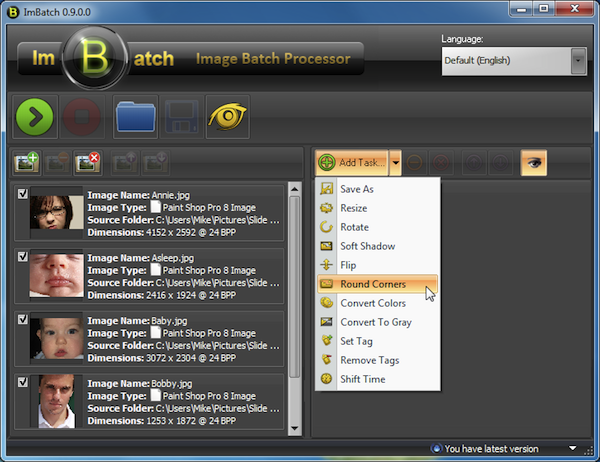
Got a heap load of images to process? Try ImBatch
When you need to convert, resize or otherwise process a set of images then of course you could work with them all individually. And that will probably deliver the best results as you can tailor your tweaks to whatever each image requires. But if you’ve not just 4 or 5 photos, but 20, 50, 100 or more than you may want to look for a little batch processing assistance from a tool like ImBatch.
Getting started is as easy as dragging and dropping your preferred images onto the program. ImBatch imports all the usual formats -- PNG, JPG, GIF, BMP and so on -- as well as many other file types which you might not expect (PSD, TGA, PCX, TIFF, WDP, HDP and more).

BASIC: Making a case for an old favorite
Are you looking for a way to increase productivity when it comes to your software development? Are you willing to try something different? How would you like to speed up software development, decrease time spent on software maintenance and improve the reliability of your software?
Many a long-time C programmer will likely tell you that C (or C++, C#) is the only serious programming language worth using today in business or the enterprise. To even suggest otherwise would likely make one a laughing stock by one's peers. Yet think about this for just a moment: Of all the software projects you or your company have undertaken, how many of them have come in over budget? How many have actually failed completely? How many, though finished, were plagued with bugs that never seem to get resolved? How easy has it been to maintain such projects, years after they were developed?

Do you use a smartphone or tablet and watch TV?
I occasionally do. My wife does every day, multiple times, either using her Samsung Galaxy S II Skyrocket or Amazon Kindle. "In the US, 88 percent of tablet owners and 86 percent of smartphone owners said they used their device while watching TV at least once during a 30-day period", Nielsen says today. That's me. "For 45 percent of tablet tapping Americans, using their device while watching TV was a daily event". That's my better half. What about you?
I do tend to use my smartphone more often than a tablet while watching TV, that's to Shazam music -- something I frequently do everywhere. I was a deejay in an earlier life and compulsively search for good music. I'm not alone. Shazam audio QR codes appeared in Super Bowl ads for Best Buy, Pepsi and Toyota, among others. I see more QR codes in ads and TV shows every day. They're everywhere, and in some surprising places.

Apple, two publishers resist ebook settlement
The Justice Department is nearing a settlement with publishers over allegations of ebook pricing, but finalizing the deal is proving problematic as Apple and two publishers are balking at the terms of the deal. Amazon will be permitted to once again discount ebooks to its customers as a result.
Penguin Group and Macmillian have joined Apple in resisting the settlement, the Wall Street Journal reports. The deal voids the contracts Apple signed with publishers in 2010, and permits a return to "wholesale pricing", where the retailer determines the price.

Sex offender? No online gaming for you!
The state of New York has pulled more than 3,500 registered sex offenders from various online gaming platforms, Attorney General Eric T. Schneiderman announced on Thursday. The initiative, supported in part by Microsoft, Apple, Blizzard Entertainment, Electronic Arts, Disney Interactive Media Group, Warner Brothers and Sony, is called "Operation: Game Over."
New York State's law requires convicted sex offenders to register all of their online identities with the state, be they email addresses, screen names, or whatever. "Operation: Game Over," however, is the first time the New York law has been applied to online video games.
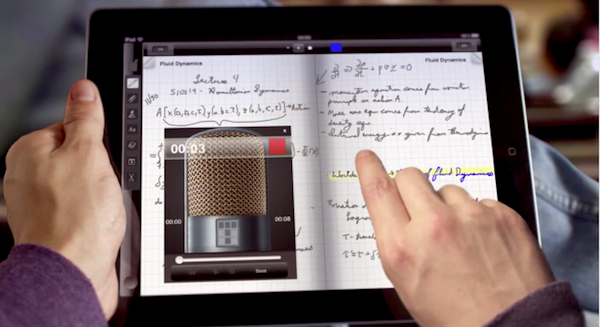
Taposé gives iPad split personality
Much has been made of Taposé in recent days, with a great detail of attention being focused on the new iPad app being based on the failed Microsoft Courier project. But it is important to look at this as a piece of software in its own right.
Taken at face value, this is an app that could easily been seen as trying to be all things to all people, but the simple fact: it is a fully-featured tool. Packing notes, maps, word processor, web browser, drawing tools and much more, this is an app that can turn its hand to many tasks.
When your PC monitoring apps are up to no good, there's Bad Application
There are plenty of PC monitoring programs that aim to keep an eye on your running processes, and carry out some actions if things seem to be going wrong (PC Lasso is an excellent example). Testing these tools can be a problem, though, as you can’t safely make regular programs hang or lock up on demand.
But then that’s where Bad Application comes in.

5 ways my small business benefits from the cloud
We have talked a lot about cloud computing recently here on the pages of BetaNews. That's not surprising since it is one of the fastest growing segments of the tech industry today. Missing, however: A more personal story on how we're using the cloud in our day-to-day business.
I run a small freelance writing and media consulting business out of my home, Oz Media Inc. While being my own boss is fun, it also requires me to be owner, CEO, CFO, IT administrator, and employee. It's a company of one. Cloud computing has definitely paid off and made running my business a lot easier, and here's why.

Are you a Mac zombie?
Sometimes when dealing with the so-called Mac faithful -- diehard users who relentlessly demean and attack anyone (reporters, particularly) who doesn't share their unquestioning enthusiasm -- I think of the "Walking Dead"; TV show or comic, it's your choice. Nothing stops their relentless, mindless walk. As if there weren't zombies enough, cybercriminals have unleashed another kind that is much worse.
Late last week, I started following progress of a new Trojan injected via rogue Java applet. Flashback is a variant of older malware and Apple issued a patch, so I chose not to write about it. Whoa, that was a mistake. Yesterday, Russian security firm Dr. Web claimed that more than 600,000 Macs are infected and part of a sophisticated botnet. Cybercriminals have amassed a sizable army of zombie Macs. Let me take a moment to welcome Mac users to zombieland -- a place many Windows users have lived for years.

PhotoBox! comes to Android, the 'Lightroom for Facebook'
Mobile app developer WeaverMobile USA announced on Thursday that its formerly iOS-exclusive photography management app PhotoBox! has launched on Android.
The application can be thought of as "Lightroom for Facebook," giving users the ability to find, manage, add effects to, and share photos posted to Facebook, as well as perform batch uploads and downloads, to tag/untag, like/unlike, and comment. It provides a pretty robust toolkit for editing photos, adding filters, drawing, and adding text.
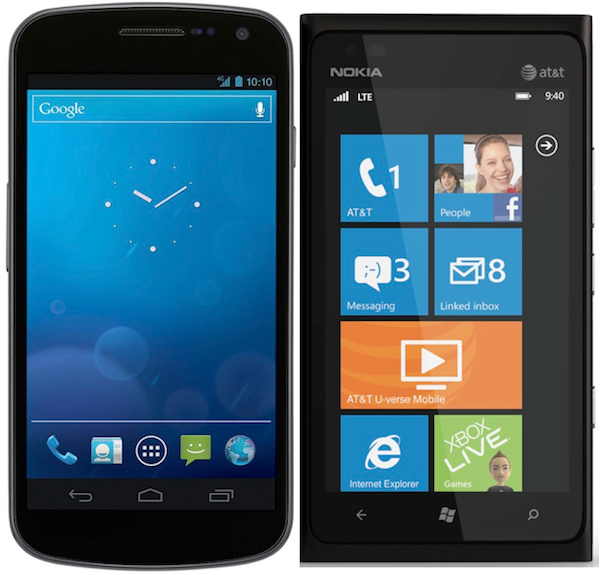
Samsung Galaxy Nexus and Nokia Lumia 900 is a fair comparison
Discussion Counterpoint. Colleague Tim Conneally and I got into a heated debate about smartphone comparisons this morning. He has the Nokia Lumia 900 Windows Phone for review (and I -- whaaaaa -- don't). I suggested Tim do a comparison with Google-branded Galaxy Nexus, which we both have. He refused. Tim was quite adamant about it, too. His out-and-out refusal clearly taps into strong feelings about how products are compared.
We bantered back and forth over group chat, with neither of our positions changing. "Buyers make these product comparisons all the time", I expressed late in our debate. "I can see we won't agree. If I had the Lumia 900, I would compare them". But I don't, and Tim won't. So I suggested: "Let's ask the readers...something like: 'Would you like the Samsung Galaxy Nexus and Nokia Lumia 900 compared?'"

Stop comparing unlike objects. RIGHT. NOW.
Discussion Point. Joe Wilcox asked me to write an article comparing the Nokia Lumia 900 to the Samsung Galaxy Nexus. I refused. Here is why. Read Joe's response.
Anyone who knows about marketing should readily understand market segmentation: it is a way of isolating customers/users/consumers by type. It could be geographically, it could be demographically, it could be psychographically, or it could be through some other defining characteristic.