
How AI can help enterprises stay on top of data governance [Q&A]
Security breaches and privacy violations can cost businesses dearly. not only in financial penalties but also by causing damage to their reputation.
Keeping tabs on your data and how it's used is an essential part of staying in control and it's an area where AI can help. We spoke to Amar Kanagaraj, founder and CEO of AI-powered data protection and data governance specialist oneDPO to find out more.

Database-as-a-Service use increases but some businesses face unexpected bills
The share of companies using Database-as-a-Service (DBaaS) has increased to 45 percent, compared to 40 percent last year, according to a new survey.
The study from open source database company Percona finds more than half (56 percent) of large companies use DBaaS. In line with the trend of companies looking to mitigate their risk, around half use more than one DBaaS service.

Delivering stronger security for enterprise data [Q&A]
Data is among an enterprise's most valuable assets, no matter where or how it's stored, having visibility and unified access control is essential.
Mohit Tiwari, CEO at Data Store and Object Security (DSOS) company Symmetry Systems, left a professorship at the University of Texas in Austin to start the business and develop a new approach to data security in the form of Symmetry DataGuard which maintains authority over data even when all else fails. We spoke to him to find out more.

IT leaders are unhappy with their data management and data warehousing solutions
New research published today by intelligent integration platform SnapLogic reveals that 83 percent of organizations are not fully satisfied with the performance and output of their data management and data warehousing initiatives.
The study carried out by independent research firm Vanson Bourne, finds that the average organization has 115 distinct applications and data sources across their enterprise, but almost half of them (49 percent) are siloed and disconnected from one another.

Silicon Power PC60 USB-C SSD [Review]
Backing up data is an essential part of computing responsibility. Just like regularly changing your car's oil, you should regularly back up your computer's files. The sad reality is, many people don't think about their important files until they are lost forever. How sad would it be if you lost your entire music library, your work projects, or worst of all, your family photos?
Nowadays, the cloud makes data backup easy, but you should not trust that solution exclusively. What if there is a situation where you don't have internet access, or even worse, the cloud provider goes out of business? You should also backup your files locally -- redundancy is key. Depending on how much data you have, a portable solid state drive often makes a lot of sense, as they offer very fast speeds and no moving parts. Not only does an external drive allow you to move data between multiple computers, but you can easily lock it in a safe or fireproof box if needed.

Building a data-driven culture with a data analysis framework
Creating a data-centric culture in your business requires a shift in mindset that won’t happen overnight. However, it is a goal that becomes more attainable the more it is driven by your people working towards it with passion and enthusiasm -- as opposed to something dictated to them from the top.
There are a mix of factors that can cause barriers that hamper the successful development of a data-driven culture. At the base level, the technology and infrastructure choices a company makes, and what it provides its employees to work with, can be majorly prohibitive to a healthy data culture if that technology doesn’t support people in how they do their job.

New solution helps enterprises handle sensitive data
When looking at adopting a SaaS solution a big concern for enterprises is the risk involved in sending data out to be managed, stored, processed, and analyzed by a third party.
Code analysis and debugging specialist Rookout is launching Data On-Prem, a solution which gives large enterprises the ability to quickly solve complex problems involving sensitive data.

New platform helps prevent data loss when employees leave
Around a third of employees take data with them when they leave a business according to email security firm Tessian.
In order to help companies understand and tackle the risks it's launching a new Human Layer Security (HLS) Intelligence platform to provide businesses with deeper insights into human layer security threats and the tools required to trend down the risk of accidental data loss, data exfiltration and advanced impersonation phishing attacks.

Data analysts spend only half their time analyzing data
During the course of a typical workday, data analysts only spend half their time actually analyzing data according to a new study.
Conducted by Dimensional Research for Fivetran, the online survey of around 500 data professionals across five continents also shows 68 percent of the analysts who responded say they have ideas that would drive more profit for their organizations, but they lack time to implement them.

NPD found a surge in mobile data usage in March
Mobile data usage has been on the rise for a while, as networks get better and faster and more people get mobile phones. Of course, with many people home right now phones are likely being used more than ever.
NPD, a market research firm that monitors these things, found a surge in usage in March, which coincides with the pandemic and people being forced to work from home.

How mobile data costs compare around the world
If you have a monthly mobile phone plan you may not think too much about the price you pay for mobile data. However, comparison site cable.co.uk has been looking at mobile data costs around the world with some surprising results.
The United States is one of the most expensive developed nations for purchasing mobile data, coming in 188th in the world, with an average 1GB cost of $8.00 -- well above the global average of $5.09.
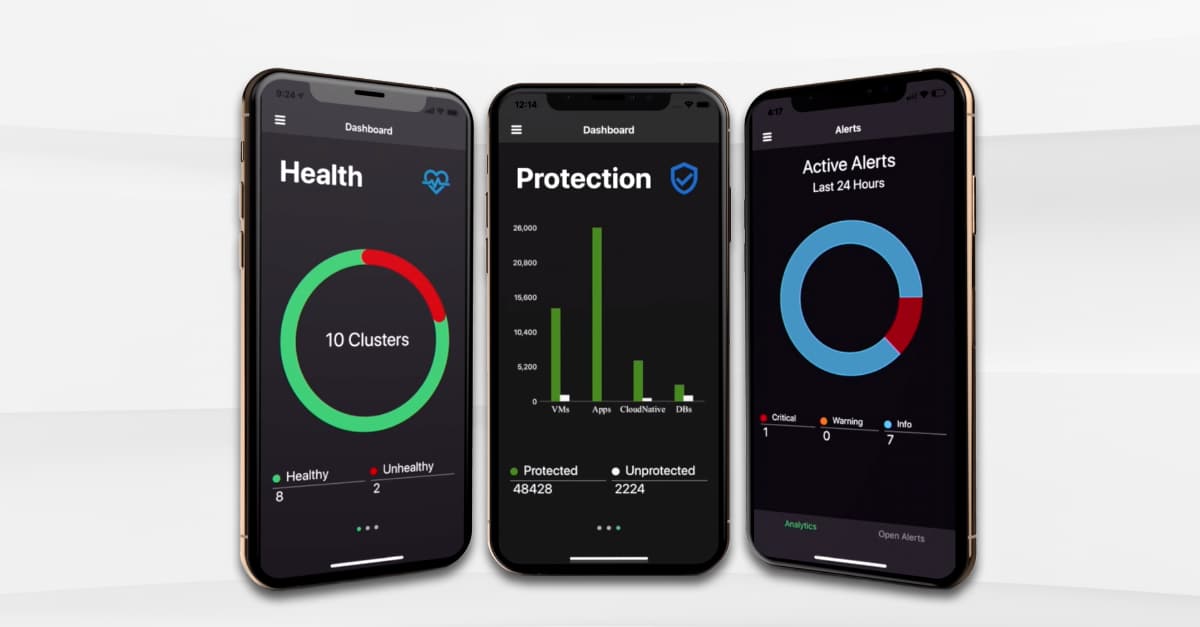
Cohesity launches mobile app for its enterprise data management platform
Data management company Cohesity's platform allows enterprises to manage all of their data functions -- backups, archives, file shares, object stores, and data used for dev/test and analytics -- on a single platform.
It's now adding to its offering with the launch of a Helios mobile app which allows IT staff to monitor the health and performance of their Cohesity infrastructure, easily manage support cases, and get alerts about anomalies, including potential ransomware attacks to their production environment, while on the go.

ADATA IM2S3314 is an industrial-grade M.2 2242 SATA SSD
Solid state drives are great for home consumers and PC enthusiasts, but that is not the extent of their usefulness. Actually, the improved performance of SSDs over mechanical hard disk drives is beneficial for business use too. In particular, industrial applications can benefit from the fact that SSDs have no moving parts, making them less likely to fail from hardcore vibration or excessive jostling.
Today, ADATA launches an all-new industrial-grade SSD. Called "IM2S3314," it uses the diminutive M.2 2242 form factor and the SATA 3 interface. The drive can be had in several capacities ranging from 16GB to 256GB, with two memory types -- MLC (multi-level cell) and A+ SLC (single-level cell). But wait, what is this "A+" variant of SLC? ADATA explains that its proprietary A+ SLC technology, "utilizes custom NAND Flash firmware with an A+ sorting algorithm to emulate SLC performance." And now you know!

GigaSpaces helps enterprises boost speed, scale and availability of systems during the COVID-19 crisis
The restrictions imposed as a result of the COVID-19 pandemic mean that enterprises are more reliant than ever on online transactions.
To help businesses improve their systems speed, scale and availability GigaSpaces, provider of the InsightEdge in-memory real-time analytics processing platform, has announced that it's offering a free Go-Live professional services package.

Employees reluctant to adopt data-driven working methods
New research commissioned by analytics database Exasol finds that 63 percent of UK data decision makers experience resistance from employees in adopting data-driven methods.
Key drivers of this resistance are anxiety over job redundancy if all decisions are based on data (39 percent), a lack of understanding (39 percent), and a lack of education on the positive impact data can have (36 percent).