
10 million US Facebook users saw divisive ads bought by Russia
It's no secret that Russia tried to influence the outcome of the US election last year using a variety of techniques including the use of advertising on Facebook. The social network recently said that it would share details of these ads with Congress, but would not be making them public.
But while the company is not making the ads themselves available for all to see, it has revealed some more details about them -- including the fact that they were seen by an estimated 10 million people in the US. Facebook also says that 44 percent of more than 3,000 Russian-placed ads were seen prior to the election.
Google changes its approach to news subscriptions, scraps First Click Free policy
Google has announced changes to the requirements it places on websites that provide news on a subscription basis. With a large number of news sites locking content away behind a paywall, Google had required publishers to provide people with access to three free articles per day or face demotion in search results.
Scrapping what was known as the First Click Free Policy, Google is dropping any such requirement to provide free access to content. A new approach -- Flexible Sampling -- lets publishers decide how many, if any, free articles they provide.

Mozilla updates Firefox Privacy Notice with greater detail, transparency and prominence
Mozilla has announced an update to Firefox's Privacy Notice which aims to better inform users about what data is collected and why.
As well as making its privacy policies more understandable, Mozilla is also trying to ensure that more people actually see them. For new installations, the Privacy Notice is automatically displayed in a tab. But it's the layout and accessibility of the updated document that's the real change.
Internet Explorer users beware: the address bar is leaking everything you type
A bug has been uncovered in Internet Explorer which makes it possible for websites to view anything that is typed in to the address bar. This means that web addresses and search terms could be accessed by a hacker or malicious website.
The vulnerability was discovered in the very latest version of Internet Explorer, and Microsoft is yet to release a patch for it. Discovered by security researcher Manuel Caballero, the attack can be made completely invisible to a victim.
Apple now collects data from Safari using differential privacy to identify problem websites
With the launch of macOS High Sierra, Apple is making some changes to Safari. One of the key changes is the introduction of differential privacy technology which gathers data about the websites users visit in order to identify those that are problematic because of high memory usage or crashes.
As the name of the technology implies, as well as gathering useful data from users, one of the key features of differential privacy is that it respects the privacy of individuals. The AI-powered technology keeps, according to Apple's Craig Federighi, "the information of each individual user completely private" while still collecting data that will enable Apple to decide the priority with which it should tackle problematic sites.

Facebook overhauls rules governing political ads
As well as handing over Russian ads to Congress to allow for investigation into election interference, Facebook is also overhauling its rules for political ads. Dmitry Peskov, a spokesman for the Kremlin, claims that: "We do not know how to place an advert on Facebook. We have never done this, and the Russian side has never been involved in it" -- but there is still a firm belief that Russia tried to influence the outcome of the election.
In a bid to prevent this from happening in the future, Facebook has announced a series of updates to its policies governing political advertising. Part of the changes are increases in transparency, making it possible for people to see what ads are being run by advertisers, and how they are being targeted.

Adblock Plus releases cryptocurrency miner hijack protection filter
Cryptocurrencies have been in the news a lot recently as the price of Bitcoin and Ethereum bounces up and down. But cryptocurrency miners have also been in the headlines after it was discovered that the Pirate Bay had secretly embedded a miner in its code, and then that the SafeBrowse extension for Chrome was also mining in the background.
To help protect users who do not want their computers to be used for such things without their permission and who don't want to give up CPU cycles to generate profit for others, Adblock Plus has released a filter that will block hijacks by cryptocurrency miners. It works with Chrome, Safari, Firefox and Android.
Microsoft joins the Coalition for Better Ads
Microsoft has become the latest member of the Coalition for Better Ads (CBA). The group works with technology companies and trade organizations to help develop an ad ecosystem that works for advertisers without compromising the experience of internet users.
In taking up membership of the CBA, Microsoft is joining Google who has already worked with the organization to develop a selective ad blocker for Chrome due for release next year. Microsoft is also looking to introduce ad blocking into Edge, but the blocker would only discriminate against ads deemed unacceptable by the CBA.

SafeBrowse Chrome extension found to be secretly mining for cryptocurrency
Recently it was discovered that the Pirate Bay had embedded a JavaScript cryptocurrency miner into the footer of its homepage, and now a popular Chrome extension has been found engaging in similar activity.
The SafeBrowse extension purports to block popup ads and skip ad pages that appear before downloads, but in fact it was secretly running a Coin Hive mining tool in the background. With over 140,000 users, SafeBrowse -- which has now been removed from the Chrome Web Store -- was quietly making an income for its developers through clandestine use of CPU time.

Theresa May wants tech firms to remove 'extremist content' faster… but it's not quite that simple
UK prime minister Theresa May has called on the likes of Microsoft, Google, Twitter and Facebook to act faster to remove terrorism-related and extremist content. At the moment, it takes an average of 36 hours to remove content shared by the likes of Isis, and May wants this slashed to just two hours.
But even this is not enough for the government. It wants technologies to be developed -- or refined -- that will identify this sort of content and prevent it from getting online in the first place. Facebook agrees -- its love of AI is well-known -- but the solution to online extremism is not as simple as saying "technology firms need to do more."

EFF resigns from W3C in protest against Encrypted Media Extensions DRM standard
Digital rights group the Electronic Frontier Foundation (EFF) has resigned from the World Wide Web Consortium (W3C) because of a move to standardize the Encrypted Media Extension (EME) API for controlling DRM in web browsers.
The EFF is far from being the only group to be unhappy with the W3C for the decision to standardize EME, but this is the first -- and possibly only -- one to have gone as far as resigning as well as filing objections. The group says that it proposed compromises that were ignored, and the opposition of EFF and other W3C members were simply overruled.
Microsoft confirms Outlook.com is down for some people
If you are having trouble accessing Outlook.com at the moment, you're not alone. Many people -- particularly in Europe -- are experiencing problems with Microsoft's email service.
Microsoft has confirmed that there is an issue with "load-balancing infrastructure," and investigations are underway to discover the source of the problem. Users affected by the problem say that the messages they try to send remain in the Draft folder rather than reaching the intended recipient.
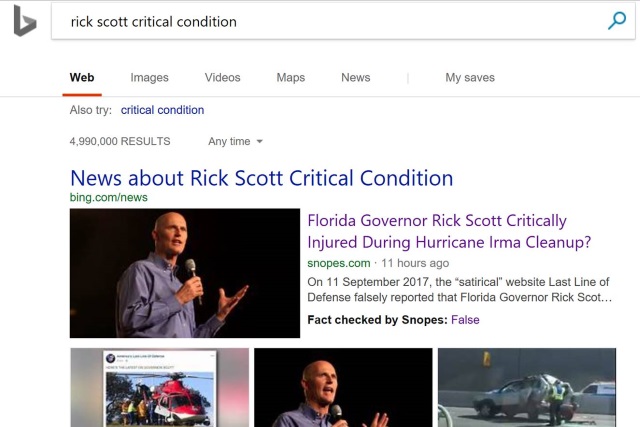
Microsoft enters the fight against fake news as Bing gains Fact Check label
The "fake news" moniker may be a relatively recent one, but the phenomenon is not exactly new. Search engines and social media sites have long fought a battle against rogue news sources, and Microsoft's latest attack sees the company adding fact-checking to Bing.
The addition of Fact Check labels means that anyone looking at search results should be able to tell at a glance if a particular news story has been debunked. The label can be applied to sites as a whole as well as individual articles, making it easier for Microsoft to alert people about poor news sources -- although the company does not do any actual fact-checking itself.
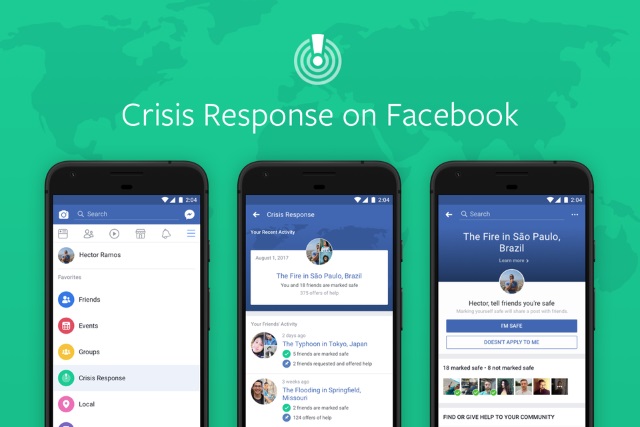
Facebook launches Crisis Response, a portal to find out about crises around the world
Facebook has today launched Crisis Response, a central hub that provides access to its various crisis response tools such as Safety Check. Over the years, the social network has gradually added more and more tools that serve to help those caught up in a disaster, and those who know them, and the new center pulls all of these into one place.
As well as serving as a central hub, Crisis Response on Facebook is also being bolstered by links to articles and videos posted on the site so users can be kept better informed about a given crisis.

Researcher finds 'serious' security flaws on HMRC's UK tax site
A security researcher discovered two serious flaws on the HMRC tax website which could have allowed attackers to view, or even edit, tax records. But the researcher, Zemnmez, was astonished not only by the flaws, but also at how hard it was to report them.
In a lengthy blog post entitled "how to hack the uk tax system, i guess," Zemnmez gives details of his findings. He also reveals that it took no fewer than 57 days to successfully report the issues so they could be looked into.