
Erin Andrews gets $55 million for peephole video that will never go away
What happens in Vegas may stay in Vegas, but what happens online is yours forever. Things posted don't simply go away -- a problem many of today's youth will face in the future. However, it's also a problem people have to come to terms with right now, even when it's not online intentionally.
That's the case with sportscaster Erin Andrews, who was videotaped naked in her hotel room through the peephole of the room's door. Yes, it made for huge views and sensational news, but it also damaged a human being.

Verizon will have to pay $1.35m fine over 'supercookie' tracking
The Federal Communications Commission (FCC) has announced that it has found Verizon Wireless to have deliberately violated the privacy of its users.
Verizon Wireless is the largest US carrier with over 100m subscribers, but failed to disclose the practice of using supercookies in order to violate their users privacy from late 2012 until 2014, violating a 2010 FCC regulation on Internet transparency.

Online gamers hit by sexist, racist and homophobic abuse
Nearly a third of gamers say they have been harassed while playing online, figures from a survey by Broadband Genie show. 31 percent of players found themselves on the receiving end of abuse, and 13 percent of respondents said they don’t always feel safe in online games. While it's possible to dismiss some of the harassment as banter (bantz, if you will) this is not true in every instance.
Two thirds of gamers thought abusive comments could be classed as little more than banter, but the prevalence of racist, sexist and homophobic -- as illustrated by the ongoing Gamergate controversy -- serves as a warning not only for gamers, but for the parents of children let loose online. Some harassment is limited to within games, but in five percent of cases, victims said the abuse continued on social media and forums.

Consumers do not trust websites with new domains
According to a new study from global cyber security and risk mitigation firm NCC Group, over half of consumers (52 percent, up three percent from last year) do not feel comfortable visiting websites ending in new domains.
In fact, just two per cent of the 10,000 consumers surveyed in the Trust in the Internet Study 2016 said they feel extremely comfortable visiting the new generic top-level domains (gTLDs).

Google kills Project Fi invites and discounts Nexus 5X -- service now open to anyone in USA
Many consumers have a love/hate relationship with their cell providers. On the one hand, these companies provide us with our much-needed data -- allowing us to access the Internet from almost anywhere. On the other hand, where the hate comes in, is high prices and data caps. By limiting data, these companies are arguably impeding technological progress -- users shouldn't have to be mindful of data usage.
It is for this reason that Project Fi has been a godsend for some. Google's cellular service -- piggybacked off of Wi-Fi, T-Mobile, and Sprint -- offers affordable tiered data plans. The big catch, unfortunately, was the invite system. You see, you had to have a special invite to sign up, meaning many of those that wanted to, simply couldn't. Today, this changes as Google kills Project Fi invites, making it available to anyone in the United States. I am very happy to say 'RIP' to the invite system!

Big Brother's crystal ball: China developing software to monitor citizens and predict terrorist activity
We've become used to the idea of online surveillance thanks to Edward Snowden blowing the lid off the activities of the NSA and GCHQ. While it's easy and natural to bemoan the infringement of privacy such surveillance entails, no one ensures as limited and controlled an internet as the Chinese.
There's the famous Great Firewall of China for starters, and as part of a counter-terrorism program the country also passed a law requiring tech companies to provide access to encryption keys. Now the Communist Party has ordered one of its defense contractors to develop software that uses big data to predict terrorist activity.

One in five Brits blocks ads
An increasing aversion to online ads amongst British adults is posing a threat to online publishers, new figures show.
The latest figures from IAB in conjunction with YouGov reveal that more than one in five British adults, or 22 percent, are now using ad-blockers, representing a four percent rise compared to previous results in October 2015.

The 'free ride' of BBC iPlayer viewing is over as license fee loophole is to be closed
Watch TV in the UK -- be it through an aerial, cable, or satellite -- and you have to pay for a TV license. The official line is that you need a TV license "if you watch or record programmes as they're being shown on TV or live on an online TV service" and this has long-meant that anyone time-shifting their viewing by watching shows on BBC iPlayer have been able to do so for free. This is set to change.
Having waxed lyrical about the threat of adblockers to the web, UK culture secretary John Whittingdale turned his attention to the BBC's streaming services. He plans to close a loophole that has permitted people without a TV license to watch non-live shows on iPlayer without paying a fee and -- more importantly -- without breaking the law. He says that this is 'wrong' and wants to bring the 'free ride' to an end.

Malvertising campaigns now use fingerprinting techniques
Cyber-criminals are now using fingerprinting techniques in their malvertising campaigns, researchers from security firms Malwarebytes and GeoEdge have reported.
Fingerprinting is an evasion technique in which crooks, through snippets of code, check if the targeted machine is a honeypot set up by malware researchers or an actual machine belonging to a potential victim.

Kiddle lets children search the web 'safely', leaves the sex talk to mom and dad
Parents with younger children may well be concerned about the type of content their offspring could stumble across online. While it is possible to enable the Safe Search feature of Google, this is not 100 percent reliable, and more adult content can slip through the net. A new 'visual search engine for kids', Kiddle, launched this week to plug the gap.
Although nothing to do with Google, Kiddle apes the colorful logo of the famous search giant, and also relies on Google Safe Search for some of its results. The bulk of the first ten results returned by any search, however, are handpicked by editors to ensure they are safe for children and easy to read. There are also some automatic filters in place that prevent searches for 'bad words' and the like and, interestingly, treat searched for homosexuality and heterosexuality in completely different ways.

Most consumers don't like to be tracked, but few are doing something about it
Most users know their online activity is being tracked. They’re not OK with it, yet most of them do nothing about it. Those are the general conclusions of a new quiz entitled Are you cyber savvy?, made by Kaspersky Lab.
The security firm says consumers don’t know how to protect their privacy online.

Documents reveal details of EU-US Privacy Shield data sharing deal
Details of the data sharing arrangements agreed between the US and EU earlier in the month have been revealed in newly published documents. The EU-US Privacy Shield transatlantic data transfer agreement is set to replace the Safe Harbor that had previously been in place.
The European Commission has released the full legal texts that will form the backbone of the data transfer framework. One of the aims is to "restore trust in transatlantic data flows since the 2013 surveillance revelations", and while privacy groups still take issue with the mechanism that will be in place, the agreement is widely expecting to be ratified by members of the EU.

Tor Project says Google, CloudFlare and others are involved in dark web surveillance and disruption
With privacy concerns and the threat of surveillance from the likes of the NSA, more and more people are turning to the dark web and Tor. The anonymous, encrypted network has become a haven for not just illegal activity, but also for those who simply don’t want what they do online to be tracked and traced.
But now the Tor Project has voiced concerns that CDN and DDoS protection service CloudFlare is monitoring Tor traffic by introducing CAPTCHAs and cookies. CloudFlare is not alone: similar accusations are levelled at Google and Yahoo which are described as 'larger surveillance companies'. Concerns about interference with Tor traffic have been raised by project administrators in a ticket entitled "Issues with corporate censorship and mass surveillance".

Passive Wi-Fi promises major energy savings for mobile and Internet of Things devices
Researchers at the University of Washington have found a way to lower the power consumption of Wi-Fi significantly. They have dubbed the new form of low power wireless internet "passive W-Fi". It could be harnessed to power IoT devices or to help improve battery life in mobile phones.
Passive Wi-Fi will require just 59 microwatts to transmit data between devices which is 10,000 times less than the power used by traditional Wi-Fi chips in personal computers and mobile phones.
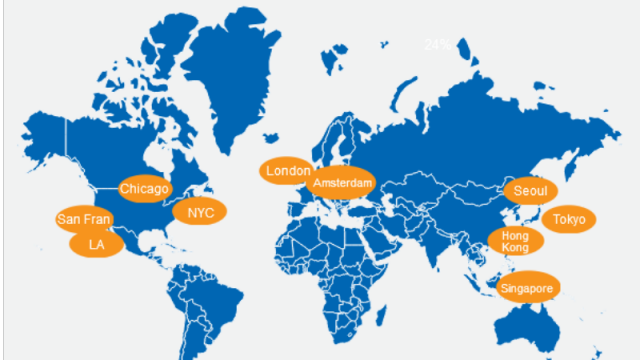
Major cities to become 'smart' by 2020
Within the next four years, a bunch of cities around the world will be transformed into smart cities, technology research firm IHS Technology suggests.
By becoming smart, they will offer operators $25 billion (£17.96bn) in opportunities.