
ChatGPT Atlas ranks as the least private browser in new study


A new report on browser privacy places OpenAI's new ChatGPT Atlas squarely at the bottom of its rankings, citing weak protection against tracking, poor link security, and almost no effective data blocking. The study, conducted by software provider Digitain, reviewed 13 browsers and scored them across multiple privacy categories.
The report notes that the AI browser failed every state partitioning test, which means websites can track users across separate browsing sessions. Chrome also performed poorly, while more privacy focused browsers like Brave and Mullvad took the top spots.
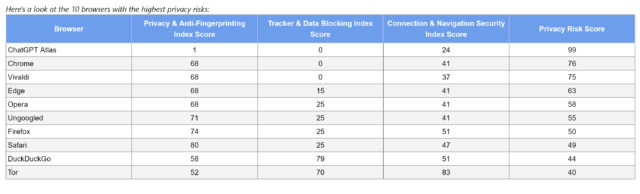
Researchers tested how well each browser prevents fingerprinting, blocks trackers, and protects users while they move between websites. Each category received a score, and those results combined into a final "Privacy Risk Score" from 1 to 99. Higher scores indicate weaker privacy protection.
ChatGPT Atlas' privacy woes
ChatGPT Atlas received the highest Privacy Risk Score at 99. It received just 1 point -- out of 100! -- for anti fingerprinting and 0 points for tracker blocking. The browser allows websites to collect data through cookies, query strings, and other tracking methods with no built in defense. It also managed just 24 points for connection and navigation security, placing it far behind more established browsers.
Google's Chrome followed with a Privacy Risk Score of 76. It scored 68 points for reducing fingerprinting but like ChatGPT Atlas recorded 0 in tracker blocking. The report says that Chrome allows companies to monitor browsing activity across the web through tracking cookies and other markers. The browser managed 41 points for connection security.
Vivaldi came next among the least private browsers. It matched Chrome’s 68 point anti fingerprinting score and also received 0 points for tracker blocking. Its connection security score came in at 37 points, placing it slightly below Google's browser.
Microsoft Edge was fourth. It received 68 points for anti fingerprinting and 15 points for tracker blocking. Edge matched Chrome’s 41 point connection security score, but the study still found the browser provides limited privacy safeguards for users.
Opera rounded out the top five. It received 68 points for anti fingerprinting and 41 points for connection security. It performed somewhat better in tracker blocking with a score of 25 but still ranked among those browsers with higher overall privacy risk.
“New AI powered browsers like ChatGPT Atlas and Comet from Perplexity are getting a lot of attention right now, and millions of people are trying them out because of the AI hype," said Paruyr Harutyunyan, group head of digital marketing at Digitain. "These browsers come with interesting features that traditional ones don't have, but users need to stop and check how secure they actually are. AI works by collecting and learning from data, which means these tools might be gathering more of your personal information than you realize. Just because something uses AI doesn't automatically make it safe or private.”
What do you think about these browser privacy findings? Let us know in the comments.
Image Credit: tweek/DepositPhotos



