
Someone built a floppy disk TV remote control for kids and it actually works

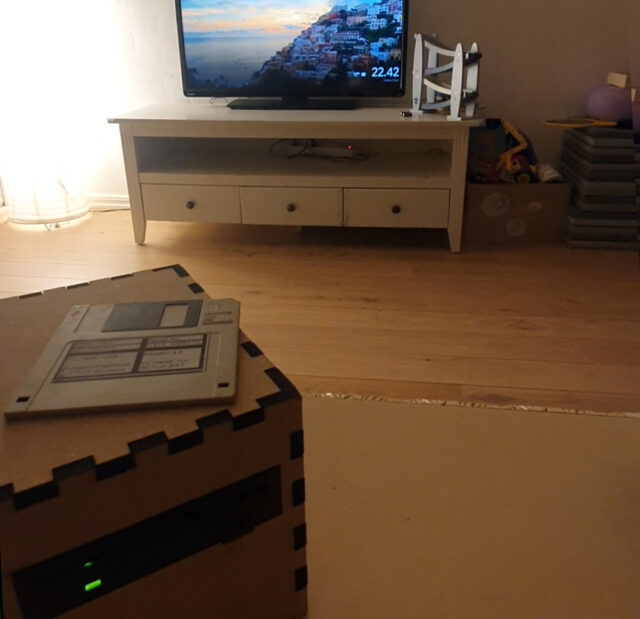
A Danish hobbyist developer has built a floppy disk based TV remote designed to let young children control what they watch without having to worry about navigating apps or complex menus. The project replaces modern remotes with physical media, giving kids more independence while limiting autoplay and algorithm driven distractions.
The idea grew out of frustration with how current smart TVs behave in a household with children. Menus are layered, remotes are crowded with buttons, and streaming apps constantly push new content.
SEE ALSO: What if cloud data was stored on floppy disks?
Mads Christian Olesen wanted an interface that his three year old son could understand and use alone. It needed to be tangible, durable, and simple, with a clear link between a physical object and a single piece of media.
Olesen's unexpected solution was the floppy disk. He liked how the sound and motion of inserting a disk, the brief spin up, and the mechanical noise of reading data all reinforce the idea that something real is happening.
Floppy disk remote
Early experiments with embedding RFID tags inside floppy shells failed and were abandoned. Opening and resealing disks also proved awkward and impractical.
The breakthrough came from using the floppy itself as storage with a single tiny script file that triggers a specific action. All data sits on the first track and can be read almost instantly.
Insert one disk and a single video plays, then stops. There’s no autoplay and no endless queue.
Instead of hiding content in the cloud, each disk represents a choice that can be handled, lost, or damaged. That physicality was intentional, including the idea that breaking a disk has consequences.
Detecting when a disk is inserted turned out to be harder than expected. Most floppy drives don’t reliably signal disk changes, so the drive was modified with a simple mechanical switch that triggers when media is inserted.
Reading the disk is handled by an ATmega microcontroller using an existing floppy controller library. Wi-Fi communication is managed by a separate ESP based chip, connected over serial.
The split design was necessary because the precise timing required to read floppy disks isn’t compatible with ESP based boards. A combined ATmega and ESP board was used, although Olesen describes it as awkward to work with.
Power comes from 18650 lithium-ion batteries, which introduced yet another challenge. Floppy drives draw large current spikes when spinning up, enough to reset the microcontroller.
A boost converter was added to reach the required voltage, along with large capacitors and careful isolation of ground connections. Stability only arrived after setting unused pins to high impedance.
Once powered, the system follows a simple flow. Insert a disk and playback starts. Remove it and playback pauses. Some disks trigger playlists or sequential episodes, but only one step at a time.
The enclosure is a laser cut MDF box, keeping the build straightforward and repairable. On the server side, simple scripts translate disk events into commands for a Chromecast.
In testing, Olesen’s young son understood the concept quickly. Pausing, resuming, and choosing content became a game rather than a struggle.
Some disks were damaged, which exposed another issue. Leaving the read head on track zero caused wear, so the system now parks the head elsewhere after reading.
The result obviously isn’t polished consumer hardware, but rather a fun project and deliberate step back to physical media, designed to give a child control without handing over the keys to a recommendation engine.
What do you think about using floppy disks as a TV remote control? Let us know in the comments.



