
Hurricane Sandy is a a data disaster
Earlier this week, as Hurricane Sandy beat the crap out of the Eastern seaboard, I received an email message from lower Manhattan. You may have received this message, too, or one just like it. It felt to me like getting a radiogram from the sinking Titanic. An Internet company was running out of diesel fuel for its generator and would shortly drop off the net. The identity of the company doesn’t matter. What matters is what we can learn from the experience.
The company had weathered power outages before and had four days of diesel fuel stored onsite. Managers felt ready for Sandy. But most of their fuel wasn’t at the generator, it was stored in tanks in the building basement -- a basement that was soon flooded, the transfer pumps destroyed by incoming seawater. It was like a miniature Fukushima Daiichi, not far from Wall Street.

Everything Everywhere deploys 4G LTE in the UK today
Almost a month ago Everything Everywhere announced that it will deploy 4G LTE over its existing 1800MHz spectrum, starting October 30. Today, the United Kingdom-based carrier launched both faster data services and fiber for its local customers.
EE is the first UK carrier that is allowed to offer 4G LTE, after it previously received the license from local communications regulator Ofcom. It was initially announced that the fast data services will be deployed to 10 major cities across the United Kingdom, but today the carrier upped the number by one. Fiber broadband will also be available to 11 million premises, with touted speeds up to 76 Mbps. Also launched today are 700 EE-branded stores.

Saudi Arabia calls for new international body to censor the Internet
You’ll no doubt be familiar with The Innocence of Muslims, the controversial film that has angered Muslims across the Middle East, sparking riots and leading to several deaths.
It’s unlikely you’ll have actually watched it, although the more curious among you may have caught some of it on YouTube, where the film is still freely available -- provided, of course, you’re not reading this in one of the countries where Google has blocked it, specifically Libya, Egypt, India, Indonesia, and Malaysia. Russia recently banned the film, too, which unsurprisingly also is not available to watch in Iran, Pakistan, or Afghanistan, where they’ve chosen to go a step further and block YouTube entirely.

Smart ways of using DNS data [Q&A]
Nominum is the world’s leading provider of integrated subscriber, network and security solutions for network operators and its software currently processes over one trillion Domain Name System (DNS) queries per day from hundreds of network operators worldwide; a number that far exceeds the combined 6.5 billion searches, likes and tweets served by Google, Facebook and Twitter each day.
Its new N2 Platform and Nominum IDEAL ecosystem gathers and anonymizes this data, allowing application providers’ seamless access to it. I spoke to Nominum’s CEO, Gary Messiana, to find out more about how it works and what it means for network operators and consumers.

For every 8 pageviews, one comes from phone or tablet
Americans still love their PCs for sitting back and surfing the web, but, hey, it's the post-PC era, baby and times are changing. In August, 13.3 percent of web pageviews -- from browsers, not apps -- went to mobile phones or tablets, according to comScore. That's double the number in a year.
Mobile phones accounted for 9 percent of pageviews and tablets 4.3 percent. The latter foreshadows the category's huge potential to disrupt the PC-browsing paradigm. Tablet install base is tiny compared to handsets.

JD’s Auto Speed Tester clocks your Net connection
If you’re curious about your Internet connection’s performance then of course there are plenty of online speed tests around that promise to tell you more. But these are limited, in particular because they can only measure your connection speed at a single point in time, while your actual performance will probably vary throughout the day.
For more accurate results, then, you should probably grab a copy of JD’s Auto Speed Tester, a powerful free tool that runs in the background and automatically benchmarks your connection at regular intervals.

GoDaddy is down!
As I write, domain registrar and web hoster GoDaddy is inaccessible -- and a heap load of websites with it. Typically when sites go dark like this, they are under a direct denial of service attack. Anonymous claims responsibility, via Twitter, but there is yet no official word from GoDaddy as to the cause and whether there might be a security breach.
About 90 minutes ago, GoDaddy tweeted: "Status Alert: Hey, all. We're aware of the trouble people are having with our site. We're working on it". Then 5 minutes ago: "So many messages, can't get to you all... Sorry to hear all your frustration. We're working feverishly to resolve as soon as possible". Well, I guess that confirms Twitter isn't hosted by GoDaddy.

A+ Proxy Finder locates and rates HTTP, HTTPS and SOCKS proxies
If you’d like to find a good proxy server to keep you anonymous online then there are plenty of online sources which claim they can help. These lists aren’t always reliable, though -- some recommended servers may not work any more, others aren’t as anonymous as you might think -- and you can spend quite some time manually checking their various suggestions before you find anything that suits your needs.
If all that sounds too much like hard work, then, you might prefer to use the free A+ Proxy Finder, which automates the process of locating and evaluating HTTP, HTTPS and SOCKS proxies.

Instant WordPress: Test blogs on PCs before deploying them
Setting up a local installation of WordPress on your own PC can be a convenient way to test themes and plugins, but it’s not the simplest of tasks. Along with WordPress itself you’ll need to install and configure PHP, a server, database and more.
Sounds too much like hard work? Then you might prefer Instant WordPress, which provides everything you need and requires no complex configuration at all.

JavaScript Video is your density, I mean, Destiny
Second in a series. Three quarters of the bits being schlepped over the Internet today are video bits, so video standards are more important than ever. To accommodate this huge load of video data we’ve developed compression technologies, special protocols like the Real Time Streaming Protocol (RTSP), we’ve pushed data to the edge of the network with Content Distribution Networks (originally Akamai but now many others).
All these Internet video technologies are in transition, too, with H.264 and HTML5 video in the ascendence while stalwarts like RealVideo and even Flash Video appear to be in decline. The latter is most significant because Adobe’s Flash has been -- thanks to YouTube -- the most ubiquitous video standard. Flash video was everywhere. But with Flash apparently leaving the ever-growing mobile space, will we ever see another truly ubiquitous web video standard? We already have and it is called ClipStream G2 JavaScript video.

Have you looked at your .htacess file recently? Your Apache server may not be secure
If your organization’s website runs on Apache, and many do, you might wonder if the webserver’s .htaccess controls are securely configured. If you believe the demo we saw on July 27 at Black Hat by Matias Katz and Maximiliano Soler, the answer is a resounding ‘NO!’ What Katz and Soler describe in their session is not some rare “corner case” hack that could only possibly occur in a lab with billions of automated attempts, this is easily testable in the real world, and the tools to exploit it are freely available.
It turns out that Apache, the most commonly-used web server in the world, has an arrangement where it hands off PHP-based requests within .htaccess to PHP itself, which has worked fine on millions and millions of websites for years. But with .htaccess, you can specify what requests get sent to PHP to try to interpret. The usual methods are GET and POST, but if you feed the .htaccess process some non-standard input, PHP automatically (unless otherwise instructed) treats it as a GET request, and allows the utility to start saving the PHP files on a webserver to your local filesystem.

The Internet was created to save money
Depending on who you are talking to there were several very different reasons why the Internet was created, whether it was military command and control (Curtis LeMay told me that), to create a new communication and commerce infrastructure (Al Gore), or simply to advance the science of digital communications (lots of people). But Bob Taylor says the Internet was created to money. And since Bob Taylor was, more than anyone, the guy who caused the Internet to be created, well, I’ll believe him.
Taylor, probably best known for building and managing the Computer Systems Laboratory at XEROX PARC from which emerged advances including Ethernet, laser printing, and SmallTalk, was before that the DARPA program manager who commissioned the ARPANet, predecessor to the Internet. Taylor was followed in that DARPA position by Larry Roberts, Bob Kahn, and Vint Cerf -- all huge names in Internet lore -- but someone had to pull the trigger and that someone was Bob Taylor, who was tired of buying mainframes for universities.
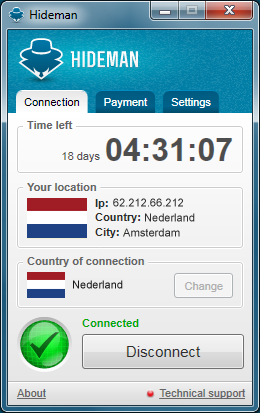
Hideman cloaks your IP address
VPN clients are a generally a very good way to maintain your anonymity online, and Hideman is no exception: just launch the program, click the Connect button and in a second or two you’ll be allocated an IP address in another country.
Which country? Hideman provides servers in Australia, Canada, Czech Republic, France, Germany, Netherlands, Panama, Russia, Singapore, Ukraine, United Kingdom and United States.

InternetOff takes back your time (and life)
You’ve work to do. And lots of it. But you just need to check your email, first. And Facebook. And Twitter. And a few websites, and your RSS feeds, and the latest news, and the list goes on.
Sounds familiar? If you’re really busy and could do without the usual lengthy list of online distractions then InternetOff may be useful, as the program does just what its name suggests -- turning off your Internet access at a click.
LinkChecker lives up to its namesake
There are many tasks involved in maintaining a large website, but one of the most important comes in regularly validating your links. And that’s because a mass of broken links won’t only annoy your visitors, it’ll probably also reduce the search engine visibility which allows people to find you in the first place.
Help is at hand, though, in a variety of tools which aim to validate a site’s links for you. And LinkChecker is probably one of the most straightforward.