
Microsoft Edge's InPrivate mode no longer records your browsing history
When you use a browser's incognito mode you expect it to keep that browsing session private. That is its purpose, after all, to let you access websites without saving any data or information that might be used to trace your visits from the browser. Thing is, at least in Microsoft Edge's case, its InPrivate mode has not exactly worked as advertised -- in fact, it did not work at all.
Microsoft Edge's InPrivate mode is a "privacy nightmare", as my colleague Mark Wilson puts it. Instead of completely ignoring your session, Microsoft Edge actually records your browsing history, making it possible for others to find out exactly which websites you have accessed. However, the software giant now claims to have addressed this privacy issue in the form of a new Windows 10 update.
Microsoft launches Windows 10 update history site to share update release notes
Keeping up to date with the latest updates for Windows 10 can be something of a full time job -- particularly if you're signed up to get Insider builds. To make it easier to keep track of what changes each update brings, Microsoft has launched the Windows 10 update history site.
The site is in response to feedback from Windows 10 users who have been looking for an accessible way of learning about updates. The site provides details of exactly what the updates delivered through Windows Update. It is something of a work in progress at the moment, but one of the recent updates featured fixes a bug that meant browsing sessions in Microsoft Edge's InPrivate mode were not necessarily completely private.
Windows 10 phones home (A LOT) even with all reporting and telemetry disabled
One computer user has become so disillusioned with Windows 10's spying features that he has been driven to using Linux Mint as his primary operating system. But Voat user CheesusCrust was curious to find out just how pervasive Microsoft's privacy invasion is. The results of his investigation are quite staggering.
Using a router kitted out with DD-WRT, and a copy of Windows 10 Enterprise installed in a virtual machine on his Linux laptop, he started by disabling every single one of the tracking and telemetry features found in the operating system. Eight hours later, 4,000 connection attempts to 93 different IP addresses were logged, with most of these IPs addresses being linked to Microsoft.
Microsoft: Windows 10 will keep you safe, and this is how
The reason Microsoft has given for pushing Windows 10 so aggressively is it wants to get users to a "safe place". Very altruistic. Although there’s no excuse for forcing users to upgrade in the manner that it has.
Still, there’s no questioning that Windows 10 is Microsoft’s safest operating system to date and to help sell the security benefits, the software giant has put together a web page detailing how the OS can protect you from modern security threats.

Microsoft Azure IoT hub is now available -- here's what you need to know
Microsoft has released the latest component of its cloud IoT suite, the Azure IoT hub, which was first announced back in September.
Azure IoT Hub is designed to make it easy to connect IoT devices to the cloud as well as allowing bidirectional communication, with device to cloud telemetry and cloud to device commands.
Windows 10 hits 18 percent usage share in the enterprise
Windows 10 is doing great. Despite various problems, security and privacy issues people have had with its virtual assistant Cortana, the adoption rate of Microsoft’s latest operating system has been quite impressive.
According to the latest studies done by Spiceworks, 18 percent of businesses are currently using Windows 10. The predictions are saying that 40 percent of businesses are expected to upgrade by July this year, when Windows 10 celebrates its first birthday. The operating system seems to be on good course, as the penetration has increased seven percent since October last year.
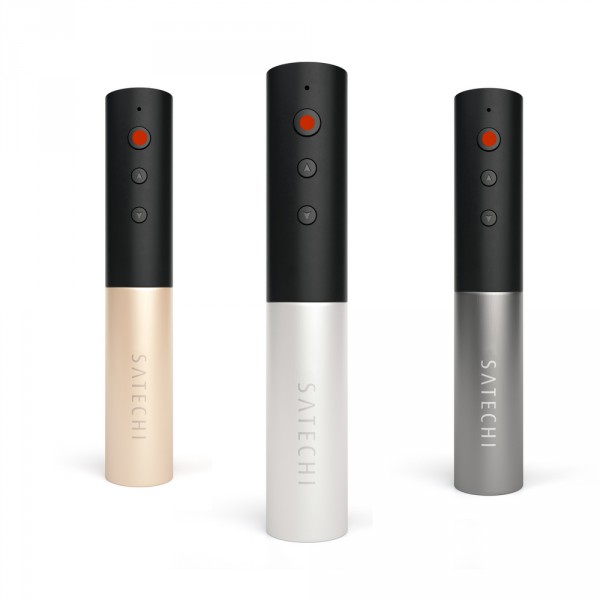
Satechi unveils Aluminum Wireless Presenter
In the business world, there are many constants. You probably aren't appreciated by your boss. You likely don't get paid enough for all you do. And of course, you probably have to sit through many horrible PowerPoint presentations.
Don't get me wrong, PowerPoint presentations aren't always bad, but there's a good chance that a large number of them will be boring. If you ever find yourself needing to present your own such presentation, you should invest in a wireless presenter. Not only will it make you look more prepared and professional, but it can allow you to move about the room to keep your audience engaged. Today, Satechi announces an affordable such Bluetooth presenter, with a beautiful aluminum body.
Windows 10 Insider Preview Redstone Build 14257 arrives on the Fast ring
Last year Fast ring preview builds of Windows 10 arrived at a pretty sedate pace. This year they are coming thick and fast with a new build announced on a weekly basis.
The speed that new builds arrive does mean the differences between versions aren’t huge, but it’s all about preparing the ground work for future additions, like extensions.

Windows 10 is Microsoft's Elephant Man
I read a comment from a user who was talking about Windows 10 Mobile. He referred to it as Microsoft's stillborn baby. As dark and as gruesome an image as this may be, it feels very fitting, and it got me wondering how best to think of the desktop version of Windows 10. Clearly this is not a stillborn -- there's plenty of life in this kicking and screaming beast, and there is no sign of an abortion on the horizon.
But it is the black sheep of the family, the -- brace yourselves, politically correct gentlefolk -- deformed and underdeveloped spawn of Microsoft's loins. If it was an animal, it probably would have been destroyed in utero. As it is -- to view it in more human terms -- it's more like the Elephant Man: a lumbering, lurching curiosity that many would like to see dead, but which at the same time retains its right to existence.
Extensions are coming to Microsoft Edge via the Windows Store, and Insiders will be able to try them 'soon'
The kindest thing that can be said about Microsoft Edge is Windows 10's new browser has potential. It’s far from awful, it’s just rather unfinished. There’s little there to tempt users of Firefox or Chrome into switching.
Microsoft is working to change that though, and make the browser more appealing. Today it reveals a little more about its future plans, including how it will be handling extensions. It doesn’t announce exactly when the browser will receive this much-requested feature, but it does touch on how add-ons will be made available, and how you’ll be able to try out some early examples for yourself.

How to uninstall the Windows 10 'Recommended' update and go back to Windows 7 or 8.1
Now that Microsoft is forcibly downloading Windows 10 onto unsuspecting Windows 7 and 8.1 users’ PCs there’s going to be a lot of unhappy customers faced with a new OS they never asked for nor wanted.
You can prevent this from happening by making sure the "Recommended Update" setting is unchecked on your PC, but if you fail to do this and accidentally allow the installation to go ahead (or maybe you tried Windows 10 and didn’t like it), the good news is it’s easy to roll things back to your original operating system.
Microsoft buys SwiftKey
Since November 2014, Microsoft has purchased a number of major apps and games to bolster its mobile portfolio on Android, iOS and, of course, Windows and Windows Phone. It has added Minecraft, Acompli, Sunrise and Wunderlist under its belt, titles which have been very popular and highly regarded by smartphone and tablet users. These acquisitions have turned the software giant into one of the strongest developers on the aforementioned platforms.
But Microsoft is not stopping there, as it just announced the purchase of SwiftKey, one of the most popular third-party keyboards available for Android and iOS. And, just like that, four of my favorite apps are now owned by the software giant.

Microsoft accused of Iowa Caucus voter fraud with hashtag #MicrosoftRubioFraud
Here's the deal, folks. As I said in a previous article, open source is a necessity when it comes to voting. I praised Bernie Sanders' campaign for questioning Microsoft's motives in providing the platform for the Iowa Caucuses. With that said, Microsoft was ultimately not the problem, closed source was.
Unfortunately for Microsoft, as could be expected, it is now being accused of voter fraud by apparent Donald Trump supporters. Since Ted Cruz won last night, you would think the claim is that the Windows-maker fraudulently boosted him. Nope. Actually, conspiracy theorists are claiming Microsoft increased the number of votes cast for Marco Rubio, who placed third. This movement is using the hashtag #MicrosoftRubioFraud.
How to block the Windows 10 'recommended' update on Windows 7 and 8.1
Microsoft has changed the Windows 10 update from "Optional" to "Recommended". And by "Recommended" it means "You’re getting it whether you want it or not".
If your Windows 7 or 8.1 PC is set to install recommended updates automatically (because -- more fool you -- you just wanted it to be up to date and safe) then Microsoft will cheerfully download the new OS and start the installation process for you. Don’t want that to happen? Here’s how to stop it.

Microsoft forcing Windows 10 onto people is wrong
Microsoft says it wants to get people to a "safer place" and that’s why it’s so aggressively pushing Windows 10. But it’s one thing to advertise the new OS on someone’s computer, and another thing entirely to force them to upgrade to it.
Microsoft Marketing Chief Chris Capossela, says a lot of people are putting off upgrading to Windows 10 ("constantly kick[ing] the can down the street" in his words), and so the software giant is taking steps to give them a "push" into taking action. But not with a gentle reminder, or even full on nagging, but by downloading and then starting the OS installation without permission, and that sucks.