
Why everyone needs to be speaking the same language on data privacy [Q&A]
Today is Data Privacy Day and with CCPA coming into force at the start of this month, the focus is very much on personal data, how it's used and how it needs to be protected.
One of the issues is that there are lots of definitions and terms involved which means it’s vital that everyone understands what they’re dealing with.

UK ignores US warnings and says Huawei can help build its 5G network
The UK government has announced that -- despite being considered a "high-risk vendor" -- Huawei will be permitted to contribute to the 5G network infrastructure in Britain.
The US recently warned that allowing the Chinese firm to be involved in the rollout of 5G would be "madness", but the UK has chosen to ignore this. Huawei will have limits placed on its contributions, meaning that it will only be able to supply "non-core" elements of the network.

Official how to switch from Windows 7 to Ubuntu Linux tutorial now available
If you are still using Windows 7 on your computer, you are making a huge mistake. Running an unsupported operating system is pure foolishness -- there will be countless exploits in the future for which you simply won't receive patches. In other words, your data and overall online safety is now at major risk. If you insist on sticking with Microsoft's operating system, you might as well upgrade to Windows 10 -- either by installing the operating system on your current computer or buying a new PC with the OS pre-loaded.
Understandably, many people are scared of Windows 10 -- Microsoft's data collection through extreme telemetry can make it feel like your own computer is spying on you. In that case, a Linux-based operating system should be considered. Today, Canonical releases an official guide for those thinking of switching to Ubuntu from Windows 7. Not only does the guide address potential hardware incompatibilities, but it provides a handy list of popular Windows software and its comparable Linux alternatives.

New low-code environment helps deliver network automation
With more programmable features and APIs being introduced, networks have shifted in recent years from being hardware-focused to software-centered functions.
This has changed the network management techniques and skillsets required to keep pace with the changing environment. To address this, network automation specialist Itential is launching its Automation Studio which allows developers and network engineers to manage increasingly complex networks regardless of their level of knowledge or coding skills.

Google is shutting down its App Maker tool
Google is in the mood for a cull at the moment. Having announced the end of support for Chrome Apps, the company has now announced that Google App Maker will be closing down in less than a year.
While the ultimate shutdown date isn't until January 2021, App Maker is now no longer being actively developed. Additionally, Google says that as of mid-April it will no longer be possible to create new apps.

Cisco launches Industrial IoT security architecture
Increasingly the boundaries between operational technology and business networks are breaking down as businesses seek access to the real time data that industrial IoT devices hold.
But that leads to increased risk to critical infrastructure as devices become more exposed. To combat these threats, Cisco is introducing an IoT security architecture that provides enhanced visibility across both IT and OT environments, and helps protect industrial processes.
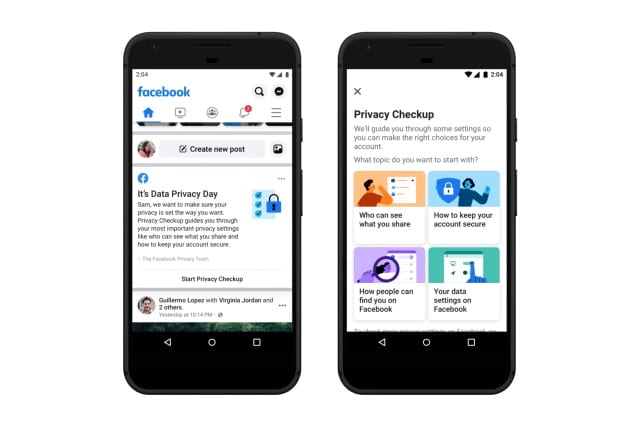
Facebook promises to give users more control over their privacy... again
Today is Data Privacy Day, and Facebook is using the occasion to try to convince its users that it cares about their privacy.
The social network says that it recognizes there is a lot of work to do to improve privacy protections, but that's not going to stop the company from trying to make it seem as though it doesn't represent a massive invasion of privacy. As part of its latest PR campaign, Facebook will encourage users to review their privacy settings as well as launching the Off-Facebook Activity tool globally.

Now you can get help from Google on Twitter
Google has announced that it will now be offering customer support via Twitter.
Anyone with a problem with their smartphone is invited to tweet using the hashtag #AndroidHelp, and the company will do its best to help. The official Android Twitter account will be used to respond, and the team says it will be able to help with a range of issues.

Today you can speak with Microsoft about the future of Windows and Office
It's not very often you get to communicate directly with large technology companies to gives feedback about their products, but later today you will be able to speak with Microsoft engineers to share your thoughts about Windows and Office.
For 90 minutes today, Microsoft is conducting an online research event providing one-on-one sessions, giving people the chance to help guide future development. It is an expansion of the Windows Insider and Office Insider programs, and Microsoft says it's keen to hear users' thoughts.

Hacker demonstrates Remote Code Execution exploit for Windows Remote Desktop Gateway
A self-described "reverser/pwner [and] Windows kernel hacker" has demoed a working exploit for two recently discovered vulnerabilities in Windows Remote Desktop Gateway (RD Gateway).
The exploit takes advantage of the CVE-2020-0609 and CVE-2020-0610 vulnerabilities which have already been shown to make a denial of service attack possible. Now Luca Marcelli has shown how the same vulnerabilities can be exploited in a Remote Code Execution attack.

Avast free antivirus sends browser history to marketers
When you install an antivirus program -- even a free one -- you have a reasonable assumption that it's going to help keep your data safe.
But a joint investigation by Motherboard and PCMag has discovered that Avast's free antivirus is harvesting user data. Although this is supposedly 'de-identified' it is being sold to marketers in a way that can be linked back to an individual.

Businesses gain from strong data privacy practices
Data privacy is very much in people's minds at the moment with the introduction of CCPA and other legislation around the world.
Businesses can sometimes see privacy regulations as a necessary evil that they have to comply with, but new data from Cisco reveals growing, tangible benefits for businesses that adopt strong privacy practices.

Breakthrough technology allows voice biometrics to be used at the edge
The use of voice for authentication has been limited in IoT applications and devices because of storage and processing limitations.
But new technology from ID R&D looks set to change that, offering voice biometric optimization with an AI-based SDK of under 1MB, enabling voice biometrics to be implemented at the edge.

Solus 4.1 Fortitude Linux distro now available for download with Budgie, GNOME, KDE Plasma, and MATE
There are too many Linux distributions these days, but as long as many of them are of high quality, I suppose that isn't such a bad problem to have. Many people in the Linux community know of the common ones, such as Ubuntu, Fedora, Mint, and Manjaro, but there are some lesser-known distros that are actually worth consideration, like Deepin and Solus.
Speaking of the latter, there is a new version of that operating system available for download. While technically just a point release, Solus 4.1 Fortitude is chock full of updates, fixes, and more. You get Linux kernel 5.4.12 and Mesa 19.3.2. The operating sytem comes with many quality apps pre-installed too, such as Firefox 72.0.2, LibreOffice 6.3.4.2, and Thunderbird 68.4.1 -- three essential productivity tools. Once again, there are four desktop environments to choose -- Budgie, GNOME, KDE Plasma, and MATE. All four are great, but Budgie is considered the default for this operating system.

Not dead yet! What Bob Cringely has been up to…
A few days ago I tweeted something and a reader reacted, saying about Cringely, "I thought he was dead!" Not dead yet, but I should probably explain my disappearance a few months ago from life in print. I’ve just been too busy working for a living. How does a 67-year-old hack with three minor children recover from going blind, losing his home and business in a horrible fire (like 2,000 others, we are still fighting with insurance companies), while appeasing an angry crowd of Kickstarter supporters armed with pitchforks and shovels? In my case, I went looking for venture money to recapitalize MineServer and I simultaneously started a satellite launch company to fund my eventual retirement.
I am not making this up.