Social networks get more social as spring springs
One part momentum, two parts hype, one part fascination with Rainn Wilson's random thoughts and violent ailurophobia -- stir, and you've got a remarkable 76.8% unique-visitor growth rate for Twitter in March, as noted by a Social Times blogger who had a bit of fun with Compete.com this morning. And the warming trend extends past the trendy microblogging service and its 14 million users.
Facebook's up 23.4% to over 91 million users, and even shaky MySpace, which has seen declines of about 11% over the past year, got a 4% bump to 55.6 million users, and standoffish LinkedIn is up 13.1% to 12.7 million users. And the URL-shortening services crucial to microblogging are showing great gains too; tinyurl.com, is.gd and bit.ly are all up by double digits (21.6%, 21.8% and 48.8% respectively), with wee is.gd showing 3721% growth over the last twelve months. (Rainn Wilson photo courtesy of Stacy D of Flickr, via Wikimedia Commons.)

Zoho invites more cloud app users by embracing more IM protocols
For a number of reasons, some of them indeterminate, despite all the evolutionary pressure to move it to the next level of its evolution, instant messaging hasn't evolved as an application. One reason I've always suspected is that it's difficult for developers to find the impetus to devote the amount of effort required to evoke revolutionary change, on a platform that's offered to most customers for free. The counter-argument to that is that SMS isn't free, and yet it's stuck even further in the Stone Age.
If IM does resemble one ongoing revolution in application architecture, it's "the cloud" -- the nebulous, always-on service built to respond to user requests from wherever. Whereas at the beginning of the decade, services like AOL, Yahoo, and MSN used their respective IM platforms as weapons against one another, today's strategies -- which now includes Google -- have them opening up those platforms for generally unencumbered use by others. That hasn't exactly made Trillian for Windows and other multi-protocol IM clients the most perfect of applications just yet, but week after week, those of us who work in widely-dispersed offices do manage to get by somehow.

Suggested Google-Twitter tweets for Biz Stone
Oh, Biz Stone. A blog post about the swirling rumors of Twitter's acquisition by Google? Really? I mean, you were certainly coy enough -- the post is titled "Sometimes we talk" (cue hipster shrug) and includes an emphatically noncommittal "It should come as no surprise that Twitter engages in discussions with other companies regularly and on a variety of subjects."
My dear Mr. Stone, no. This is the brave new 140-character world you created, sir, and millions of Twitterers demand that you be pithier. So let's remove that post from your metaphorical tweetstream and go with something a bit more... in keeping? Naturally I tweeted for suggestions, and received the following:

NEC lets employees track carbon footprint online, and compete with their colleagues
This week, Japanese ISP BIGLOBE and spun-off parent company NEC began testing a new energy conservation incentive in the homes of 100 of its employees that turns carbon emission reduction into a game called Carbon Diet.
The circuit breakers in the testers' homes are connected to a WiFi and ZigBee-enabled device which tracks their electricity consumption. The data from the box is then converted into stats which are used in various online multiplayer games.

Cloud Expo: How will Microsoft's Azure handle older applications?
Microsoft's emerging Windows Azure cloud services provider will act as a platform not just for shiny new cloud applications but also for repurposed legacy applications, according to Ranjith Ramakrishnan, CTO of Microsoft third-party partner Cumulux.
According to Ramakrishnan, Microsoft is initially offering four data centers in the US and one in Europe for hosting cloud applications of both sorts. His company is now working on extending Azure enablement to its mPortal mobile portal.

Online goof-off time during the workday can boost productivity, says study
Tell your boss the University of Melbourne says it's probably a good thing for you to hang out on Facebook (or in our comments threads!) today. A study released on Thursday found that people who spend part of their workday surfing the fun stuff online are actually more productive than employees whose networks (or habits) are too buttoned-down.
The survey by the Department of Management and Marketing examined the productivity and habits of 300 workers, 70% of whom said they spend at least some time each day engaging in "Workplace Internet Leisure Browsing" (news, YouTube, social networking, shopping and the like). The study found that workers who spent some amount of time doing so -- up to around 20% of their day -- displayed as much as 9% greater productivity.

NPD reports changes in teen music habits: Less buying, less downloading
Would you find it more surprising to hear that even teens are spending less during the economic downturn, or to hear that even teens are kind of nonplussed by the current music scene?
A report out this week from The NPD Group says that the 13-to-17 crowd acquired 19% less music in 2008 than they did the previous year. That's acquisition by any means -- CD purchases (down 26%), digital downloads (down 13%), peer-to-peer sharing (down 6%), even borrowing (down 28%).

Hulu whips up its own DRM to block people from watching videos outside browsers
Hulu is reportedly attempting to keep out the non-browser based watchers by implementing its own form of DRM with JavaScript, but the trick didn't work for long as media center applications have already been updated.
Because of the sudden popularity of solutions like Boxee and MCE, and the related displeasure they caused content providers, streaming television service Hulu has been cat-and-mousing with third parties in the way that typically ends in legal action.
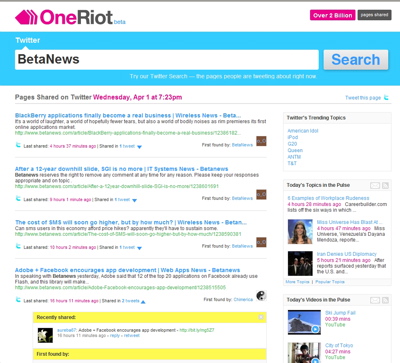
OneRiot unleashes a fresh take on Twitter searches
Thanks to its open API, sometimes it seems as if there are many ways to parse the Twitter tsunami as there are people actually using the service. That said, social-web search site OneRiot has turned its experienced attentions to the microblogging service, and the results -- launching today -- are promising for those seeking to track the viral spread of URLs through the Tweetosphere.
Twitter's own search capacities are becoming increasingly integral to the service, as evidenced by the new homepage design they're working on over there. Third-party sites offer search-based slices of profanity on Twitter (Twittourette, spectacularly NSFW) or mental states on Twitter (twistori) or recurring keywords on Twitter (Tinker and Sideline, both launched earlier this week) or what you will. OneRiot's unique angle is to examine which URLs people are sharing in real time, learning from their tweets what it is people are talking about from moment to moment.

IBM gets more social with LotusLive Engage
IBM has now set April 7 as the commercial launch date for LotusLive Engage, the latest addition to its new LotusLive line-up of social network-inspired business collaboration software. Engage is aimed at collaboration outside the organization's firewalls, meaning that business partners and customers can also be part of the online loop.
Major features of Engage include a Web meeting space, with desktop sharing, recording, and security; instant messaging, with photo and file sharing; online file storage and sharing; and project tracking, to-do lists, and brainstorming. Price Waterhouse Coopers, Nortel Networks, and Penn State University are a few of the early users.

Wikia Search finds its way to the bitbucket
The contributions counter on the front page ticks slowly, slowly along, but it would be faster to watch the minutes count down for Wikia Search, Jimmy Wales' "people powered" would-be Google competitor, which announced Tuesday that it was shutting down at day's end.
The Wikipedia founder wrote in his blog that the project "has not been enjoying the kind of success that we had hoped." Wikia Search, known early in its career as Wikiasari, was launched in January 2008, and rolled out its Wikia Intelligent Search Engine for developers in October.

YouTube wins out in the race against Hulu for ABC content
In a move which may have forestalled a deal that may have accelerated arch-rival Hulu's "evil plot" to assimilate consumers' brains, YouTube has made an extended deal with Disney Media Networks -- parent company of the American ABC and ESPN channels -- that not only gives ABC its own branded YouTube channel, but enables Disney to manage its own in-stream advertising.
This afternoon, a hastily-produced preview video was posted to ABC's new channel in a format that could not be embedded elsewhere, contrary to the usual YouTube methodology. And a two-and-a-half minute clip from a recent SportsCenter serves as a placeholder for future content on ESPN's new YouTube channel. ESPN already has a full-featured sports news and video highlight service on Disney's own Go Network, its homebase since 2004 after Disney and Microsoft's MSN terminated their deal.

Adobe + Facebook encourages app development
At this point, the Adobe Flash platform is ubiquitous. For many users, like the growing number of those browsing on their iPhones its absence can be point of perpetual irritation.
Likewise, Facebook has reached near ubiquity, counting everyone from octogenarian grandparents, to captive elephant seals as users. A marriage of the two is a perfect fit.

Former music industry lawsuit target Seeqpod files for bankruptcy
Music search engine provider SeeqPod filed for Chapter 11 bankruptcy protection in the US Bankruptcy court in the Northern District of California yesterday. Not a large company by any means, it listed a modest $2 million in assets and $1.6 million in debts. Five percent of the company is owned by the Department of Energy's Lawrence Berkley National Laboratory.
SeeqPod is most easily remembered for being sued by Warner Music Group early last year based on the record company's belief that the search engine was built to make money off of advertising in its built-in Web player, even though it did not even advertise.

MySpace to be bathed in a Silverlight
MySpace may not need any more chaos on its festively designed pages, but with traffic numbers down it could probably use some good news on the apps-development front, not to mention some good apps. To the rescue: Microsoft. On Monday MySpace announced that its Open Platform will support Silverlight, Microsoft's cross-browser, cross-platform implementation of the .NET Framework. (This runs the table for MySpace, by the way, putting it on iPhone, Android, Blackberry, Sidekick, Palm, Nokia, and now Windows Mobile phones.) The SDK will be available from Microsoft's CodePlex site on Thursday.