
Adblock Plus wants to know why you're blocking ads (!)
Adblock Plus has been in the headlines quite a lot recently. Adblocking is certainly popular, but the company needs to strike a balance between keeping users happy, and maintaining a good relationship with advertisers. The Acceptable Ads program is part of this, but at its second #CampDavid session there have been some further ideas about the future of adblocking.
There was talk about what should be viewed as an 'acceptable ad', and an Acceptable Ads Committee will oversee this. But the discussion between Adblock Plus and advertisers brought up an important question: just why do people install adblockers?

France orders Facebook to stop tracking non-users
Facebook is facing a great deal of heat in the European Union, where many countries are concerned with the ways in which the social network collects data and how it uses cookies to track Internet users.
The CNIL, France’s data protection authority, has issued a formal notice to Facebook, because it fails to comply with European data protection law. CNIL has given Facebook three months to make the necessary changes to comply with the EU’s laws. If the company is able to do this, it will not face sanctions from the data protection agency. Facebook is currently reviewing CNIL’s order which it is confident that it currently complies with.

New UK homes to get superfast broadband -- maybe
The UK government has today announced that it will work with Openreach -- BT's local access network business -- and the Home Builders Federation (HBF) on an agreement to deliver superfast broadband connectivity to new build properties in the UK.
The deal will mean that fibre-based broadband is offered to all new developments either for free or as part of a co-funded initiative.

One in three home routers will double as a public hotspot by 2017
Would you be willing to share your Wi-Fi router so that everyone around you could use it as a public hotspot? Your Internet connection would stay secured behind a firewall.
This is actually not a rhetorical question, but an inevitability, according to a recent Juniper Research report. According to the market analysts, by 2017, one in three home routers will be used as a public Wi-Fi hotspot, and by 2020 there will be a total of 366 million of these units worldwide.

The clock is ticking for the US to relinquish control of ICANN
The US is not afraid to throw its weight around; it likes not only to be involved in things, but to be in control. For decades, ICANN (Internet Corporation for Assigned Names and Numbers) -- the non-profit organization that manages IP addresses and domain names -- has been overseen by the US Department of Commerce, much to the chagrin of people around the world. Most upset are those who point to the independent nature of the internet, and the need for any body with global power to be similarly indpendent. Later this year ICANN is set -- at long last -- to completely separate from the US government.
While this does hinge on US government approval, by the end of September, ICANN could instead be in the hands of businesses, individuals, and multiple global governments. While the changing of hands should not alter the way ICANN operates, it is hoped that it will go some way to restoring faith that may have been lost after revelations about online surveillance by the NSA and other US government agencies.

Virgin Media says it's not right to advertise broadband speeds that most people cannot get
The 'misleading' nature of ads for broadband services has been the subject of debate for some time. The 'up to' figures put forward in relation to speed are often so open to interpretation as to render them meaningless. Customers have had enough, and now Virgin Media is ready to fight on their behalf.
Current rules enforced by the Advertising Standards Authority (ASA) permit UK ISPs to make claims about broadband speeds, even if just 10 percent of customers could receive these speeds. Virgin thinks this is unfair and is calling on the ASA to update its guidelines so customers will have an easier time comparing deals.

Majority of consumers expect their data to be compromised in 2016
The series of high-profile data breaches we witnessed last year has left a mark on the way consumers perceive online business, a new research from NCC Group and IDG Research Services shows.
According to the research, entitled Trust in the Internet 2016, 63 percent of consumers expect their data to be compromised this year, and 60 percent are now worried, more than ever, about protecting their data on the Internet.

Tim Berners-Lee is an idiot for wanting to expose cyberbullies' identities
While there is greater interest than ever before in online privacy there are also calls from some quarters for people who use the web to be fully accountable. This is part of the thinking behind Facebook's real names policy, and it's also what's driven Tim Berners-Lee -- no less than the inventor of the web -- to call for the identities of cyberbullies to be exposed.
In the wake of gamergate and countless other examples of women being abused online for little more than being women, bullying of school children by their contemporaries, and endless racist, sexist, and politically motivated attacks online, the suggestion might seem -- on the face of it -- to make sense. But it fails to stand up to scrutiny and is likely -- ultimately, if anyone were insane enough to follow his advice -- to be completely counterproductive.

Google wants to drive ISIS from the open internet to the dark web
You can say what you like about ISIS, but it certainly knows how to do propaganda. In fact, the group can pretty much sit back with its feet up -- when it's not busy, you know, killing people in increasingly horrific ways -- as web users the world over are only too happy to do the legwork and spread the shocking imagery on its behalf. But Google has had enough and wants to drive ISIS from the web to the dark web.
While many would question the value of pushing the terrorist group further underground and encouraged to use ever-more secretive tools, Google believes ISIS propaganda doesn't belong on the open web, but should only be accessible through the like of Tor. Jared Cohen, director of Google Ideas believes it makes sense to drive Islamic State to the dark web to try to blunt its propaganda.

Smart TVs pose huge security risks
Over the past few years we have seen everyday items such as refrigerators, lighting and heating systems and even kettles all of a sudden becoming "smart". In fact there are now more smart items on the planet than smart humans, or in fact any type of humans, with an estimated 13.4 billion devices currently connected to the Internet. This is not necessarily a problem -- until, of course, hackers start exploiting these devices to gain access to your home or work networks.
Most people would never even suspect that their television set could be hacked, yet this is happening, in research labs at least, with greater frequency. In one recent example, security company Avast demonstrated a hack of a Vizio Smart TV enabling root access to the TV’s underlying Linux operating system. Last year I also found that this flaw involving a maliciously crafted SSID value could be exploited with a USB device. After exploiting this flaw, the attacker has access to everything connected to the home network of their victim. Avast also demonstrated what a man-in-the-middle (MITM) attacker (such as an intrusive government or ISP) could learn by monitoring network traffic from the TV set.

Police could tap into router data to verify digital alibis
Law enforcement agencies are missing out on a vast amount of valuable data that could be used to convict criminals, or prove innocence. Dan Blackman from Edith Cowan University, Australia says that police are missing out on swathes of data that could be gathered from Wi-Fi devices.
For privacy advocates it's a suggestion that is likely to make the gag reflex kick in, but Blackman says that router data could be a valuable tool in fighting crime. Information such as device MAC addresses, coupled with data about connections to routers can be used to place individuals at the scene of a crime -- or away from it -- but timeliness is the key to success.

Oscobo is a privacy-focused search engine that won't sell your data
Using the web can mean selling your soul to the devil. Or Google. (Which you may well regard as the same thing.) With the increased interest in privacy there is a new market for tools and services that help to protect users. Catering to web users who are concerned about how Google might use search data, Oscobo is a new search engine that promises not to track users.
Founded on the belief that "personal data should remain just that -- personal", Oscobo is a UK-based company that says it won't store any data about its users, let alone share it with anyone else. With the controversy surrounding the snooper's charter, it makes sense that the privacy-focused search engine should start life in the UK, but there are plans to expand further afield to provide tailored results for people around the world.

Would dropping the 140-character limit completely change the face of Twitter? [UPDATE] Jack Dorsey responds
Twitter could be on the verge of making one of the most significant changes in its history. The micro-blogging service has long been famed for its 140-character limit that allows for pithy quips, concise statements, and brief utterances. But all this could be about to change. Reports suggest that the 140-character restriction could be thrown out of the window, with a decidedly meatier 10,000-character upper limit being ushered in instead.
If such a change is implemented, it would bring regular tweets in line with direct messages which enjoyed a lengthening just a few months ago, and comes shortly after Twitter changed the order in which tweets are displayed. Both of these changes led to a good deal of debate, but would increasing the maximum length of a regular, public message by more than 70 times be such a fundamental change as to be a step in the wrong direction?
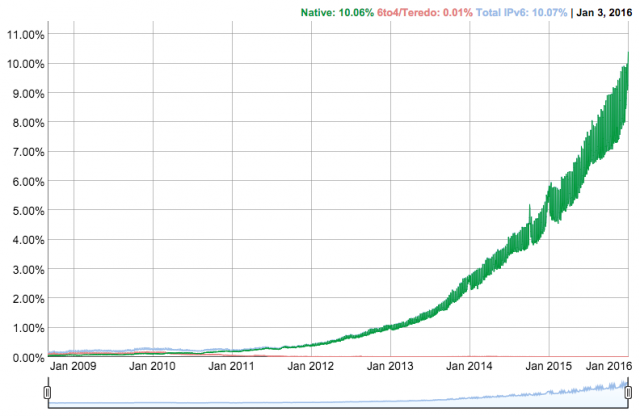
IPv6 adoption nearly doubles in a year
New data released by Google has shown that the uptake of IPv6 -- the most recent version of the internet communications protocol -- has grown considerably in the last 12 months.
Google revealed that 10.09 percent of all traffic to its websites was made of IPv6 connections as of January 2 2016, nearly double that from the same time last year when the number was 5.47 percent.

How the Internet has forever changed five major industries
The digital revolution has resulted in disruption to many industries, with whole new business models created, new brands rising to the top of many industries and those companies failing to adapt, falling by the wayside.
The digital age has impacted industries in both goods and service -- from travel and transport, to publishing, retail and music. The switch from physical to digital has revolutionized both the production and distribution of books and music.