Using Internet Explorer is more taxing than you think
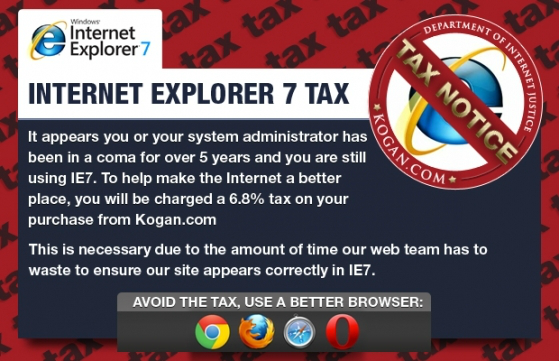
Australian-based online electronics store Kogan has fired off an ingenius web site press stunt. The retailer adds 6.8 percent extra -- the "Internet Explorer 7 Tax" -- to online purchases made using the browser. Note this is only for customers who use IE 7 browser, not version 8 or later.
In a day and age when web standards compliance is king, Kogan comes out swinging. The company states that taking the extra time to develop for IE7 hurts the bottom line -- not just for its operations but for customers. Kogan wants customers to use modern browsers that support web standards. Many older browsers don't support new standards and technology.

KeyScrambler Personal protects Firefox and Internet Explorer from keyloggers
The best way to protect yourself from malware is of course to prevent it ever reaching your PC, but if something does slip through your defences then this doesn’t have to be the end.
KeyScrambler Personal, for instance, will encrypt any keystrokes within Internet Explorer and Firefox. And as a result it’ll keep your logon and other details safe, even if a keylogger breaches your system.
Windows 8 is like a bad blind date
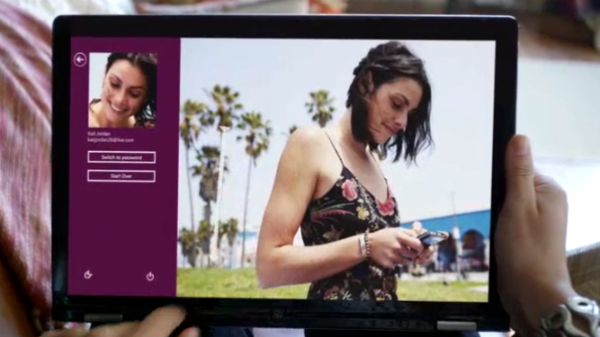
She's stunning, sexy and sultry. But you can't live with her.
Every day for the last three weeks, I sat down to write this analysis but couldn't bring myself to. I resisted for not having used Windows 8 as much as its predecessors -- typically from public beta to release candidate before offering hard opinion. In October, I requested one of the Samsung tablets handed out to BUILD attendees but Microsoft wouldn't provide one. After several more requests, I got one in April and May for about a month's use and was shocked -- and not "wow, it's good". Windows 8 demos much better than my actual user experience. I blamed myself. Surely the problem is mine -- that Microsoft wouldn't unleash UX worse than Windows Vista. But as I see other users/reviewers sharing similar experience, time has come to break my silence. I wouldn't recommend Windows 8, in its current form, to anyone.

Add .NET Framework Repair Tool to your kit
Microsoft has released the .NET Framework Repair Tool, a compact and portable executable file that aims to detect and resolve some common .NET Framework problems.
The program focuses mainly on issues relating to installation or updates. If its tests don’t reveal anything obvious in this area, though, it can also apply a couple of generic solutions: specifically, stopping, re-registering and restarting the Windows Installer service. And as a result, the Repair Tool may also help to resolve a variety of other Windows Installer-related problems.

Is there an IT labor shortage in the USA that can only be solved with more H1B visas?
My recent series of columns on troubles at IBM brought me many sad stories from customers burned by Big Blue. I could write column after column just on that, but it wouldn’t be any fun so I haven’t. Only now a truly teachable lesson has emerged from a couple of these horror tales and it has to do with US IT labor economics and immigration policy. In short the IT service sector has been shoveling a lot of horseshit about H1B visas.
The story about H1B visas is simple. H1B’s are given for foreign workers to fill US positions that can’t be filled with qualified US citizens or by permanent US residents who hold green cards. H1Bs came into existence because there weren’t enough green cards and now we’re told there aren’t enough H1B’s, either. So there’s a move right now in Washington to increase the H1B limit above the current level of approximately 65,000 because we are told the alternative is IT paralysis without more foreign workers.

Rev up this week's 20 exciting software downloads
There are a number of worthy highlights this week, including the long awaited Opera 12 release, iTunes support for iOS 6 devices and a relatively major update to Skype for Windows and Mac.
The major release this week must be Opera 12. After months of beta-testing, the browser is finally available, along with an interesting twist, in the form of the first native 64-bit build. Whether a 64-bit version of a web browser makes a huge difference is another matter entirely. Opera 12 ships with numerous speed improvements, including basic support for hardware acceleration. It’s not all good news though as gone are the widgets and other features such as Opera Voice. Download Opera 12, Opera 12 (64-bit) and the separate Opera Portable 12, which you can take on the road.
That Facebook account verification email in your inbox is a scam
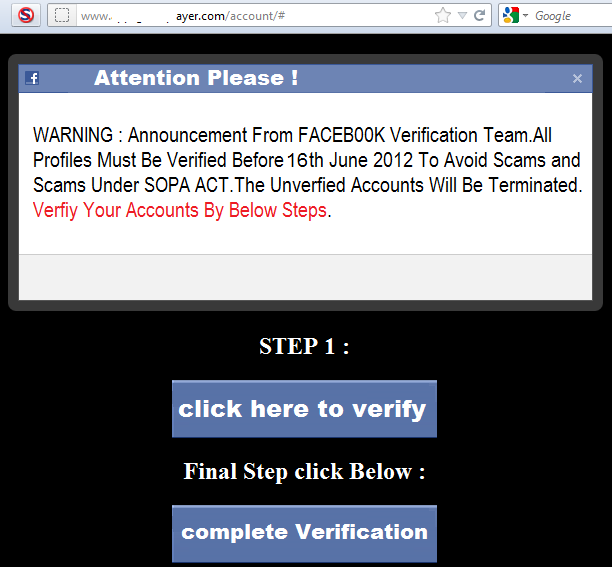
If the scary email or app notification, and subsequent webpage, is to be believed, you have only a few days to verify your Facebook account or you’ll be out of luck. But don’t worry, a few days later you will magically get a few more days to verify, and so the scam goes.
A Twitter follower with the handle of @chasapple sent us a tip on an app message they received, here’s a screenshot of what happens if you clicked the link.

Ethiopian government outlaws VOIP, 15-year prison sentences possible
Troubling news is coming out of East Africa this week. International media site Al Jazeera has just picked up that on May 24th 2012, Ethiopia ratified new legislation called the 'Ethiopian Telecom Service Infringement Law'. The Legislation criminalizes any third-party Internet services not run by the state controlled telecom monopoly, Ethio Telecom, with Skype being a focus. However, the ban affects other services, such as Google Talk.
The new telecom law is meant to impede Internet telephony, with reported punishments of heavy fines and 8 to 15 years in prison if caught. The legislation prohibits all network telephony traffic, along with audio and video data traffic via social media, reports the The Africa Review.

Microsoft, Symantec team on future disaster recovery solutions for Azure
Customers of Microsoft's Windows Azure platform will gain disaster recovery features thanks to a partnership with Symantec announced this week. The offering is the first such service for the Azure platform, the two companies say.
While the effort was announced this week during Microsoft's annual TechEd conference in Orlando, Microsoft says the actual service itself will not be available until sometime next year, and is a move that makes sense for Symantec at this point.
Nokia layoffs = Benefit for US, Sweden. Problem?
Last year, when Microsoft announced it was partnering with Nokia in Windows Phone development, it was widely expected to result in significant staff cutbacks in Nokia's research and development department. In fact, it was part of the agreement. Both Nokia and Microsoft said there would be an R&D handoff. Finland's Minister for Economic Affairs, Mauri Pekkarinen went so far as to say it would result in the biggest structural change that Finland has ever seen in the new technology sector.
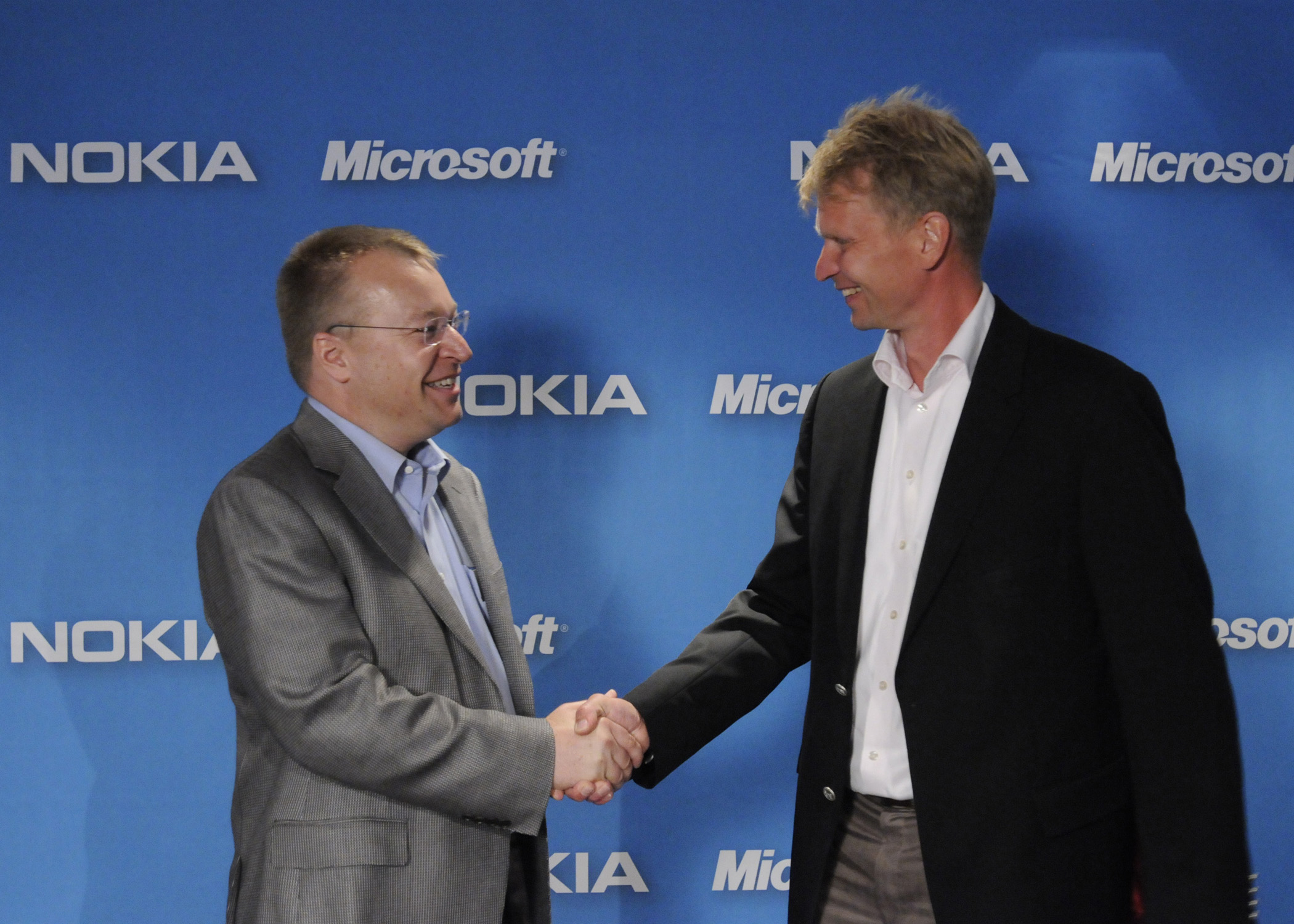
Yesterday, Nokia CEO Steven Elop announced major R&D cutbacks...these 10,000 layoffs should have surprised no one.

Will Microsoft's mystery product be 'clap on, clap off' for mobile?
Cue up the rumormill for anyone's guess what Microsoft will announce at 6:30 pm EDT on Monday. I'll throw out one, inspired by software developer Robert Johnson, who occasionally writes for BetaNews (and we wish it was more often).
"If Mashable is correct and Microsoft really is gonna announce a self-manufactured tablet then it could possibly be a further refinement of the laptop that was rumored a few months ago", he speculated. "Remember how there were reports of people who had seen a device made by Asus that contained Kinect cameras?" Yes I do, and replied: "Kinect mobile has limited applications, but they're big for key enterprise markets, such as healthcare. Otherwise what have you got? 'Clap on, clap off' for PCs".

We can’t expect regulators to become our crowdfunding coaches
Last in a series. In part one, we learned how important crowd funding can be for helping tech startups and the economy. In part two, we worried about how criminals and con men might game the eventual crowdfunding system when it starts in earnest next January. And in this final part I suggest a strategy for crowdfunding success that essentially comes down to carpe diem– seize the day!
Crowdfunding done right will have a huge positive impact on any economy it touches. But by done right I mean done in a manner that maximizes impact and minimizes both corruption and unnecessary complexity. This is not something that must be accomplished specifically through strict regulation, either. I’m not opposed to regulation, just suspicious of it. I’m suspicious of any government policy that purports to be so elegant as to accomplish economic wonders at little or no cost. That just hasn’t happened in my fairly long lifetime so I see no reason to expect things to change.

Rapid Environment Editor makes useful a Windows relic
Long ago, in the days of DOS, there was no Registry where key system settings could be stored. And so variables such as, say, the location of the operating system Temporary folder were saved instead to the Environment, where they could be freely accessed by all your programs.
These days the Environment is largely a relic of the past, but it can be useful to check its contents occasionally, if only as a part of cleaning up your system. And while you can do this within Windows (right-click Computer, click Properties > Advanced System Settings > Environment Variables), it’s generally much easier to use the free Rapid Environment Editor.

Apple cofounder calls Siri 'poo-poo'
It's another dress-down Friday here at BetaNews, and how could I resist dressing down Apple's Siri when cofounder Steve Wozniak makes doing so easy? Besides, I've already asserted "Siri sucks", then there is that lawsuit about the voice assistant. Speaking of Apple legal wranglings, who needs enemies when you've got friends like Woz. Surely the lawyers behind that lawsuit are drooling all over the Times Union, where the comments appeared.
Apple's misfortune: Wozniak used Siri before the iPhone maker bought the company, and he really liked the technology. He called it "pretty incredible". But no longer. "A lot of people say Siri. I say poo-poo". He gives an example. Before Apple bought Siri: "I would ask 'What are the prime numbers greater than 87?' and they would come up all in a row". Afterwards: "I'd say 'What are the prime numbers greater than 87?' And I'd get prime rib".

Polyglot 3000 is a universal translator for text
I you have some text that you’d like to get translated then there’s usually no need to know its language. Plenty of online services will do their best to automatically detect the language for you, then translate it to whatever you need. If your preferred service can’t recognize the language, though, it might be useful to have a desktop alternative like Polyglot 3000 to hand.
The program’s design is very straightforward, and works exactly as you’d expect. Just paste your sample text into Polyglot (or enter it manually, or open it in a plain text file), click the “Recognize language” button, and the program will deliver its report. Which usually means naming the most likely language for this sample (currently 474 are supported), and providing a Recognition Accuracy estimate to let you know how reliable this verdict might be.