




Betanews Podcast: Transportation security, Facebook sensitivity, and you
On our second edition of the Betanews podcast, we take a look at the ongoing effort to keep stuff that we share on the Internet from not being shared so much. The Transportation Safety Administration and the American citizen are very much in the same bucket today, as both are being faced with a new and intriguing privacy and sensitivity debacle...essentially the same one, just in two different respects.

The strange parallels between Microsoft's century start and decade's end
End of year is typically time for company retrospectives, but 2009 is also end of decade. For Microsoft, the slow economy and push into Web services bookends the decade 2000-2009. Microsoft parallels between the new century's first year and the decade's last year are surprising. I've put together a list of 10 things, presented here in no particular order of importance.
1. Microsoft struggled through recession. In December 2000, Microsoft issued an unexpected profit warning for its fiscal 2001 second quarter. In January 2009, Microsoft released disappointing 2010 second quarter results, announcing intent to lay off 5,000 employees. Recessions marked the beginning and end of the decade, hitting Microsoft sales hard.

Third-party mobile browsers Skyfire and Bolt give Opera a run for its money
Mobile browsers have come a long way in a relatively short time. In a way, webOS, iPhone OS, and Android users have been kind of spoiled by the fast and easy-to-use browsers installed on their devices by default. For these sorts of users -- the ones who pull out their mobile phones to run a search every time someone has an unanswered question -- it's easy to forget that much of the mobile world would rather avoid opening its default mobile browser at all.
Opera may be the most prominent third-party solution to poor mobile browsing experience, but free browsers such as Bolt and Skyfire are quickly making a name as well. They too seek to improve the mobile Web experience for everyone, even those on resource-constrained devices with less-than-lovable browsers built in.

The PDF redaction problem: TSA may have been using old software
The problem with the release of a Transportation Security Administration security screening manual was not, as many news outlets reported yesterday, the fact that it appeared "out there on the Internet." As US Homeland Security Secretary Janet Napolitano told reporters this morning, according to the Washington Post, the TSA manual was supposed to have been posted on the Internet -- it was part of a cache of documents intentionally posted to a government procurement Web site.
The real problem is that the portions of the PDF document that were supposed to have been redacted -- or removed from the file and replaced with blackouts -- were not actually removed. Sec. Napolitano said this morning that disciplinary action may be taken against the TSA employees responsible, and at one point implied that only one person may inevitably be to blame.
Deep discounts drive Black Friday tech revenue down, unit sales up
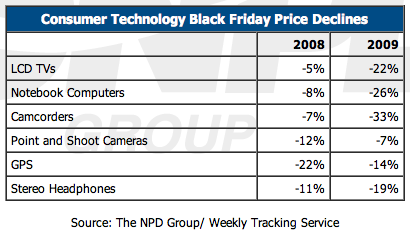
The sour economy soured consumer technology retail revenue on Black Friday, according to new research from NPD Group. Related, U.S. retail pricing declined year over year in all major categories -- camcorders, GPS systems, LCD TVs, notebook computers, point-and-shoot digital cameras and stereo headphones. NPD did not publicly report pricing on cell phones or desktop PCs. The company tracks online and brick-and-mortar sales.
Black Friday revenue declined for a second year in a row -- both days since the late-September 2008 stock market crash that sent an already recessionary economy tumbling downward. Overall Black Friday revenue was $2.7 billion at U.S. retail, down 1.2 percent from the same day a year earlier. On Black Friday 2008, year-over-year revenue fell 3.4 percent.

iPhone brings back the DOS dilemma
Apple's iPhone is supposed to be about the cool, new mobile Internet future. But using the smartphone reminds me too much of the past. The beautiful, ergonomically-designed iPhone has two related flaws: Fixed battery and prohibited background applications. Apple wrongly chose to put form before function in designing iPhone hardware and software.
The device's related flaws remind me of MS-DOS PCs' 640k memory limit. Microsoft used digital steroids -- extended and expanded memory -- to bulk up MS-DOS. But it was never enough to make up for what memory limitations took away from DOS' performance or stability.

Mobile Internet is 450 million users strong and doubling in four years
Do you browse the Web on your phone, iPod touch or other portable wireless device? Congratulations, you're one of the 450 million mobile Internet users, according to IDC. The analyst firm today predicted that number would reach 1 billion by 2013.
I'll do some quick math. Apple has shipped more than 30 million iPhones, so there's a possible 6 percent or so of mobile Internet users -- and that's not counting more than 20 million iPod touch users. Another nearly 30 million Crackberry -- ah, BlackBerry -- addicts accounts for another 6 percent of users.
In a peace offering to newspapers, Google offers a new news format
Exactly what online news should be or become is a subject that consumed the "blue sky" discussions among publishers since the late 1990s. Despite every concept they've ever created, tried or untried, what publishers typically end up with is either something that looks segmented and departmentalized like CNN.com or NYTimes.com, or is basically a blog whose scroll reveals a history of news, like it was printed on a roll of paper towels.
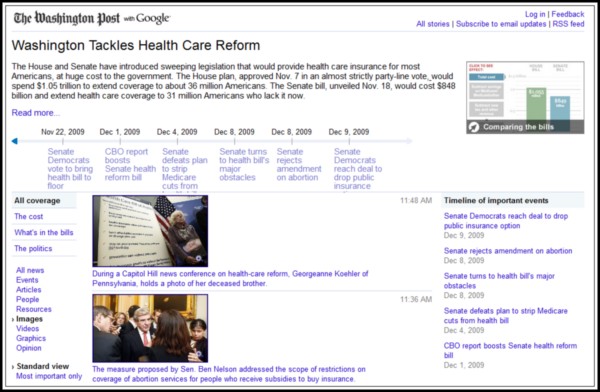
So the concept that Google Labs began attempting yesterday with its "Living Stories" concept (whose name for some reason brings to mind a certain peacock) is absolutely not new. It's been discussed before, in some fashion or another, and even approved -- for what it's worth. But on a large scale, it's never been done until yesterday: assembling all the stories relating to a pertinent, current topic on a page devoted to the topic, not the publisher and not some permanent department of the publication like "Sports" or "Tech."

Google Maps doesn't prevent car accidents, only search accidents
Those of you who follow my Tweets (@TimConneally) know that I got into a car accident yesterday. Nothing too serious, mind you, just a little unexpected voyage into converging traffic. I was hurriedly trying to obey my Google Maps turn-by-turn directions without noticing that the light I was approaching was actually red.
I'm not speaking against Google Maps navigation at all, but the incident successfully brought one of the application's new features to mind: Report Problems in Maps.

DOJ: Microsoft interop docs are now 'substantially complete'
Three years and seven months after Microsoft promised to produce full documentation for its communications protocols, so that licensees can figure out what they mean and how to use them, the US Justice Dept.'s Antitrust Division has declared that the documentation project is pretty much done. It's not completely done, but there's enough of it complete that Microsoft will now be allowed to collect royalties again.
In the Dept.'s latest Joint Status Report, now semi-annual and released today, the ATR Division writes, "As explained in prior Joint Status Reports, by 'substantially complete,' Plaintiffs mean that the documentation, when considered as a whole, appears on an initial reading to cover the information required by the templates in a reasonably thorough and comprehensible manner. The 'substantially complete' determination means that Microsoft may now end the MCPP [Microsoft Communications Protocol Program] licensee interim royalty credit and will be able to resume collecting royalties. This determination, while a significant milestone in the overall documentation rewrite project, does not mean that the documents are finished or that no additional work remains to be done. There is, in fact, much work left to do."

The $1 DVD rental debate: LA group says Redbox will lose movie makers $1B
We know many Hollywood studios view Redbox $1 DVD rental kiosks as a problem that must be kept in check. A recent report from the Los Angeles Economic Development Corporation (LAEDC) says those rental kiosks could represent a billion dollar drain on Hollywood's revenues.
The report, entitled "The Economic Implications of Low-Cost DVD Rentals" (PDF available here) characterizes those red boxes as pockmarks on the face of a sickened home video industry.
First impressions of Droid: Easy, breezy, friendly, if a little fat
Up to now, if you wanted a smartphone with power and without complexity, the only orchard you could go to was Apple's. With the arrival of the Motorola Droid, though, that's changed.
The Droid uses Google's Android operating system. It's not as slick as the OS in Apple's iPhone, but it's still a breeze to use, and it has some tricks of its own, like voice search. Yes, you can talk to this phone, and it will fill in your search terms. It's accurate, too. As a goof, I asked it to find "chronosynclastic infundibulum," and performed the search without a sneeze.

After telling US to mind its own business, Kroes slaps caps on Rambus royalties
The European Commission has agreed to a proposal by US-based memory parts designer Rambus, to limit its royalties that memory makers worldwide will pay for double data rate (DDR)-based memory units to 1.5% per unit, and DDR memory controllers to 2.65% per unit. This in order to put to rest an ongoing EC investigation into Rambus royalties practices -- one which continued long after the US Supreme Court upheld an April 2008 Appeals Court ruling that stated the entire global memory standards system had lost its credibility.
During a morning press conference in Brussels Wednesday, EC Commissioner for Competition Neelie Kroes told reporters Rambus made this offer in order to redress prior conduct: specifically, manipulating the memory standards process in order to claim exclusive rights to high royalties.

Why Apple succeeds, and always will
Simply put: Apple doesn't play by the rules. It reinvents them. Apple applies what I call "David Thinking" to its broader business, product development and marketing. Apple is David to Microsoft Goliath -- and other ones, too. Goliath plays by one set of rules. David choses to change the rules, which favor his strengths rather than those of Goliath.
David Thinking is most provocative and surprising when Goliath acts like David. After all, David sometimes becomes Goliath; Apple is a giant in music with iPod and iTunes Music Store. But David turned Goliath also risks making mistakes that would allow another upstart advantage. Today, Apple is both David and Goliath, depending on market.

EC's Kroes to US senators: Mind your own business on Oracle + Sun
12:15 pm EST December 9, 2009 · European Commission spokesperson Jonathan Todd confirmed to Betanews this morning that statements attributed by the Associated Press to Commissioner Neelie Kroes were "accurate" as the AP portrayed them, although he did add that they were unprepared remarks. This means the EC is unlikely to report those remarks as official. Todd declined to add anything further.
In an extraordinary parting shot from the outgoing European Commissioner on Competition, Neelie Kroes -- who transfers to oversight of the 'Digital Society' in January -- the Associated Press quotes her as having openly responded, in a speech earlier today in Brussels, to a request by several US senators. Those senators, led by John Kerry (D - Mass.) and Orrin Hatch (R - Utah), had asked Comm. Kroes to expedite her investigation of Oracle's proposed acquisition of Sun Microsystems.



