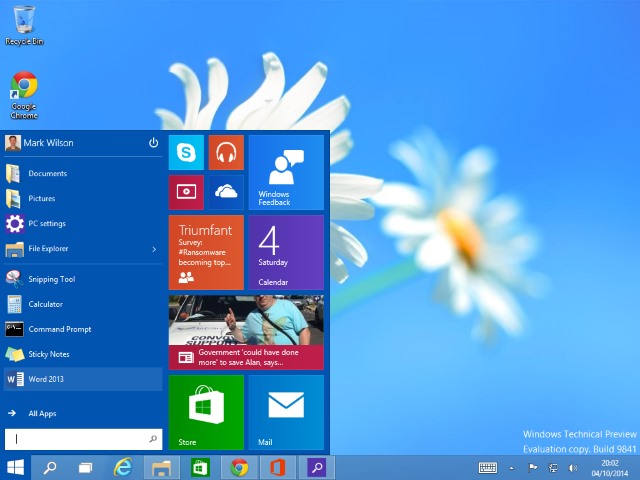
Start menu improvements coming in Windows 8.1 RT Update 3 in September
We already knew that Windows 8.1 RT Update 3 is coming in September, but recent Windows news has been dominated by the release of Windows 10. The update will be pushed out to Microsoft's Surface and Surface 2 tablets as well as other RT devices, and Microsoft Window's 10 FAQ pages have been updated to explain some of the improvements that users can look forward to.
Nothing has changed with regard to Microsoft's position on Windows 10 for RT devices -- this is still not going to happen. Updates to Windows 8.1 RT is the best that users can hope for, and now the company is starting to advertise -- through Windows 10 -- what the update will bring.
Windows 10 RSAT and Windows Server 2016 Technical Preview 3 coming this month
Microsoft's Gabe Aul has revealed that the company plans to release a new technical preview of Windows Server 2016 later this month. Responding to questions on Twitter, the company's Corporate Vice President and face of the Windows Insider program also said that Windows 10 RSAT will be launched in August.
Unlike the preview builds of Windows 10, previews of the latest edition of Windows Server have been slower to creep out of Redmond. Sysadmins will be keen to get their hands on the latest builds to see just what direction Microsoft is taking with its server software after the decision to delay the launch.

How to find your Windows 10 product key
If you upgrade your computer from Windows 7 or Windows 8 to Windows 10, you probably have no idea what your product key is for the latest version of the operating system. The time may come when you want to perform a clean installation of Windows 10, and this is when you'll need that key.
It is not possible to use your product key for your old version of Windows to activate Windows 10, but during the initial upgrade process this key is converted into a new one. Using a special tool, you can find out the key that has been generated for you so you can make a note of it for future reference.
Stay in control of your privacy in Windows 10
Over the past week and a half many thousands of people worldwide will have taken the plunge into Windows 10. But, as we've previously pointed out the free upgrade comes at a price in terms of privacy.
So what can you do to enjoy the advantages of Windows 10 without giving away too much of your information? Here are some tips to help you protect your details.
Windows 10 forces app updates on Home users but a September update could change this
Some Windows 10 users have been upset by the fact that updates to the operating system are no longer optional -- without using extra software, at least. Microsoft has now made it clear that the same applies to app updates. Updates to apps will be delivered automatically with no option to skip them.
This is not the first time updates in Windows 10 have caused unrest. As well as the mandatory updates debacle, the fact that updates are shared with other people to speed up delivery also concerned some users. But what has riled Windows 10 Home users about apps updates is the lack of choice and transparency.

Microsoft doubles budget for bug bounty program
You might think you have the best programmers in the world, but chances are there’s a kid in his parents’ basement somewhere who’s smarter than all your engineers combined.
That’s why bounty hunting for bugs has become hugely popular among software makers, employing pretty much every hacker worldwide in their search for overlooked bugs. Microsoft is one of such companies, and it’s using the Black Hat conference to promote its new bug bounty program, which sees the bounty doubled.
Microsoft open sources Windows Bridge to bring iOS apps to Windows
Microsoft is taking steps to try to ensure that the apps that people want to see on Windows are actually available. We've already seen the company woo developers with tools such as Project Westminster to make it easier to create Universal Windows Apps, and Astoria to help convert Android apps for Windows.
Project Islandwood was the same idea, but for iOS apps -- the idea is that by making it easy to convert apps for Apple's platform into Windows apps, Microsoft can use developers to plug the 'app gap'. To spread the project's net further, it has now been released under the name Windows Bridge for iOS and -- more importantly -- it has been released to GitHub as an open source tool under the MIT license.

Outlook for Apple Watch is the future of Microsoft
Satya Nadella is a man with a formidable challenge. Microsoft CEO's predecessor, Steve Ballmer, squandered the company's mobile fortunes. From smartphone platform leader a decade ago, the software-and-services giant is a category also-ran in 2015. Microsoft has no independent mobile platform future. The war is over. There remains this: Making alliances with old enemies to preserve existing territory, while using the foothold to reach into new frontiers.
Made available August 5th, Outlook for Apple Watch is a very smart move and metaphor for what went wrong on Microsoft mobile platforms and what has to go right to preserve and extend the legacy applications stack. While Windows 10 makes its way to Lumia devices, the future is Android and iOS and how the company supports them with contextually meaningful cloud-connected apps and services.
Microsoft: Windows 10 collects users' private information, but not for ads
It’s been a week since Windows 10 was released, and the biggest issue about Microsoft’s latest OS seems to be in the nature and the amount of private data it collects.
We recently wrote about Cortana, the digital assistant, and how much it collects, and now Microsoft has updated its terms of service agreement to better clarify what it collects and how it uses such data.

Microsoft's Outlook gains Apple Watch support
Apple Watch has been quickly gaining the support of major iOS developers, as more and more top titles have been updated to work well with the best-selling smartwatch on the market. So it should come as no surprise that Microsoft, with its increasing focus on mobile, has introduced Apple Watch support in the latest version of its Outlook mobile email client.
Apple Watch users have been able to take advantage of Outlook features prior to this update, which bumps up the app's version number to 1.3.5, but in a more restrictive manner. The official support, however, brings some new features that make Outlook much more useful on the smartwatch.

Windows 10 Start Menu wins major design award -- Microsoft proves haters wrong
When Microsoft unveiled its legendary Start Menu in Windows 95, it changed everything. The usability resonated with consumers, arguably leading to a huge increase in personal computer sales. While the menu remained mostly unchanged for many years -- apart from small additions and appearance tweaks -- Windows 8 replaced it with a Start Screen that consumers largely rejected. Things were looking bad for Windows for a while there.
Luckily, Microsoft was on the right track with the much maligned Start Screen -- its innovative live tiles just needed to be delivered in a different way. Enter Windows 10. The latest version of Microsoft's operating system combines the classic Start Menu with the best aspects of the Start Screen and so far, consumers seem to love it -- sentiment has largely been positive on social media. Want proof that the Windows 10 Start Menu is revolutionary? Look no further than the prestigious digital design award bestowed upon it today!

Microsoft pushes out a big update for Windows 10
There haven’t been many updates for Windows 10 since Microsoft launched its new operating system last week, but today the software giant is rolling out a cumulative update designed to "enhance the functionality of Windows 10 through new features and improvements".
If you’ve been experiencing problems with the new OS, as I have, then this update may go some way to overcoming them.

Upgrade to Windows 10 and your kids may no longer be safe
Parents who are upgrading their computers to Windows 10 are warned that the move from Windows 7 or Windows 8.1 will obliterate the safety features used to protect children. You may have spent time putting restrictions in place in a bid to keep your offspring safe when using your computer, but Windows 10 will change these child-friendly accounts into standard accounts with no limitations whatsoever.
The upgrade process wipes out website restrictions, game and app age ratings, time limits, and other parental controls and monitoring options. Unless a parent goes to the trouble of reinstating each of these settings individually, their children will have unfettered computer access. The discovery, revealed by The Register, will come as a surprise to many, but the worry is that many parents will simply be unaware that their children are not protected. And this is far from being the first time Windows 10 has been criticized.

The usual suspects top Forbes' Richest People in Tech list
Forbes today unveiled its inaugural 100 Richest People in Tech list. Comprising 100 billionaires, the top of the chart is dominated by all of the names you would expect to see -- Bill Gates, Larry Ellison, Jeff Bezos, Mark Zuckerberg, and Larry Page take the top five slots.
It's not just the names that are familiar. The US is the dominant country in the chart, with more than half of the list filled by American billionaires. The image of California as being the center of the world of technology is borne out by the fact that 49 of the top 100 hail from the western state. So, yes, Bill Gates tops the charts with $79.6 billion, but where are the other big names?