

AOL makes a move on Craigslist's classified territory
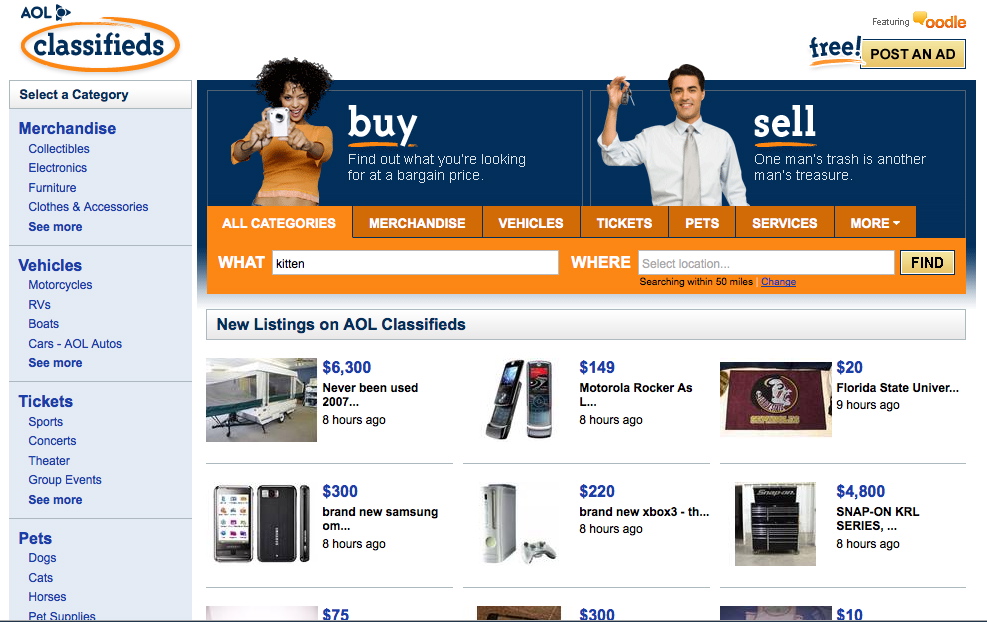
AOL Classifieds, which launches today in the US and Canada, allows sellers to post listings free, just as Craigslist does. (The service makes money from selling increased-visibility ads, sort of the way eBay makes money from the featured-auction option.) A UK version of the service will launch in the near future.
The service is powered by Oodle and aggregates listings from over 80,000 sources and 250 partner sites, many of them intensely local in orientation. Higher-profile members of the Oodle network include the Washington Post Express, Military.com Classified, MySpace Classifieds, Etsy, LiveDeal, and Local.com Classifieds.

AOL's Bebo becomes more of a SocialThing
By consolidating some of its acquired technologies, AOL now hopes that folding together functionality from two of its recent acquisitions will ease the pain.
AOL bought Bebo back in March 2008 for $850 million. The service, which is similar to Facebook or MySpace, skews young and is most popular in the UK, Ireland and New Zealand. In August, AOL picked up SocialThing, which is a "lifestreaming" service -- that is, it aggregates status updates and other information posted by friends on multiple social networks. FriendFeed is a lifestreaming application, and the Flock browser has lifestreaming functionality as well.

Novell lays off openSUSE Linux developers
Even before the proverbial ink was dry on last week's interoperability deal between Microsoft and Red Hat, Linux competitor Novell laid off a still unknown number of employees involved with the open source openSUSE community.
The openSUSE community has included volunteer developers in addition to paid employees of Novell, a major rival to Red Hat in the Linux space which forged its own interoperability pact with Microsoft in late 2006.

Vizio in a showdown with Funai over an HDTV patent
With the switch to digital TV (at least until a few weeks ago) having been scheduled for this month, and with more families having scrambled last Christmas to make an affordable upgrade to high-definition, the bad economic season ended up being a windfall for US-based Vizio. Its strategy of selling low-priced HDTVs mainly through Wal-Mart helped it improve its market share to clinch a strong second place in the US (with 14.3%) against Samsung, according to figures released just last week by hardware analysis firm iSuppli.
But that victory may have only managed to paint a red target on Vizio, with its competition now aiming for the heart of the company. Last year, an administrative law judge (ALJ) with the US International Trade Commission issued an initial finding in favor of Japan-based Funai, the long-standing also-ran in the electronics business which late last year acquired the right to use the Philips brand name for CE components in the US -- including for Blu-ray drives. Funai holds a key patent, issued in 2000, for a mapping system used by cable TV and satellite service providers -- essentially a way for set-top boxes and digital-ready HDTVs to tell which incoming video stream belongs to what program. And Funai has been charging TV manufacturers for the right to use that stream, even though -- as Vizio now contends -- the concept of the stream itself is critical to an ATSC standard that every manufacturer must follow.
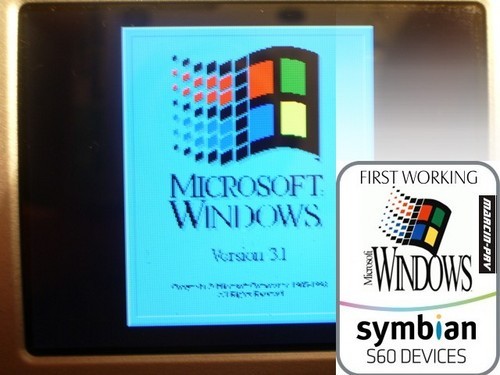
Windows 3.1 installed on Nokia N95
Polish bulletin board FrazPC last night received a post from developer and writer Marcin-PRV showing that he can successfully run Windows 3.1 simultaneously with Symbian S60 on a Nokia N95.
This feat could not normally be done by the N95's ARM processor, but thanks to an emulator known as DOSBox for Symbian, the ARM chip emulates the x86 architecture...a 486, to be exact, according to Marcin.

Red Hat rolls out Linux product family and strategy for virtualization
At a press conference today, Red Hat introduced a new virtualization product family that will use Kernel Virtual Machine (KVM) -- a technology acquired through Red Hat's recent buyout of Qumranet -- rather than Red Hat's long-time Xen hypervisor. The Linux leader said its objective was a pursuit of scalability, management, and interoperability with Microsoft's Windows virtualization platform.
Red Hat, though, will also release "specific tools and services to [help customers] transition to the next [virtualization] platform whenever they are ready," said Navin Thadani, senior director of Red Hat's virtualization business, speaking during the press conference. Red Hat will also continue to support Xen with security updates and patches through the current version 5 generation of Red Hat Enterprise Linux (RHEL), according to Thadani.
A more social way to sync mobile contacts
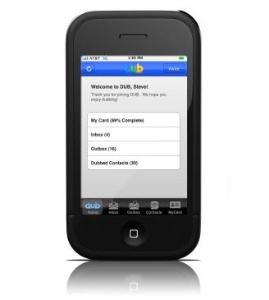
While major service providers like Google, Microsoft and Apple offer cloud-based contact synching for personal records, DubMeNow is like a mobile business card swap.
With the Dub application loaded onto a user's phone -- the company says all US mobile phones are supported -- the user's contact information can then be blasted out to e-mail addresses, phone numbers, or other Dub users. Let's say you meet a potential client whilst out somewhere, you enter that person's number into the Dub app, and it then sends all your flagged contact information directly to that person's address book. It syncs with Outlook and CRM apps such as Salesforce, Microsoft Dynamics, SugarCRM, and Siebel, allowing for a single contact to be sent to multiple recipients in one action.

Nielsen finds TV consumption at all-time high
Nielsen released its fourth quarter figures for TV, Internet and mobile video consumption in the United States has hit an all-time high.
The average US television viewer now consumes 151 hours of TV per month, roughly 20% of the total month, or 31% of their time awake, if eight hours of sleep are taken into account. Nielsen's "three screens" report considers traditional television viewing, Internet video viewing, and mobile handset video viewing habits when creating an overall picture of American TV consumption.
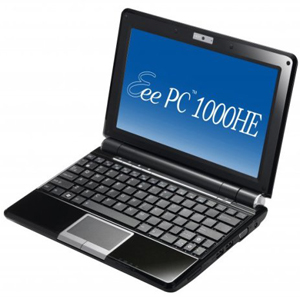
Eee maker Asustek ponders an Android netbook
Asustek -- which runs the Asus PC business -- has allocated engineers to develop an Android netbook as early as the end of this year. However, the Taipei-based company hasn't yet decided whether to proceed with a final product in this category, according to a report in Bloomberg, which cites Samson Hu, head of Asustek's Eee PC business, as the source of its information.
If Asustek does go ahead with a notebook based on the Google-driven Android platform, it could be an industry first. So far -- in terms of commercial products, at least -- the Android flavor of the Linux OS has appeared only on smartphones. At CES last January, Asus didn't exactly signal disinterest in the notion of notebooks or netbooks running Android.
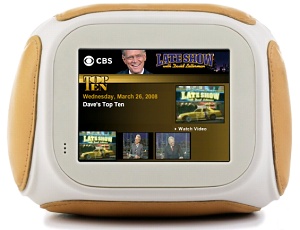
Broadcom brings the Chumby RIA platform to STBs, Blu-ray
This morning, semiconductor company Broadcom announced it will be bringing the Chumby open source widget platform to connected TVs, Set top boxes, and Blu-ray players.
Chumby began as a somewhat quirky device, which could be best described as a "social clock radio." Users set up a profile on the Chumby site which they then pair with their touchscreen Chumby device.

Microsoft seeks to Elevate the nation's tech skills
At the National Governors Association conference in Washington, D.C. on Sunday, Microsoft announced a program to teach basic and intermediate computer skills to, potentially, millions of Americans. The three-year Elevate America program will include one million vouchers for Microsoft eLearning courses as well as for select certification exams.
The vouchers will be distributed through state and local governments' workforce development programs. Microsoft originally planned to launch the initiative in three states -- Washington, New York and Florida -- but by the end of the day Sunday California, Colorado, Delaware, Minnesota and Virginia had climbed aboard too.

Capitol One phishing warning looks, well, fishy
An attempt by credit-card issuer Capital One to alert customers to ongoing phishing attempts may be causing more FUD than it's curing, according to an observer posting to the RISKS discussion list.
The latest issue of the RISKS Digest includes a wry note from Marc Auslander, noting that his Gmail account flagged the note, sent by a third-party mailer, as spam. When he alerted Capital One to the problem, he writes, "Their response is advice on how to turn the warning off! So much for their anti-phishing campaign." Indeed.

Microsoft biffs the severance-payout math
The proverbial adding of insult to injury was underway at Microsoft this week, only they seem to be having some trouble over there with the whole "adding" concept: TechCrunch is reporting that a number of laid-off Microsoft folk have received letters informing them that they were paid out too much severance... and please send the money back, kthx.
TechFlash has TC's back on this one, getting a Microsoft Saturday confirmation that yeah, the letters are real. (Your writer sends her personal sympathies to TF blogger John Cook; it was an awfully pretty day in Seattle to be working.) It's certainly a pickle for the company, entirely aside from the unknown amount of money involved -- press the issue and take a serious publicity hit, don't go after the cash and risk cranky shareholders. Seems nothing's ever easy in Redmond.

High-def culture shock: Blu_Ray makeup
Cosmetics company Cargo has infiltrated the consumer electronics lexicon. Now offering a line under the name "Blu_Ray," Cargo has produced makeup for those conscious of the flaw-exposing power of high definition cameras. The High Definition Make-up Essentials Kit "delivers a look that can easily stand up to high-definition filming, so you will be ready for your close-up."
For those wondering: Yes, "Blu_Ray" is an official trademark of the Cargo cosmetics company, obtained in May 2008. Also be on the lookout for Italian-designed "Blue Rey" clothing to wear when being filmed.

AMD: Considering the chips that comprise the cloud
In all the talk lately about "the cloud," the topic of computer processors doesn't always happen to float by. But it should, according to AMD's Margaret Lewis.
As AMD's director for commercial software solutions and strategy, Margaret Lewis chimed in with representatives of Accenture, Amazon, Red Hat, The Shumacher Group, and the IDC analyst firm in a star-studded panel discussion about cloud computing earlier this week.