
For those who missed Google Voice beta, Ribbit Mobile opens in beta
Some of us missed the boat and never got in the Google Voice beta test group. With all the controversy the service stirred up among the media, the public, telecommunications companies, and the FCC, there's a distinct possibility that Google Voice as we know it could end up in regulatory limbo after being politicized and thrown into the "net neutrality" conflict.
Today, a beta of an alternative has opened up: Ribbit Mobile from Ribbit, an independent British Telecom subsidiary often billed as "Silicon Valley's first telephone company."

Could Google be killing Google Groups over and over again?
The death of Usenet has been proclaimed for well over a decade now, but the use of some derivative of the Internet's NNTP protocol for the trafficking of messages -- some of which are actually parts of legitimate conversations -- continues today. In fact, it probably can't really be stopped since, as is the case with a P2P network, no one really owns Usenet.
Since 2001, the Web's portal to Usenet has been Google Groups, the successor to the Deja.com archiving system. Google's plans to make something of Google Groups stretch as far back as 2004, with promises to make the experience more personalized and exciting. For the most part, Google Groups provides organizations with an expense-free system for broadcasting memberships to select groups on an opt-in basis.
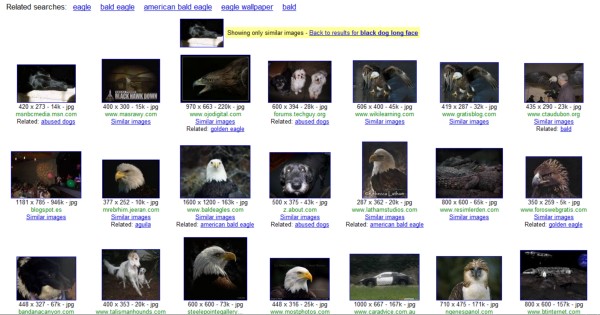
How useful is Google's 'Similar Images?'
Let's face facts: The real reason you'd ever want a search engine to locate "similar images" to one or more you're observing at the moment, is because you're not certain of what you're looking for or what you want to find. A search for photographs that look like da Vinci's Mona Lisa is going to turn up more pictures of the same Mona Lisa. And while a search for photos that look like Paris Hilton will turn up more photos of Paris Hilton, a search for photos that look like other one-hit wonders like William Shatner will turn up pictures of folks we may have never heard of, like someone named Mike Vogel.
So while Google Labs' pre-built experimental searches for its first public incarnation of Similar Images, unveiled Wednesday, does demonstrate an uncanny ability to isolate Paris Hilton pictures from its index, the fact that most of those pictures are labeled "Paris Hilton" anyway suggests that these are not real-world experiments. In the real world, people are looking for a picture of that person in that show with the other guy with the weird hair, or a painting from an artist with the funky name. They're looking for the imaging algorithm to fill in the gaps for the information they don't have on hand, not to demonstrate the ability to mimic a successful search when the information is in front of our face.

Google flexes Twitter integration with Social Search Lab
Monday, a new experimental Google search feature called Social Search was made live in Google Labs, following up on last week's announcement that Google and Twitter had established a partnership.
But the implementation of this Twitter data is much more conservative than many were expecting. Following the Web 2.0 Summit in San Francisco, a lot of talk in the search community revolved around "Realtime Search," (a buzzword formerly known as "conversational search") where chatter (articles, blog posts, comments, forum entries, status updates, tweets, videos, and podcasts) on a particular subject is indexed in real time, putting searchers more or less directly into the conversations as they occur.

Web search in a post-Twitter world
We all contribute to the news cycle when we post timely content online, even if it's 140 characters or fewer, and this week we learned that our little bits of information have substantive value when search giants Google and Microsoft announced that they will index our tweets and status updates.
But the sheer volume of content that we produce could be a problem, and Twitter users who find day-to-day value in the service may scoff at the idea that the "information firehose" of live content can be tapped and made searchable. It doesn't take extensive use to see that most tweets are in fact worthless, and that thousands of bots simply use Twitter as a tool for free promotion, by tagging links to a particular Web site with trending topics.

Twitter hooks up with Google, Bing
WIthin hours of one another, Microsoft and Google announced that their respective search engines would begin indexing tweets from popular microblogging service Twitter.
Microsoft was first on the scene, when Redmond's President of Online Services Division Qi Lu announced the beta of Bing.com/twitter had opened at the Web 2.0 summit today. The beta provides a real-time index of tweets, and the ability to rank tweets according to its relevance.

Clever Adobe compilation trick sneaks Flash apps onto iPhone
Up to now, Apple's prohibition against anyone's runtime modules from appearing on its iPhone without authorization has been one of two central reasons that Adobe's Flash video and Flash platform have not made their appearance there -- the other reason being simply that Steve Jobs doesn't like it.
But at its annual MAX developers' conference in Los Angeles this week, Adobe's engineers unveiled a surprise: It's planning a public beta release of Flash Professional CS5 that will go through a new and unique set of hoops to enable developers to write or export apps built for the Flash runtime, to run on the iPhone as native apps. The new Flash Pro will use a mechanism for Flash application developers to deploy their apps on the iPhone anyway, even without the Flash mobile runtime.
Having purchased its competition, Google joins Flash video group
Two months ago, Google announced its intention to purchase On2 Technologies, the producer of the technology behind the Ogg Theora codec that was the prime candidate earlier this year to become the open video solution for HTML 5. Google's engineers had come out in opposition to Ogg Theora, and that fact was cited by the HTML 5 working group as reason for its suspending efforts to incorporate open video for this version.
Whatever Google's reasons may have been for purchasing On2, not everyone in the company appeared to be interested in advancing the format. Today, that sentiment appears to have been made official, with the announcement during Adobe's MAX conference in Los Angeles that Google is joining Adobe's Open Screen Project, established last year.

Sitting out Google Wave
I've decided I won't be part of the 100,000 or so special folks who are already rolling up their sleeves and digging into the guts of Google's newest uber-desirable online application, the private beta of Google Wave. This will give some poor fellow extra opportunity to troll eBay, bidding $100 or so for an invitation.
It's not like I'm eschewing some exclusive community. Like Gmail before it, Google Wave accounts will eventually be freely available to anyone with a pulse. But unlike Gmail -- which remains in the limelight with regular updates delivered to a widespread base of users who passionately use the service -- Google Wave's lifespan likely won't be as charmed.

Flash 10.1 to bring rich Web apps to Palm Pre, WinMo, making iPhone an island
It's quite easy for Adobe to throw around statistics about Flash, and you'll frequently hear members of the Adobe team say such things as "Adobe Flash is installed on 99% of PCs," or "75% of all online games are built in Flash," or "80% of all Web video is encoded in Flash." Though these statistics are dubious, there is little doubt about Flash's ubiquity.
But as mobile Web consumption has dramatically increased, mobile Flash technology has been struggling to deliver the full Web experience to resource-constrained devices. As Apple CEO Steve Jobs famously commented in mid-2008, the full version of Flash was too big, and Flash Lite was too small. What Flash lacked was a product "in the middle" that could fully deliver rich Internet content without also consuming a lot of CPU cycles.

Google bites Bing back, recovers all usage losses since spring
If the last two months should be interpreted as Microsoft suggests, with Bing's gradual ascent in usage share against Google as a sign of Bing's inevitably catching up, then a similar interpretation of September's numbers from live analytics firm StatCounter should be taken as a sign of Bing's ultimate demise. A sampling of five billion or more US page views from Web sites accessed by StatCounter in September reveals that, of the world's top three search services, Google's usage share has climbed back just above 80%, and is flirting with last November's peak of 81.14% -- meaning Google is back to serving four out of five US-based general queries.
Bing's usage share in the US descended by 1.13% to 8.51% for the month of September, while Yahoo's dove 1.1% to 9.4%. Google's share among the top three has now climbed above where it stood in May (78.72%), when Microsoft changed the name of Windows Live Search.
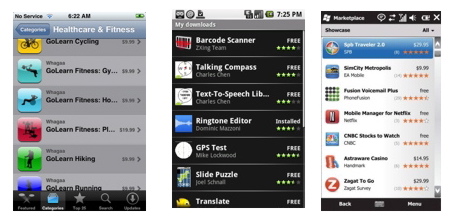
The virtual mega-mart: Apple's oversized App Store
By all definitions, Apple's iTunes App Store is a massive success, with sales numbers that would make McDonald's franchisees green with envy. Two billion applications -- half a billion in the last quarter alone -- have been downloaded since the store went live just over 14 months ago. With over 85,000 apps, it puts every mobile platform competitor to shame. The 125,000-strong iPhone Developer Program and successive evolutions of iPhone and iPod touch devices should keep driving growth for a while.
This is all obviously good for Apple, because a vibrant online App Store naturally drives demand for its high-margin hardware. And in the case of the iPhone, AT&T and other partner-carriers benefit from carrying a device whose sales are driven not only by desirable hardware, but by the ability to easily turn the device into pretty much anything the end user wants. The paltry few-thousand choices on Research In Motion's BlackBerry App World, or Palm App Catalog's even paltrier few dozen apps, end up serving as inadvertent advertisements for the iPhone.

Google Wave expands, in search of a clear use-case scenario
Today, Google is expected to invite as many as 100,000 more participants into the private beta of its concurrent communications system, called Wave. As that happens, many more participants will be able to not only communicate with one another in a more granular form of real-time, but potentially collaborate on work and projects.
It's that latter part of the program that's supposed to congeal at some point into a collective sense of purpose. But this time, unlike Microsoft's first experiments with Dynamic Data Exchange between applications on the same computer three decades ago, there isn't yet a clear, single purpose for the system. No question it could bring individuals as close together as people separated by indefinite distance could become; but as to the question of what they do with one another once they do get together, Google is hoping this question -- like so many others it puts out there in the open -- resolves itself.
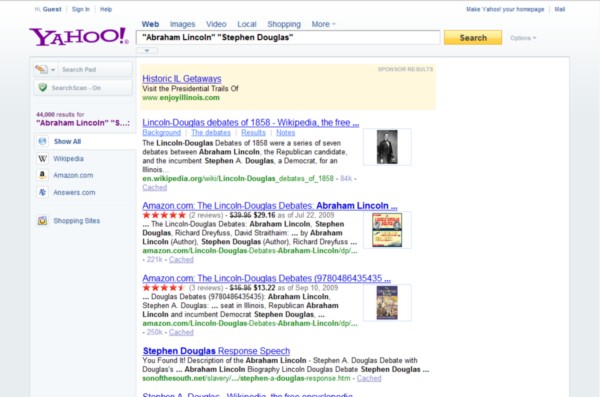
Google vs. Yahoo vs. Bing on 'deep linking:' Does it make any difference?
This week, all three of the world's top general search engines touted the addition of deep links to their search results, although Google has been actively experimenting with deep links since this time last year. The basic premise is this: For Web pages that have named anchors above selected subsections -- for example, <A NAME="Details"> -- the search engine is capable of generating subheadings in its search results that link users directly to those subsections, or at least to subsections whose titles imply they may have some bearing upon the query.
The fact that deep links are now official features of Google, Yahoo, and Bing search may not be nearly as relevant today as the fact that all three services made their announcements almost in unison. It's an indication of an actual race going on in the search engine field, reminiscent of the horse-and-buggy days of the early '90s when Lycos and AltaVista were vying against Yahoo for search supremacy. This despite the fact that Yahoo is due to be utilizing search results generated by Microsoft's search engines Real Soon Now.

Labels and studios could have access to your YouTube metrics
YouTube Insight really is an amazing free tool. For users who have uploaded content to Google's popular video sharing site, YouTube Insight provides extremely concise metrics for a video's viewership. It includes maps that show where in the world your video has the most viewers, your audience's demographic makeup, and even a second-by-second audience attention metric.
Today, Google announced that YouTube Insight has been tied into YouTube's Content ID, the management tool that lets broadcasters, studios, labels, and individual copyright holders to identify videos uploaded to YouTube containing their intellectual property.