
The most popular stories on BetaNews this past week March 9 -- 15
This is the week that saw the web celebrating its 25th birthday and Tim Berners-Lee took the opportunity to call for a web bill of rights, which I argued is essential for the future of democracy.
Another week means a fresh batch of security concerns. In Europe, users were warned of the dangers of connecting to public wifi hotspots, while a new report found that cybercriminals are becoming increasingly sophisticated in their techniques. Ian was on hand with advice for anyone trying to tackle or avoid viruses.

Concord Hospitality wisely chooses Chromeboxes instead of Microsoft Windows
Choosing the right computer for a task can be tricky. If you spend too little money, you may buy an under-powered machine with poor performance. Conversely, if you spend too much, you may end up with too much power, effectively wasting money. Finding the balance is key.
Chromebooks and Chromeboxes are all the rage lately -- they are great computers if they meet your needs. For many businesses, they would be a bad choice. You see, the firms may need Microsoft Office and other specialized software, which will not run on Google's Chrome OS. However, if your needs are browser-based, it is a great choice. One such company, Concord Hospitality, is utilizing Chromeboxes with great results.
How to assign custom address bar keyword for Google Search query, function
If you repeatedly use Google Search for a certain query, like "breaking news", you have to type in the same thing, every time, in the browser's address bar to get the results. It can quickly get irritating. Luckily, there is a more efficient way to do it -- you can assign a custom keyword.
To give you an example, you can set the combination "bn" to substitute "breaking news". You can then use the keyword instead, to see the respective results. This trick works with various functions Google Search offers, like isolated site queries (triggered by "site:", followed by what you are looking for). It is incredibly useful in day to day usage.

Google's Chinese web encryption is nothing more than PR and posturing
We are spied upon. Someone, somewhere, knows what you have been doing online. It might be your snooping friend taking a look at your browsing history, or it might be that weird looking guy on the next table in the coffee shop watching your every click. It might be advertisers using cookies, or it could be your own government. This is now just about expected; it is part and parcel of using the internet. In some parts of the world, access to the internet is not only monitored, but also restricted and controlled. But it didn’t used to be like this, and it needn't stay like this.
In some regions the idea of mass spying is a relatively recent concept. The activities of the NSA, GCHQ and other government organizations are something only the most recent generation of internet users is "used" to -- for the rest us, it is at best an unpleasant sea change, and at worst just the tip of the iceberg. As it was revealed that governments were not only spying on citizens' online activities but also getting other companies involved by requiring them to hand over user data, big names such as Microsoft, Google, and Apple were falling over themselves to appear to be going out of their way to reveal everything they could about the demands made of them. It was the PR machine in action, trying to make the best of a very, very bad situation.

Hey, Google! Please be open and honest with your search ads
It may not be a new season, but it's time for a Google makeover nevertheless. This time around it is the search results page that has been given a lick of paint, although you might be forgiven for not quite being able to put your finger on what's changed. You'll almost certainly notice that things look a bit different, but the details may escape you. The changes were put in place yesterday, having been heralded on Google+ by Google search designer Jon Wiley who explains that the subtle changes are to bring the desktop look more in line with that used on mobile devices.
The size of search result titles has been boosted, and the underline that was present has now been removed. Wiley says that "we've […] evened out all the line heights [which] improves readability and creates an overall cleaner look". This all sounds great in principle. After all, as Wiley points out, it helps to make "the multi-device experience more consistent". But it also ushers in a few concerns.

Google Drive price cut gives a little and takes a lot
This week, World Wide Web inventor Tim Berners-Lee calls for a "bill of rights" for the Internet. Much of the media coverage focuses on governments, but I see corporations as greater concerns. Who has more direct access to your stuff? Google is front and center, but by no means alone, profiting from your content.
Today's big Google Drive price cut -- $1.99 and $9.99 monthly down from $4.99 and $49.99 for 100GB and 1TB, respectively -- makes me wonder. The search and information giant offers more value for less money. The question: Who benefits more? Customers paying less, or Google getting their business? I have to wonder when, if not already, the company will use contextual data gathered from your Drive for targeted everything, from Now to ads and more.
Google Street View paddles down the Colorado River
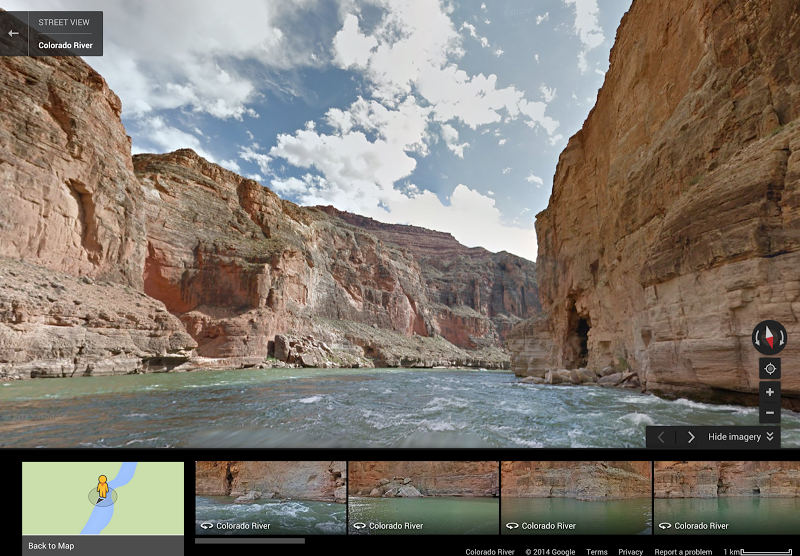
Despite its name, which stems from the location of origin, the Colorado River is most famous for its winding path through the Grand Canyon in Arizona. From there, it makes its way on to Baja in Mexico and finally a terminus at the Gulf -- a 1,450 mile journey.
If you haven’t seen the river, or the canyon (and I highly recommend doing so) then Google Street View will now give you a sense of what it is like. The search giant teamed up with American Rivers to capture the images seen in this latest update.

Eek! Android WhatsApp database can be stolen and shared by other apps
The Android version of WhatsApp, the cross-platform messaging tool recently snapped up for $19 billion by Facebook, contains a security flaw that means its chat database could be accessed by any app and uploaded to a web server without user knowledge or intervention. It's not clear whether this vulnerability has yet been exploited, but a proof-of-concept attack by Bas Bosschert (consultant, sysadmin and entrepreneur) shows that it is not only possible, but also incredibly simple. To cut to the chase, the answer to the question posed by Bas' brother, "is it possible to upload and read the WhatsApp chats from another Android application?", is "yes, that is possible".
In order for an "attack" to be successful, a user must have granted the app access to the SD card. As Bas points out, "since [a] majority of the people allow everything on their Android device, this is not much of a problem" for an attacker to overcome. Assuming this setting has been enabled, there really is very little work to be done. With a webserver at hand, it is quite easy to create an app that seeks out WhatsApp's database and uploads it ready for perusal.
Google adds new monetization options for Chrome apps, extensions, and themes
Google has announced new monetization options for Chrome Web Store apps, extensions, and themes, giving developers a better chance of generating decent revenue from their offerings. The search giant has also introduced new tools and services that are meant to make it easier to automate the publishing process.
The new available monetization options depend on the type of Chrome software. In the case of themes, developers can only list them as paid. Meanwhile, extensions can also get a free trial, subscription and in-app payments. On top of upfront payments and subscriptions, packaged apps now offer a free trial and in-app payments, in the latest change to the Chrome Web Store.
Google improves Docs and Sheets with add-ons
For many, Microsoft Office is the best office suite. It is chock full of features that makes it ideal for power-users. A major corporation cannot realistically depend on anything else. Sure, a small business or student can get by with Libreoffice or Google's web apps, but a Fortune 500 company would be foolish to do so -- at least today.
Not everyone is a power-user though -- having too many features can ultimately become noise. This is where Google's Docs and Sheets shine -- they are simple and meet basic needs. However, that does not mean the software cannot evolve. Quite frankly, Google is a company that is a leader in evolution and forward thinking, so its software is always gaining new features. Today, the search-giant announces an evolution in Docs and Sheets with the ability to utilize add-ons.

Majority of mobile devices will be 64-bit by 2018 -- is Apple to thank?
Apple is revolutionary through evolution. The company did not invent the tablet, but the iPad sparked the modern trend. It did not invent the touchscreen smartphone, yet the iPhone revolutionized portable computing.
Speaking of the iPhone, last year, Apple introduced the iPhone 5s with a 64-bit processor. The fruit-logo company certainly did not invent 64-bit computing, however, competitors are now playing "me too" and trying to catch-up in the mobile sector. According to a new study, the majority of mobile devices will be 64-bit by 2018. Do we have Apple to thank?
Chromebook users can grab a 60-day free trial of Google Music
I'm not going to rehash all of the reasons Microsoft has to show concern over rival Chrome OS, but now Google is providing one more to add to that list. It's not major, and likely won't sway someone's decision towards a Chromebook, but it heaps another straw onto the camel's back.
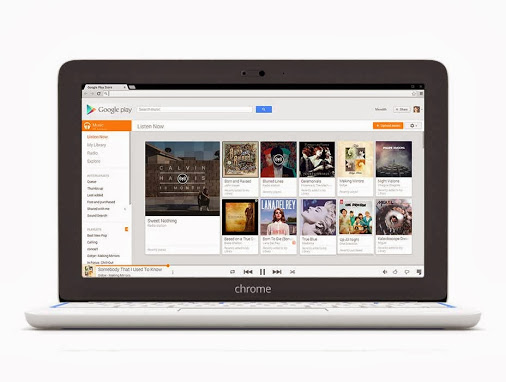
The search giant is offering a 60-day free trial of its Google Music All Access, which normally costs users $9.99 per month -- or $7.99 if you got in very early, as I did.
Chromebook belongs to computing's past, not its future
Early this evening, I exchanged emails with someone writing a blog post about Chromebook. He seeks sales numbers that I doubt are available. Success is a difficult measure despite the hype. In January post "The trouble with new Chromebooks" here and "Twenty-Fourteen isn't Year of the Chromebook" on my personal site, I raise questions about the computer's future.
I extend reservations in the text of my email reply, which follows.
Google embraces open source for 10th year of Summer of Code
For many, open source is believed to be the future. If you aren't familiar, in basic terms, open source is software that is accompanied by free to distribute source code. By having the source code, users can see the guts of the program they are using. This is in contrast to closed source software, like most of Microsoft's, where the code is hidden to retain intellectual property and make a profit.
Neither school of thought is wrong -- you can't fault a company for trying to make money by going closed source. Bill Gates would not have become the richest man in the world if Microsoft's software portfolio was open. However, not everyone lives for money. Open source allows even the poorest people to potentially access quality software at no charge. Today, Google announces it is looking for college students to work on open source projects for its 10th year of Summer of Code.

The most popular stories on BetaNews this past week March 2 -- 8
It's been a busy week for Microsoft -- and not necessarily for the reasons the company might have expected. For anyone unwilling to wait until April to receive Windows 8.1 Update, a few methods emerged that made it possible to grab a copy of the eagerly awaited update ahead of the official launch. While some of these options appear to have been stopped in their tracks, where there's a will there's a way, and numerous users -- my good self included -- jumped on the downloads as soon as possible. Some were impressed while others -- yep, me again! -- were not. Perhaps it is little wonder that Windows XP usage continues to grow faster than that of Windows 8.x. This lead to analysts suggesting that the decline of the PC will be slowed rather than avoided by the continued popularity of XP.
Windows 8.1 Update wasn't that only Microsoft download that was on the agenda this week. Brian had details of how Windows RT users can update their copies of Office 2013 to SP1. At the top of Microsoft, a quick reshuffle saw a change of faces in a number of key positions as well as the departure of some well-known characters. Skype rolled out to Outlook.com around the world and gained HD video calling as well. It is normally Microsoft that is to be found on the giving-end of a smeary advertising campaign (hello, Scroogled), but after the Oscars it was Nokia poking fun at Ellen DeGeneres' blurry selfie that was taken on a Samsung device.