
Google is working with iRobot to map the inside of your home and share data with smart devices
Google is all about data, and there have long been concerns about how the data it collects is used and the associated privacy issues. As such, the company's latest collaboration is likely to raise a few hackles. Google and iRobot are joining forces to use data collected by smart vacuum cleaners like the Roomba i7+ to create maps of the inside of people's homes -- and then share that data with other smart devices.
The partnership is described by iRobot as "a collaboration with Google to integrate robotic and smart home technologies that will advance the next-generation smart home". What this means in practice is that devices other than your vacuum cleaner will not only know the layout of your house, but will know what you mean when you refer to specific rooms -- and devices will be better able to interact with each other.

UK hits Facebook with maximum possible fine for Cambridge Analytica privacy scandal
The UK Information Commissioner's Office (ICO) has penalized Facebook for the Cambridge Analytica data scandal by fining it the maximum amount permissible under law.
But the fine is unlikely to make Facebook break a sweat. At just £500,000 ($645,000) the sum represents a miniscule percentage of the social network's income. There will undoubtedly be arguments that this is little more than a rap on the knuckles for failing to protect the private data of at least a million Facebook users in the UK.

Early adopters delay IoT purchases over security concerns
While people are still excited about Internet of Things technology, many are delaying buying over concerns about privacy and security.
A new survey from cyber security company F-Secure shows that 63 percent of early adopters are looking to purchase new devices, but 50 percent have delayed an IoT purchase because of security concerns.
Privacy: Google makes it easier to delete your search history
It's the butt of many jokes, but your search history -- as well as your browsing history -- can be hugely revealing about you. While it is possible to quickly clear the record of searches that your browser stores, it is not so easy to delete the records stored by Google. At least that used to be true.
Google has just announced a new option that enables you to view and delete your Google search history, making it possible to take control of some of the data stored on the company's servers. Contrary to what you might expect, the option is not being hidden away, but will instead be accessible from a Google search. What's more, the company says that similar options will be coming to Google Maps and other Google services next year.

Tim Cook calls for 'comprehensive federal privacy law in the United States'
Speaking at the International Conference of Data Protection and Privacy Commissioners in Brussels, Apple CEO Tim Cook praised Europe's GDPR (General Data Protection Regulation) and said the US needs to fight back against the weaponization of personal data.
In a strongly-worded speech, Cook avoided explicitly naming the likes of Google and Facebook for trading in private information, but it was clear who he was referring to when he said data was being misused. He added: "We shouldn't sugar-coat the consequences. This is surveillance".

Goodbye noisy neighbors, I quit Nextdoor
Six days ago, Facebook notified me that my personal information had been pilfered in a recently revealed hack affecting tens of millions subscribers. Lovely. Why don't you kick me in the head, too, Mark Zuckerberg? Perhaps you would prefer a baseball bat, so you can beat me to death instead? I responded by removing most of the same information from my FB and started a content purge ahead of possible account deletion.
Since then, I have been on a social media account rampage, which turned my sights to Nextdoor, where I joined on Aug. 29, 2017 (my Facebook is 12 years old, for comparison). When checking privacy settings, I discovered that the social network lists your actual address (presumably by default) for locals to see. The only other option is the street where you reside—what I switched to. Do I really want cranky neighbors coming up to my door and rap-rap-rapping? Or provide would-be burglars a place to break into, after observing my habits and schedule online and off? Eh, no! I appreciate that someone had to invite me to Nextdoor, which verified my residence to be part of the local network. But sharing my street or actual address is too public for me. Late yesterday afternoon, I deactivated my account. But reasons are bigger, with the privacy thing being but one.

Apple gives US customers the chance to download their data and updates its privacy page
All of the major technology companies suck up swathes of data about their users, and Apple is no different. While the iPhone-maker may not swallow up anywhere near as much personal information as the likes of Google and Facebook, you may well still be interested to know what the company does hold about you.
With the introduction of GDPR, Apple made it possible for people in Europe to download their data. As promised earlier in the year, the company has now expanded this feature to the US.

Financial firms not keeping up with electronic communication risks
In a world of evolving technologies and shifting demographics within the workforce, and within firms' customer bases, organizations need to rethink their approach to the adoption and oversight of electronic communications.
But a new study from data archiving specialist Smarsh shows that financial organizations are not keeping pace with their retention and supervision efforts -- particularly with a growing, younger workforce that relies on expanding, mobile-friendly channels, such as social media and text messaging.

Facebook says it could use data from Portal devices to target users with ads
When Facebook unveiled its Portal and Portal+ video calling hardware last week, there were immediate concerns voiced about the privacy implications of the social network's new devices.
Facebook has been insistent that Portal is "private by design", and the company said no data -- such as call logs and app usage information -- would be used to target users with ads. Now the company has changed its mind and says that actually it could be hitting users with targeted ads.

Privacy: Twitter is under investigation for data collection through its link-shortening system
Twitter is being investigated by the Irish Data Protection Commission (DPC) over concerns about how much data it collects through its t.co link-shortening tool.
The Irish privacy regulator is concerned about the amount of data Twitter is able to collect through the service -- something that was only heightened by the company's refusal to hand over information about link tracking when it was requested.
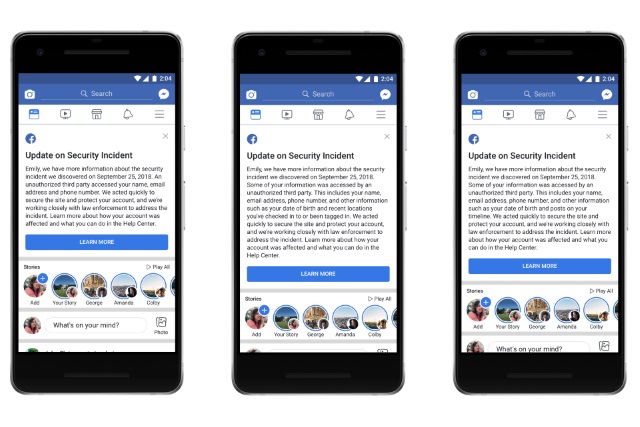
How to see if you were affected by the huge Facebook hack
The most recent Facebook security issue is one of the most serious yet for users of the social network. Depending on which numbers you are look at, the hackers who exploited a security flaw have impacted on anything between 14 and 30 million people.
Facebook is still -- with the help of law enforcement agencies -- investigating the incident, and in the meantime many people feel as those they are being left in the dark. If you want to find out if your account has been affected, here's what you need to do.

Businesses risk penalties by not wiping data from old equipment
New research from IT procurement company Probrand shows that 68 percent of UK businesses have failed to wipe the data from IT equipment before disposal, leaving them open to fines under GDPR if data is exposed.
In addition 70 percent admit to not having an official process or protocol for disposing of obsolete IT equipment.

As trust in Google wanes, interest in privacy-focused search engine DuckDuckGo soars
Google has long been eyed with suspicion, and incidents such as covering up potential data leaks does nothing to help. Privacy and security have increased in importance for the average internet user, and this has seen people moving away from Google and investigating the alternatives.
One beneficiary of this shunning of Google is DuckDuckGo. The privacy-focused search engine has enjoyed a 50 percent surge in usage over the last year, and it can now boast a new record of 30 million daily searches.
Two out of three worry about identity theft but half still engage in risky behavior
A new survey from identity management specialist SailPoint in conjunction with US National Cybersecurity Awareness Month finds two out of three professionals are extremely concerned about their personal identity being stolen.
Yet despite this half admit that they would participate in the types of risky behavior that increase the threat of leaked information and a potential breach.

77 percent of CISOs get conflicting advice on changing regulation
A new report released ahead of the Infosecurity North America event to be held next month, shows that the majority of chief information security officers (CISOs) are receiving conflicting advice about new or changing regulation.
In addition, when asked what regulatory bodies should do to help promote a smooth rollout of privacy regulations, 35 percent of respondents say that regulators should provide clearer communication about compliance requirements.