Not just Vista: The operating system is dying, too
Okay, so I raised a bit of a stink with last Friday's Wide Angle Zoom. So to make sure my position on Vista, operating systems, Microsoft and the future of the technological world under President Barack Obama's leadership are completely understood, I wanted to address some of the more...ah, pointed perspectives from the Comments section. I've paraphrased the wordings to protect the innocent. Here goes:
Vista is a great operating system. There's nothing wrong with it.

Can Linux do BitLocker better than Windows 7?
[NOTE FROM THE M.E. For over two decades, I've made a living in one way or another from being "the Windows guy." And in recent months, what you've been seeing from us at Betanews has been Windows 7, Windows 7, Windows 7 -- at one point, ten times in a row. Last month, I concluded our ongoing series about my picks for Top 10 Features in Windows 7. And I received a number of letters from folks who claimed that Linux did this first, or already did that several years ago, or does this better.
Really, now? Well, perhaps so. To find out for sure, I've commissioned a new Betanews series that seeks out whether, for features that Microsoft touts as supreme or new or of special value, similar functionality exists in some form or fashion for users of Linux client operating systems. To make sure I get a fair answer on this -- one that isn't biased in favor of Windows -- I've asked our Angela Gunn, who has more experience with Linux than I, to start digging. And to make sure she's digging in the right place, we've asked Jeremy Garcia, founder of LinuxQuestions.org, one of the Web's leading Linux user communities, to lend his voice to our evaluation. You and I are about to find out, once and for all, the answer to the musical question...]
Why would Windows 7 customers spend $120 more for BitLocker?
The fact that Microsoft will continue to offer consumers multiple versions of Windows when the company's new Windows 7 premieres on October 22, continues to stick in the craw of many who doubt there's any real demand for a less-than-complete edition of the operating system. Retailers continue to require a three-tier marketing approach, although Microsoft's choice of the name "Home Premium" this time around to refer to the lesser of its good/better/best tiers, continues to raise eyebrows.
But the questions about what's so Ultimate about "Ultimate" have only resounded more loudly, especially after CNET's Ina Fried brought the issue to a head early this morning. Since the only two differences that Microsoft's Web page mentioned between the Professional and Ultimate editions are the inclusion of BitLocker drive encryption and the multiple language pack (typically included with Windows' business licenses), prospective customers are asking what it is that makes Ultimate really worth $120 more than Professional.

Vista's dead: Microsoft kills an OS and no one cares
For anyone still burning a torch for Windows Vista, its time is rapidly approaching. Buy now or forever hold your peace.
I can't say I'm surprised at how any of this has turned out. After all, Vista's launch was, to be charitable, rocky. When it first arrived just before Christmas 2006, it was late, bloated and, for some, expensive. It may have looked pretty on the outside, but critics quickly pounced on it for driver incompatibility, sluggish performance on mainstream -- and sometimes even high-end -- hardware and enough bugs to fill a family-sized tent on a weekend camping expedition. Microsoft didn't help matters with its ill-fated "Vista Capable" designation -- a public relations debacle that convinced buyers who were too lazy to read the fine print that Vista would run just as well on hardware barely suited for XP.
Microsoft: Europe customers must wait to upgrade Vista to Windows 7
Microsoft spokespersons have confirmed to Betanews, contrary to press reports earlier today, that at some point it does plan to provide European customers with a Windows 7E upgrade package -- a way to upgrade Vista installations to Windows 7, while enabling customers to leave out Internet Explorer 8. In all cases, that means uninstalling IE from Vista, which current builds of the Win7 upgrade are not capable of doing.
"As part of Microsoft's decision to offer Windows 7 without a browser in the [European Economic Area], we also had another hard decision to make: Offer both Full and Upgrade retail packaged product and delay the entry of Windows 7 into market, or not offer the Upgrade packaged product at launch," the spokesperson told Betanews. "At this time, we will not offer an Upgrade packaged product in Europe, but in a way that does not penalize our customers."

HP, Lenovo lead off with the first free Windows 7 upgrades
Yesterday, Microsoft announced it was giving PC manufacturers the option to offer buyers of new PCs with Windows Vista pre-installed, starting today, free upgrades to Windows 7 on October 22. Betanews asked the big five PC manufacturers directly, will you be offering free upgrades? This morning, global #1 manufacturer Hewlett-Packard is the first to respond with an emphatic "yes."
"The program will enable customers who purchase qualifying HP PCs to enjoy the benefits of a new Windows-based PC immediately, and receive a free upgrade to Windows 7 when it becomes available in October," reads HP's statement to Betanews. "Following general availability of Windows 7 on October 22, qualifying customers will receive the Windows 7 upgrade and an upgrade utility disk with a step-by-step guide for installation at their convenience."

New Vista buyers can expect to pay more for Windows 7
After considerable confusion over whether Microsoft will offer free upgrades to Windows 7 for new PC buyers who find Windows Vista pre-installed, in an announcement this morning that required clarification, some confirmations, and a bit of editing, the company stated that it is leaving it up to PC manufacturers to determine how customers will get Windows 7 upgrades, and how much they'll cost.
Customers who already have Windows Vista on their PCs, Microsoft confirmed to Betanews this morning, can order upgrades to Windows 7 through Microsoft, but will pay full price to do so. Upgrading to Win7 Home Premium will cost about $10 less than upgrading to Vista Home Premium, however -- a difference between $129.95 for Vista and $119.99 for Win7. Upgrades to the Professional and Ultimate SKUs of Win7 will cost 4¢ more than did the corresponding upgrades to the Business and Ultimate SKUs of Vista -- $199.99 and $219.99, respectively. And the full retail prices for Windows 7 Home Premium, Professional, and Ultimate will be in alignment with the existing prices for Vista Home Basic (not Premium), Business, and Ultimate SKUs, except their MSRPs will now end in ".99" rather than ".95."

Tracking Vista's elusive 'Black Screen of Death'
What we've been calling a "perception problem" with Windows Vista -- the notion that users may tend to think it's less secure or reliable than it has proven to be on a large scale -- isn't just about perception for users faced with severe unreliability issues. As a Windows user for over two decades, I have been to the far depths of unreliability, and have lived to tell the tale. Probing the problems with Windows is actually part of my job, and one reason I actually am a Windows user -- unlike the rest of the world.
Yesterday, a problem that's far beyond perception afflicted a 64-bit Vista SP2-based Betanews production system for the fourth time in a year, this time with the remedy being so far out and unusual that everyday users could not possibly have discovered it by normal means. As we've found out, it's a problem that has affected a small number of Vista users since the system's debut three years ago, though that number appears to be growing steadily just as Vista is preparing to vacate the spotlight for Windows 7.
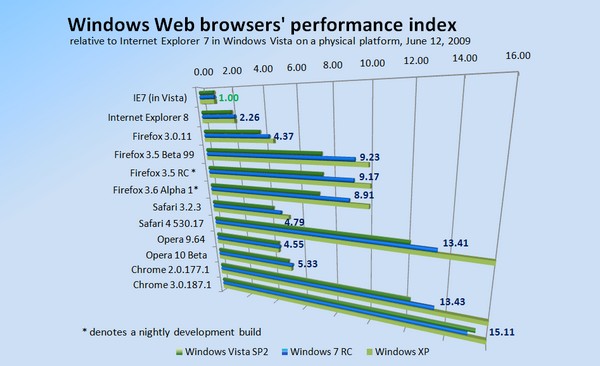
Firefox runs 11% faster in XP than Windows 7; IE, Opera run slower
Download Google Chrome for Windows 3.0.187.1 Beta from Fileforum now.
Since we began our periodic check of the relative performance of the rendering and JavaScript engines in Windows-based Web browsers, where we've seen them run about 14% faster on average now in Windows 7 RC than in Vista SP2, we've been asked...what about Windows XP? It certainly seems like the faster and more nimble platform of the three -- certainly all the netbook manufacturers seem to think so.
Microsoft to release Windows 7 in Europe without Internet Explorer
Saying that the company must abide by the law of the European Union, Microsoft Deputy General Counsel Dave Heiner revealed Thursday afternoon that it has made the decision to make a European "E" version of Windows 7 available to customers there, without Internet Explorer 8 bundled.
"We're committed to making Windows 7 available in Europe at the same time that it launches in the rest of the world, but we also must comply with European competition law as we launch the product," Heiner wrote. "Given the pending legal proceeding, we've decided that instead of including Internet Explorer in Windows 7 in Europe, we will offer it separately and on an easy-to-install basis to both computer manufacturers and users. This means that computer manufacturers and users will be free to install Internet Explorer on Windows 7, or not, as they prefer. Of course, they will also be free, as they are today, to install other Web browsers."

Top 10 Windows 7 features #1: Action Center
It's a sad fact which even Microsoft itself has stopped denying: The success of Windows in recent years has been despite the fact that the operating system isn't exactly embraced by its users. The percentage of Windows users who love Windows may not come anywhere near the percentage of Mac OS users who love Macintosh. Windows is what comes on most people's PCs.
In the past few months, Microsoft's marketing campaign has cleverly (and finally) diverted attention away from Vista, which on a public relations scale has largely failed to win the public's affection. Instead, you'll notice that the selling point of Windows recently is that it enables you to buy a bigger and better PC. Spend $1,500 or less and you're going to get twice the memory, twice the storage, and much better graphics. The word "Vista" doesn't even appear in the company's advertising. It's an effective argument -- what's more, it's accurate, and it's the strongest argument in Microsoft's favor.
Windows 7 to be released October 22
The news comes in advance of comments being planned for the Computex conference in Taiwan early tomorrow morning, by Microsoft Corporate Vice President for OEMs Steve Guggenheimer. There he is scheduled to officially deliver the news that Windows 7 general availability worldwide will begin on Thursday, October 22.
Microsoft's spokesperson gave Betanews a heads-up to expect comments from Guggenheimer concerning a program being called Windows Upgrade Option. That's precisely the title of an FAQ that was leaked to the public last month by the technology blog TechARP. That FAQ, which appeared to contain language directly from Microsoft, spoke about a low- or no-cost upgrade option for recent purchasers of consumer SKUs of Windows Vista.
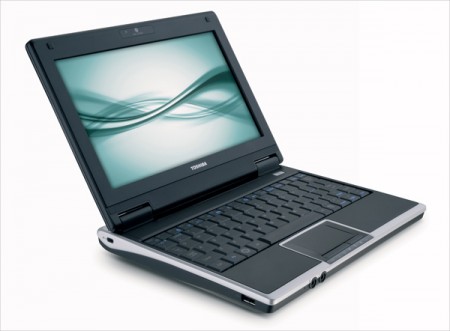
On second thought, Microsoft lifts Windows 7's three-app limit for netbooks
If it's a counter that's determining arbitrarily how many applications your limited edition of Windows 7 should be allowed to run, how much precious system resources does that counter consume? And couldn't that memory and space be put to better use, say, running an app? Where and how should netbook manufacturers tell customers they can only run three Windows apps at a time? These were the kinds of questions Microsoft's engineers have been fielding with regard to a limitation in the company's forthcoming Windows 7 Starter Edition, a SKU of the operating system it wants netbook manufacturers to pre-install.
In an indication this afternoon that all this listening to consumers' wishes may be giving Microsoft's people a headache, the company's Win7 evangelist Brandon LeBlanc announced this afternoon the addition to Starter Edition of a kind of feature, if not in fact the subtraction of a feature that nobody wanted: The three-app counter will be gone.
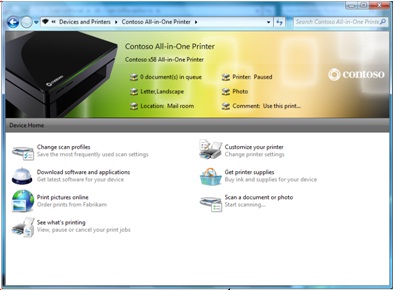
Top 10 Windows 7 Features #2: Device Stage
If the strange feeling that Vista was less secure than XP was topmost on critics' gripe lists over the last three years -- regardless of the facts which contra-indicate that feeling -- running a close second was the feeling that very little, if anything, outside of the PC worked with Vista when you plugged it in.
Here, the facts aren't all there to compensate for the feeling. Even in recent months, Palm Centro users complained about the lack of a Vista driver for connecting Centro to the PC outside of a very slow Bluetooth; Minolta scanner users were advised to hack their own .INF files with Notepad in order to get Vista to recognize their brands; and Canon digital camera owners are being told by that company's tech support staff that Microsoft was supposed to make the Vista drivers for their cameras, but didn't.