
So-called technical glitch robs Firefox of 6M to 9M downloads, Mozilla claims
Almost four months ago the European Commission opened an investigation after Microsoft failed to distribute the browser ballot to Windows users. The problem, according to the Redmond, Wash.-based corporation, only affected 10 percent of PCs, but Mozilla says there's more to it than meets the eye. Microsoft claims a glitch, lasting 18 months, caused the ballot to disappear.
Harvey Anderson, who works at Mozilla on business and legal affairs, revealed some numbers that portray the impact on Mozilla Firefox downloads. Prior to Microsoft fixing the problem daily downloads of the popular open-source browser decreased by 63 percent to 20,000 per day. After Microsoft decided to fix the issue the number of Mozilla Firefox downloads increased by 150 percent to 50,000 per day. The European Commission isn't overly excited by what happened, and sent Redmond a "statement of objections". That usually implies that a fine is underway...

Kim Dotcom reveals his Megaupload replacement -- Mega
You’ve got to hand it to Megaupload founder Kim Dotcom. Despite living under house arrest, his assets frozen, and facing the prospect of extradition to the United States and up to 20 years in prison if found guilty of copyright theft, money laundering and racketeering fraud, he’s pressing ahead with plans for a new file-sharing site.
Mega, his Megaupload replacement, was revealed yesterday, and despite just consisting of a holding page at the moment, was quickly overwhelmed. "Millions of users hitting at once. I'm delighted by the interest. But servers can't handle it. The new Mega will. WOW!!!" Dotcom tweeted an hour after the news broke.

Google releases Chrome Remote Desktop -- get it NOW!
One year after launching Chrome Remote Desktop in beta form, Google today announced that the Chrome browser app is now available as a stable release. What features can users expect?
Using the "Remote Assistance" feature from Chrome Remote Desktop, users can connect to other computers to offer or receive assistance. The set up is fairly straightforward and it involves typing in a Chrome generated code to gain or provide access to one's computer. For those that want to access their own computer via remote control, "My Computers" let them do just that using solely a PIN number after activating the feature.

Waterfox 16.0.1 is all 64-bit goodness
The 64-bit Firefox variant Waterfox 16.0.1 is available, providing Windows users with a stable version of Firefox that’s optimized for 64-bit systems.
The latest build finally appears 19 days after Firefox 16 itself released, and includes all the changes and improvements found in the 16.0.1 build of Firefox. However, it has already been effectively made out-of-date by the appearance of Firefox 16.0.2, which contains a critical security fix.
Get your Google back in Windows 8
If you’re the proud possessor of a copy of Windows 8, or you rushed out today to buy a brand new touchscreen device with it pre-installed, the first thing you’re going to need to do is configure it to suit your needs, and install all of your favorite software.
You’ll probably want to make installing a better browser a priority (no offense Microsoft) and Google has designed a version of Chrome especially for the new OS, with some customizations for touch screens, including larger buttons and the ability to keep the browser open next to other apps.
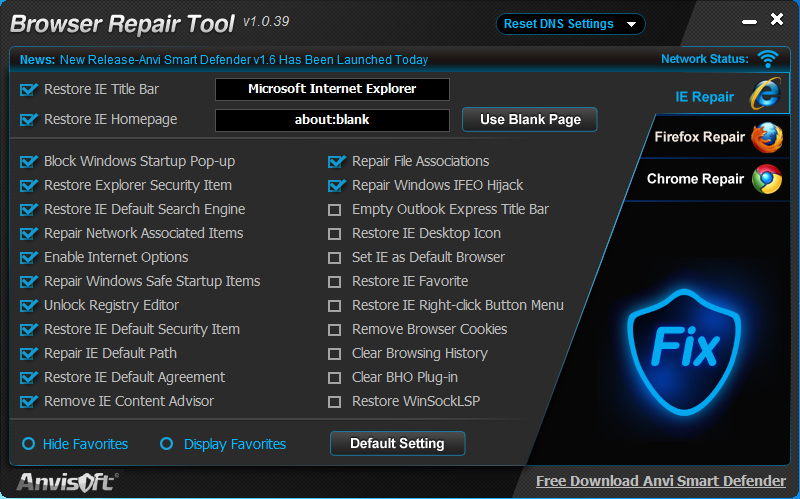
Has malware trashed IE settings? Try Browser Repair Tool
When your PC is infected by malware then of course you’ll want to remove it immediately, but that won’t necessarily be the end of your problems. Malware will often change key browser or Windows settings to suit its needs, and restoring these can take a very long time.
Or you could just use Anvisoft’s free Browser Repair Tool, which claims it can fix everything you need with just a single click.

Developers give Internet Explorer 10 for Windows 7 Preview cold reception
Whoa, and I thought BetaNews commenters were a rowdy lot. Today, Microsoft announced that Internet Explorer 10 would come to Windows 7 next month as a "preview". I would think that would be welcome news, but not to cranky complainers at Microsoft's IE blog.
"We will release a preview of IE10 on Windows 7 in mid-November, with final availability to follow as we collect developer and customer feedback", Rob Mauceri, IE group program manager, posts. "We look forward to getting your feedback on IE10 on Windows 7, and will provide another update when the preview is available".

Which Firefox is right for you -- 16, 17, 18 or 19?
Hot on the heels of Mozilla pulling the latest stable release from its download servers after discovering a security vulnerability, Firefox 16.0.1 FINAL has now been released. Those who had already upgraded to version 16 should upgrade automatically now the updated version is available. Full details about the vulnerability can be found here.
In the meantime, Mozilla has updated all pre-release versions of the popular cross-platform, open-source browser to versions 17 (Beta), 18 (Aurora) and 19 (Nightly/Elm/UX) respectively. Once again, confirmed changes are thin on the ground, although the recent release of the “Elm” branch of Firefox Nightly, previewing the new Modern UI-based version of Firefox for Windows 8, is a noteworthy addition.

Mozilla warns: stop using Firefox 16
Only two days after announcing Firefox 16, Mozilla removed the browser in response to a security vulnerability affecting all early installations.
Mozilla warns that the flaw allows a malicious website to "potentially" determine where Firefox 16 users have been and to gain access to the URL or URL parameters. The open-source group says it had no knowledge of the exploit and as a safety measure recommends that anyone who installed Firefox 16 should "downgrade" to Firefox 15.0.1 and wait for the browser to be upgraded to the new, fixed, version.
Beware of fake Bad Piggies apps on Chrome Web Store
"Bad Piggies", a mobile game that was quietly launched by software company Rovio Mobile, is one of the most popular games to be launched in the late period. Unfortunately, it's also a security risk if installed via third-party, free, extensions from the Chrome Web Store that claim to be the original app.
Security experts from Barracuda Networks have analyzed the number of free apps that turn up after searching for the popular game title in the Chrome Web Store. The company has found that these extensions, while obviously being a far cry from the actual Bad Piggies game, require elevated permissions. To profit from misleading the user, they also install a plug-in that delivers advertisements on popular websites. The severity of this security risk might be overlooked by users seeking to play the popular title.
Firefox 16 is available -- get it NOW!
Ahead of its official unveiling, Mozilla has made Firefox 16 FINAL available for download. The latest version provides little in the way of major new features, and in some ways is more noteworthy for the features missing from this release, including the long-awaited inline PDF viewer (click here to find out how to switch it on manually) as well as a number of OS X Lion/Mountain Lion enhancements.
What is present in version 16 is initial desktop support for web apps, VoiceOver accessibility features for OS X, extra developer tools and enhanced garbage collection performance to prevent freezes and performance lags.
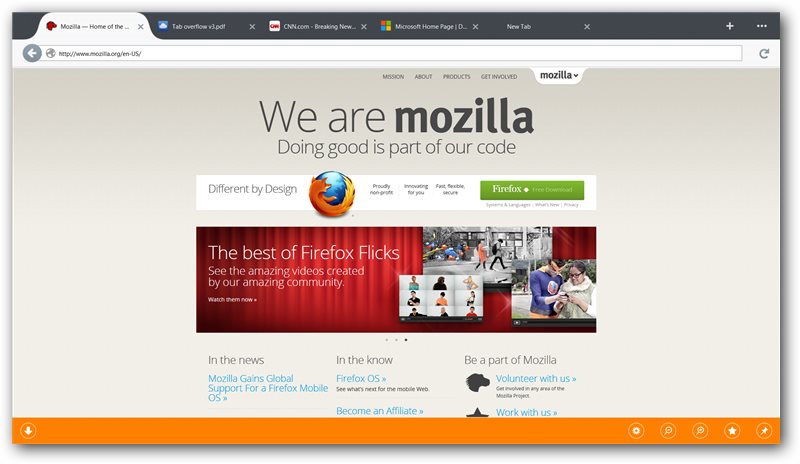
Firefox goes native Windows 8
Mozilla has unveiled its first public preview of how Firefox will look when run using Windows 8’s new tile-based interface. Firefox Metro UI Preview is based on an offshoot Nightly build of Firefox, codenamed “Elm”, and can be downloaded and tested now on PCs running Windows 8.
This early preview provides a fully functional web browser, complete with multi-touch support on compatible displays. However, as expected at such an early stage in its development, not all planned features have yet been implemented, while the Nightly tag indicates this is a largely untested build.
Chrome 23 Beta improves HTML5 video support
Google has updated both Beta and Dev pre-release channels of its open-source, cross-platform browser, Google Chrome to versions 23 and 24 respectively.
While Google Chrome 24 Dev is a minor update, Google Chrome 23 Beta introduces support for a number of APIs and HTML5 technologies that, while superficially of most interest to web developers, will improve both web-based video playback and real-time audio/video communications over the internet for end users.
For every 8 pageviews, one comes from phone or tablet
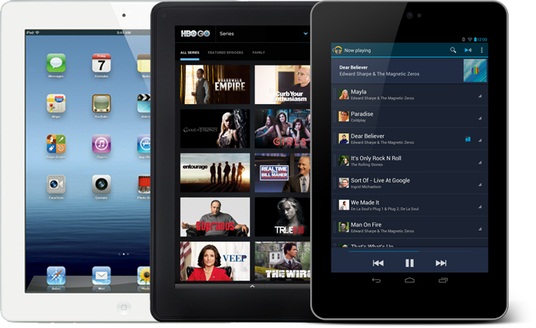
Americans still love their PCs for sitting back and surfing the web, but, hey, it's the post-PC era, baby and times are changing. In August, 13.3 percent of web pageviews -- from browsers, not apps -- went to mobile phones or tablets, according to comScore. That's double the number in a year.
Mobile phones accounted for 9 percent of pageviews and tablets 4.3 percent. The latter foreshadows the category's huge potential to disrupt the PC-browsing paradigm. Tablet install base is tiny compared to handsets.
Google Chrome for Android update paves way for Motorola Razr i
Most smartphone users wouldn't know if their device packs an ARM or Intel processor. They would care, perhaps, if software doesn't run, particularly as the first Intel-powered devices reach the mass-market.
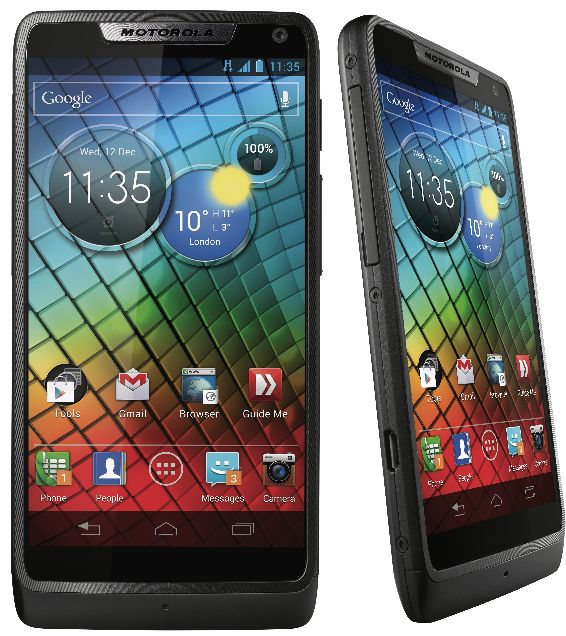
Google has updated Chrome for Android, to run on x86 processors, paving way for its own subsidiary, Motorola, to release Razr i, which packs a 2GHz Intel Atom powerhouse.