
Consumers want digital identity verification from online brands
Providing a digital identity to create an online account or complete a transaction is becoming more commonplace globally and consumers are now expecting this as part of their engagement with a business.
Research carried out by Opinium for Jumio surveyed 8,000 adult consumers split evenly across the UK, US, Singapore and Mexico. It finds that 57 percent now say they have to use their digital identity 'constantly' or 'often' to access their online accounts.

Two-thirds of data breaches at UK legal firms caused by insiders
New analysis of data breaches in the UK legal sector reveals that 68 percent were caused by insiders.
Analysis by secure cloud platform NetDocuments of data from the Information Commissioner's Office (ICO) reveals evidence of a 'Great Exfiltration' where employees are leaving their jobs and taking their company's data with them.
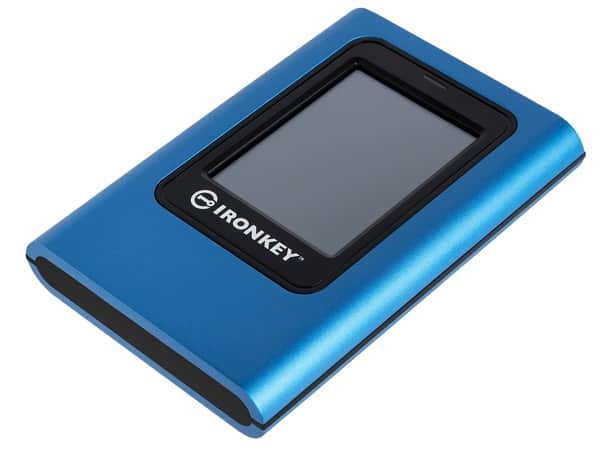
Kingston VP80ES IronKey Vault Privacy 80 is an encrypted USB-C SSD with touchscreen
Solid state drives don't just make wonderful internal boot drives for computers -- they're excellent for external storage too. Not only are they smaller than mechanical hard disk drives, but they use less power and are much faster as well. Quite frankly, if you are someone that needs to transport data on a portable drive, you'd be insane to still use a HDD with moving parts.
But what if you lose that external solid state drive? Well, if the content is unencrypted, your files could be exposed to the finder. This is particularly problematic for business users that are storing company secrets or private customer data. Thankfully, a new USB-C solid state drive from Kingston makes it super easy to encrypt and decrypt your data. You see, the VP80ES IronKey Vault Privacy 80 is a hardware-encrypted (FIPS 197 certified with XTS-AES 256-bit) SSD with a color touchscreen that allows you to enter a passcode, password, pin, or phrase.

Three out of five organizations lose data due to email errors
Three out of five organizations experienced data loss or exfiltration caused by an employee mistake on email in the last 12 months, according to a new study.
Research from email security company Tessian and the Ponemon Institute shows 65 percent of over 600 IT security practitioners surveyed see email as the riskiest channel, followed by 62 percent for cloud file sharing and 57 percent for instant messaging.

Enterprises struggle to discover cloud access policies
Cloud use is commonplace among large enterprises, with 82 percent of organizations with $1B or more in revenue using three or more clouds, up from 66 percent last year.
However, with the majority of companies (70 percent) using two or more identity systems, 75 percent of respondents say they lack the ability to easily discover all existing access policies, according to a new study conducted by Osterman Research for Strata Identity.

UK consumers willing to give up social media rather than part with more data
A new study shows that 63 percent of the UK population distrust social media due to privacy concerns and what's more as a result of privacy issues or other public scandals involving social media, 30 percent of consumers have either disabled social media (17 percent) or plan to within the next 12 months (13 percent).
The research, from digital experience company Acquia, shows only 27 percent say they would be willing to part with more data to retain access to platforms. While 48 percent indicate that recent revelations about data sharing practices have led to them using social media less often.

DuckDuckGo add-on now blocks Google's latest tracking and targeting methods
Google I/O kicks off today and while the search giant might want us to believe it cares about our privacy, most people are rightly wary of what Google knows about us, and what it does with the huge swathes of personal data it gathers.
DuckDuckGo provides a privacy-first alternative to Google Search, but the company offers much more than that, including a Chrome extension which helps safeguard your browsing. Today, the company announces an update to the add-on which means it can block Google’s latest tracking and targeting methods – Google Topics and FLEDGE.

NewProfilePic -- From Russia with security risks [Updated]
The NewProfilePic app has been taking Facebook by storm in recent days, allowing users to upload a photograph and have it turned into a piece of digital artwork.
However, it's sparked concern in the cybersecurity community because it collects data and sends it to Russia. Linerock Investments, the company behind the app, is based in Moscow alongside Russia's defense ministry.

How you can take back control of your online data [Q&A]
If you use the internet then it's certain that some organization somewhere is storing data about you. Indeed research shows that people are happy to share information in exchange for a better consumer experience.
However, that data is still yours, so how can you understand what information you're giving away and how can you take better control?

Privacy-focused Linux distro Tails 5.0 is finally here -- Download it NOW!
If you’re at all worried about your privacy -- and frankly you should be -- Tails can help secure it. The Amnesiac Incognito Live System, to give it its full name, is a live Linux-based operating system that you can boot into on any computer. It can be used to encrypt files, emails and instant messaging chats, and much more besides.
Today, the developers release Tails 5.0, the first version of the distro based on Debian 11 (Bullseye), and this comes with an important new security feature, as well as lots of other changes and updates.
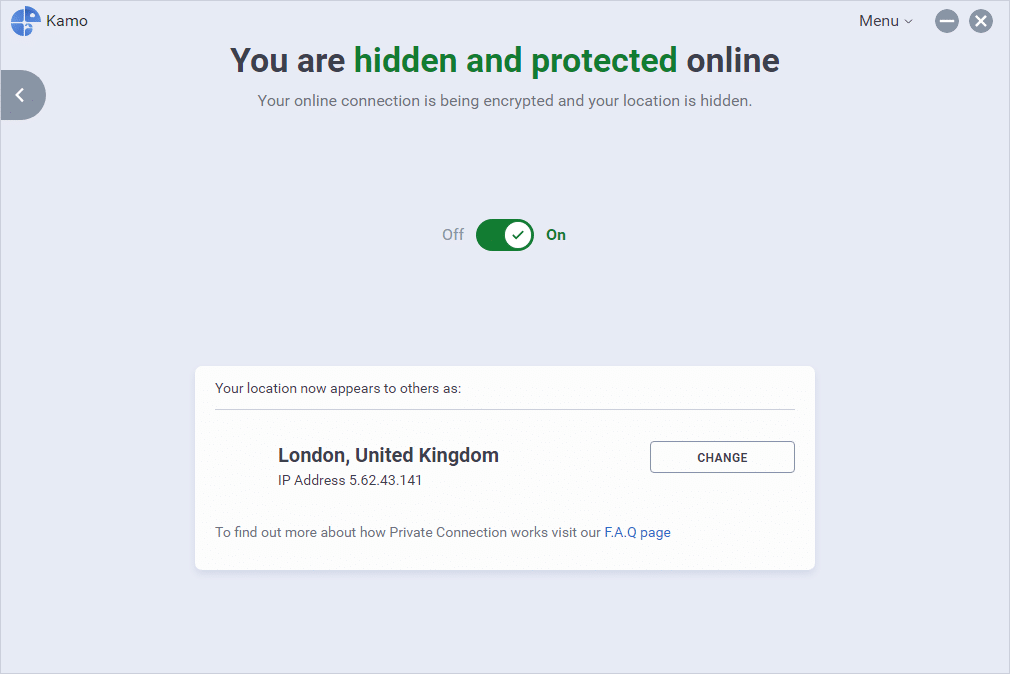
Kamo 4 adds VPN technology to block more online snoopers
Piriform Software, best-known for its CCleaner cleaning product for PCs and Macs, has released Kamo 4.0, a major new update to its Windows privacy tool.
Kamo 4.0, which blocks online trackers through a range of tools built into a single application, has added location masking through the implementation of a basic VPN, which masks the user’s IP address and exact geographic location via an encrypted connection through another server in their own country.
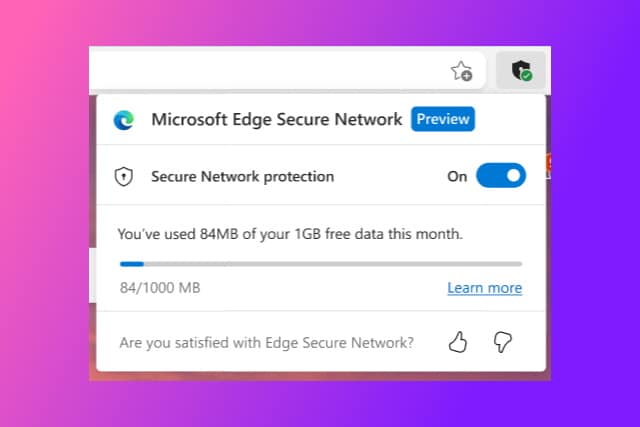
Microsoft is preparing to add Microsoft Edge Secure Network, a free VPN, to its web browser
Concerns about online privacy and security mean that more and more people are turning to VPNs. It can be hard to know which VPN to choose, and to determine whether it is best to go for a free or paid-for tool. For users of its Edge browser, Microsoft is readying another solution.
The Microsoft Edge Secure Network is a Cloudflare-powered VPN service which Microsoft is looking to integrate directly into Edge. Microsoft's VPN would not only eliminate the need to install a third-party tool -- something that serves as an obstacle to many people -- it also includes a free data quota to help entice users.

Google introduces a way to reject all cookies... But only in Europe
After being hit with a fairly hefty €150 million fine by regulators earlier in the year, Google has added a new Reject All button to the cookie consent banners that have become ubiquitous on websites in Europe.
Google says that the change is in response to the fact that, "regulators who interpret European laws requiring these banners [...] have updated their guidance for compliance". So what exactly does the change mean, and is it likely to extend outside of Europe?

DuckDuckGo and Brave announce separate plans to fight back against Google's divisive AMP (Accelerated Mobile Pages) framework
Google's AMP (Accelerated Mobile Pages) project is designed to speed up the web for mobile users, but it has big privacy implications because it allows Google to further track user actions, as well as prioritize its own ads on pages.
Today, both DuckDuckGo and Brave announced changes to their respective products to protect against Google AMP tracking.
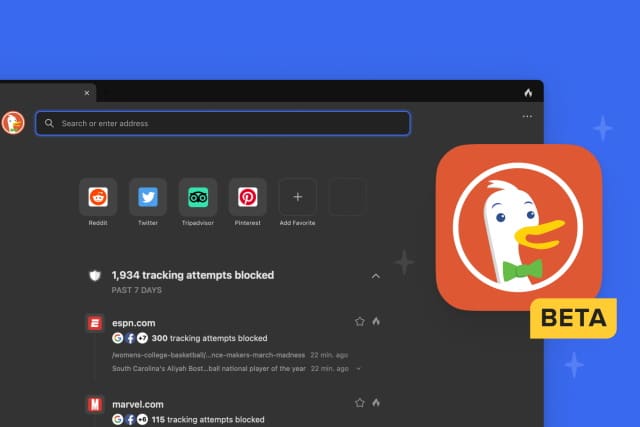
DuckDuckGo brings its private web browser to Mac in beta
Towards the end of last year, we learned that 2022 is the year that DuckDuckGo's privacy-focused web browser is coming to the desktop.
Today the company has launched the beta version of DuckDuckGo for Mac -- meaning macOS users will have another alternative to Chrome et al before people running Windows 11. The DuckDuckGo browser is billed as offering a high level of security, fast performance, and privacy by default which is more than just a replacement for Incognito Mode.