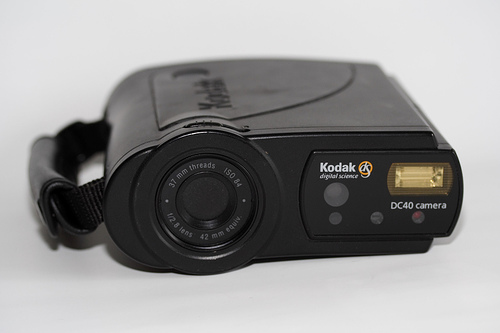
Kodak's bankruptcy seems inevitable
The Wall Street Journal on Wednesday reported that 131-year old photography and imaging technology company Eastman Kodak is preparing to file for Chapter 11 bankruptcy protection after more than four straight years of unprofitability.
Last September, Eastman Kodak began restructuring under law firm Jones Day, and in November sold off its Image Sensor Solutions business to private equity firm Platinum Equity for an undisclosed sum.
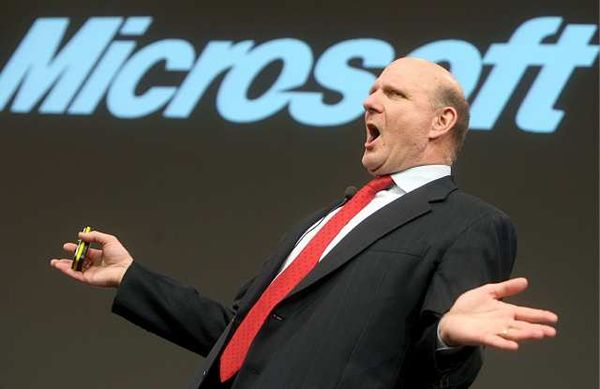
Steve Ballmer caption contest winner
Last week, we asked you to put a caption to the photo above -- for a chance to win an HP TouchPad -- and, whoa, did you ever. We received about 300 responses in comments and by email. Many of the best caption contenders came by mail, while many others came too late to qualify; deadline was December 28, 2011 at 11:59:59 pm ET. Actually, among the late-comers there were some well-deserving contest considerations. :(
We reduced the number of candidates to 15; originally we planned 10 but there were so many good entries. We used a polyhedral dice from my old Dungeons & Dragons game -- yes, there was role playing before the Internet and Xbox 360 -- to cut the contenders to 12, nine, six and three. Then one -- so the winner was randomly chosen from among the top 15.
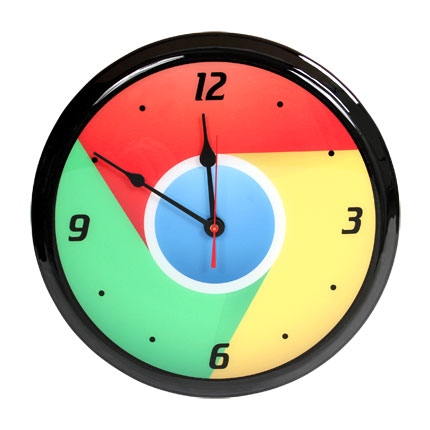
Google reduces Chrome browser search PageRank for 60 days
Microsoft and Mozilla simply couldn't ask for a better situation. At a time when usage share for their respective browsers sinks, the world's No. 1 search engine has effectively stripped up-and-comer Chrome from meaningful search ranking. Google demoted Chrome, following a sponsored-link scandal that violates its own policies about paid links. If you Google "browsers" today, unlike yesterday, Chrome won't appear among top results and is buried pages below.
From one perspective, Google did the right thing, treating itself and its own product like any of its search customers. Throughout 2011, Google was on a tear to purify search rankings of shenanigans like this one. But from another viewpoint, Google had no other choice. Its business is about trust, and the company can't be doing what it prohibits others from doing. Then there's that pesky antitrust investigation and allegations Google favors its own stuff in searches.

Windows Phone partners will spend $100M, not $200M, launching Nokia Ace
I was right and stand by my reporting.
Following BetaNews' report of Microsoft and its partners $100 million ad bonanza surrounding the launch of the the Nokia Ace in March, additional misinformation has surfaced about the Redmond, Wash.-based company's plans to push Windows Phone to the forefront after languishing for so long at the back of the pack -- that the number is higher.
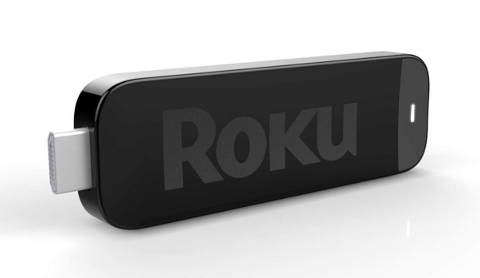
Roku Smart Stick: smallest 'set-top box' ever
Just six months after debuting its tiny 3" x 3" x 1" Roku 2 streaming set top box, over-the-top video company Roku on Wednesday announced it had gone even smaller, and put its entire streaming set top box into a package the size of a USB stick which connects to a TV's HDMI port and communicates using the new Mobile High Definition Link (MHL) interface standard.
The Roku Streaming Stick, as it is called, will require no separate power supply, and will be controlled by the television's own remote control. Televisions that support MHL will be able to integrate Roku's streaming TV platform simply by plugging in the stick. With the stick docked, it will be just like having the Roku set-top box: it adds the Roku interface (and the 400+ channels it offers), Wi-Fi connectivity, and local storage to the TV it is used on.

Scott Thompson is Yahoo's new CEO
Four months after unceremoniously firing Carol Bartz over the phone, Yahoo's board today named PayPal president Scott Thompson as chief executive. Thompson will assume the new role on January 9, when he also joins Yahoo's board of directors.
Thompson comes to Yahoo amid great turmoil. The company is undergoing something of an identity crisis as it struggles to reinvent itself. Right now, Yahoo's strongest asset is a commanding brand, but its identity is increasingly amorphous, and the company considers unloading web properties in markets where its products are best known, such as Asia. Many challenges face Thompson, none the least convincing shareholders he can bring focus back to the struggling Internet giant. Yahoo shares nudged down about 3 percent in early trading -- $15.84, off the $16.11 opening and $16.25 close yesterday.

Dolphin Browser HD 7 for Android mini-review
Whatever operating system you look at, it is fair to say that most people fall out of love with the default web browser pretty quickly. Windows users will find that they migrate away from Internet Explorer, while Mac owners are likely to adopt an alternative to Safari. The same is true for mobile platforms and when it comes to Android devices there is no shortage of web browsers to choose from. Dolphin Browser HD is one alternative browser that has gained an impressive following not only on iOS devices, but also on Android.
This is a mobile web browser that got off to something of a slow start. When it was first released it was an interesting alternative to the likes of mobile Safari and Opera Mini but it has developed over a relatively short period of time into some seriously impressive. Being designed for touchscreen devices means that the browser takes advantage of gestures to make it easier to perform common operations such as moving back and forwards between pages. Support for gestures means not only that web navigation is made a great deal easier, it also frees up screen space that would otherwise have been occupied by a toolbar full of buttons.
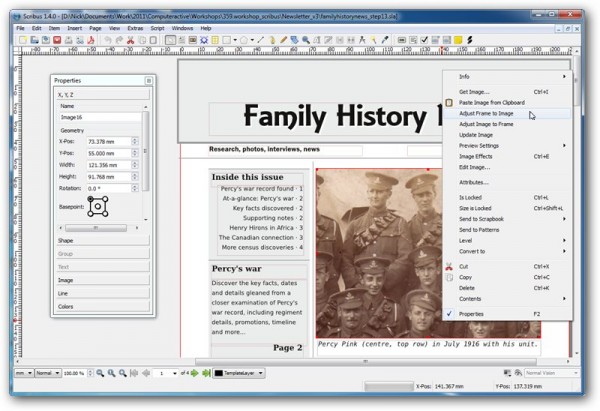
For years in development, is Scribus 1.4.0 worth the wait?
Open-source, cross-platform desktop publishing package Scribus 1.4.0 has been given a final, stable release, four years after the first developmental version saw the light of day. Over 2,000 feature requests and bugs have been resolved in this new release, which, despite the relatively minor version number jump from 1.3.3.x, is a major new release.
Notable improvements include better object handling, many more advanced options for text and typography, new features for vector objects and better handling of fills.

Wavosaur -- lightweight, full-featured audio editing
With even some budget computers now arriving with 1TB of storage, and perhaps more, drive space isn’t generally much of an issue these days. But we still get annoyed when we see software become unnecessarily bloated, grabbing vast amounts of hard drive real estate for no good reason. It’s lazy, and even if you have plenty of hard drive space left, will still slow down your searches, virus scans, defrags, and any other whole-drive operations.
Fortunately there are still plenty of projects that treat your hard drive with a little more respect, however. And there are few better examples of this than Wavosaur, a surprisingly full-featured audio editor that crams a vast array of functionality into a tiny 560KB executable, while refusing to clutter your system with anything else (no codecs, no DLLs, nothing dumped in your Windows folders at all).

Windows Phone partners bet $100M on Nokia Ace
The importance of the Nokia Ace to Microsoft's mobile plans is apparent as sources tell BetaNews of a major marketing push for the smartphone in the second quarter of this year. The Ace will launch in late March, sources confirm, along with a marketing campaign that will run in the neighborhood of $100 million. However, sources were reluctant to say exactly how that $100 million spend might be divvied up among the principals -- AT&T, Microsoft or Nokia.
The Ace will launch first on AT&T, where Microsoft has reached an agreement with the carrier to give it "hero" status. This means that AT&T itself will promote the device in its advertising, through its retail channels and direct store associates to push the device within its stores.
Such a move is a first for a Windows Phone here in the United States, a place where the platform has languished behind larger competitors. The most recent market share data from comScore indicates that Microsoft's mobile platform has only been able to manage a 5.4 percent share. Compare this to market-leading Android whose 46.3 percent share leads all other platforms.

10 Things I genuinely want to see at CES 2012
I usually come into the Consumer Electronics Show every year expecting a few things, being disappointed by the lack of a few things, and being surprised by a few things I didn't expect. Here's the list of what I'm hoping to see this year.
As these things happen or fail to happen at CES 2012, I'll chalk them up as victories or defeats, and you'll hopefully get an overall feeling for the amount of heartburn I'll have when I head back here to the East Coast at the end of the week.
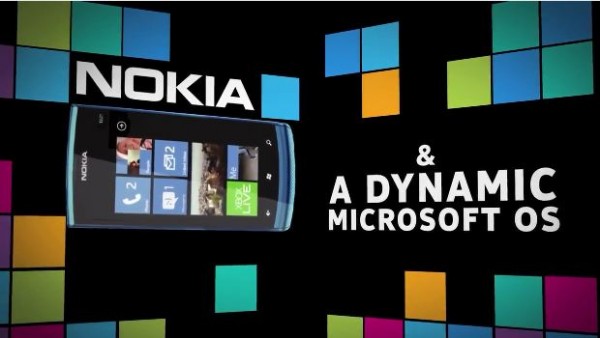
Windows Phone steps up its game in 2012 with new devices at CES
Microsoft is betting on Windows Phone and is leaning on close partner Nokia to execute that strategy. Details have leaked of the latest Windows Phone-powered device from the Finnish phone maker, dubbed the Lumia 900. To be sold in the United States as the Nokia Ace, the device will be the Windows Phone flagship.
Smartphone news site Pocketnow says that the smartphone will sport a 4.3-inch WVGA screen, 512MB of RAM, 8-megapixel camera, and 1830 mAh battery. Compared to the Lumia 710 and 800 -- which were Nokia's first Windows Phone powered devices launched in October -- the screen is much larger although its camera is the same resolution as the 800.

Microsoft stomps on Internet Explorer 6's grave
Here's what you do at Microsoft when you can't boast about how high Internet Explorer usage share is: You trumpet about how low it is. In what has to be one of the strangest blog posts coming out of Microsoft in weeks, Roger Capriotti proclaims: "IE6 usage in the US has now officially dropped below 1 percent!" Well, it's nearly 8 percent globally, Bud, but what kind of cheerleading is this? Generally companies tout who uses their products, not who doesn't.
But that's the strange state of Internet Explorer 6, which Microsoft can't seem to kill -- and not for want of trying. Days like this, I want to be an artist (sadly, capable stick figures exceed my drawing capabilities). It's so past time for someone to portray the browser that won't die as some kind of undead creature.

Add another layer of security with Smart PC Locker Pro
If you’re working on a PC in a crowded area, and need to move away for a moment, then the system can easily be locked simply by holding down the Windows key and pressing L. You’ll return to the login screen, and only someone who knows your user account password will be able to restore normal operations.
Of course is this is a shared PC then there may be several people who know the password. And Windows account passwords offer only limited security, anyway; there are ways to bypass them. So if you’re concerned about privacy then it may be wise to add another layer of security, courtesy of the free Smart PC Locker Pro.

CloseTheDoor on unwanted network connections
Understanding exactly which processes are listening for incoming network connections (and why) is an important part of monitoring your PC’s security. You can uncover this information with Windows alone (just enter netstat -anb at an elevated command window), but if you’d like the data to be displayed in a more intelligible way, and get plenty of assistance to help you figure out exactly what’s going on, then you’ll need something like CloseTheDoor.
At first glance the program looks much like many similar networking tools. So you just launch it to instantly see a table of listening ports, with details like the network interface, port number, protocol (TCP -IPv4 or IPv6 -- or UDP), the responsible process and its process ID, any associated services, and details taken from the process executable file (Company, Product, Description and so on). Which is good -- but that’s just the start of CloseTheDoor’s abilities.