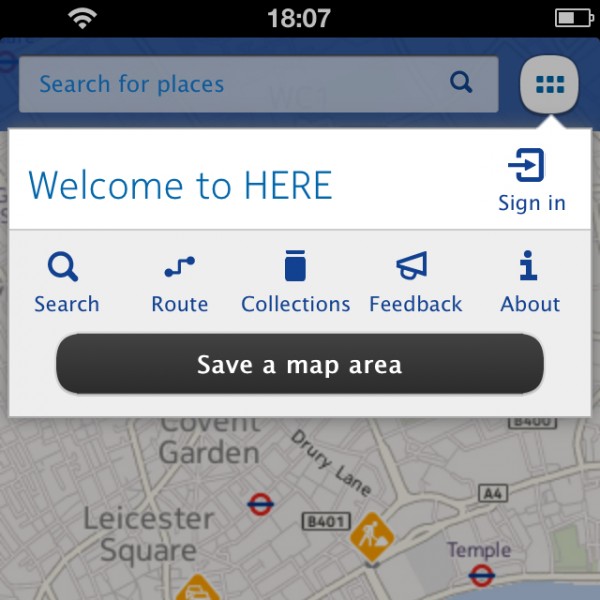
Nokia HERE for iOS will get you where you want to go [review]
If you want to get directions on an iOS device, you have two main options. 1) use Apple’s built-in mapping app to go to somewhere other than intended, potentially risking your life and the lives of your passengers along the way, or 2) fire up the mobile version of Google Maps, which is good but not as great as the old app that vanished when Apple decided its users would be better off with sketchy, featureless maps and inaccurate directions.
Thankfully, while Apple’s map team is trying to push its Toyota Prius out of a field that should be a freeway, and Google is still putting the finishing touches to its shiny new Maps app, Nokia has arrived to save the day with HERE, a mapping and location service powered by NAVTEQ data (as used in the majority of in-car navigation systems).
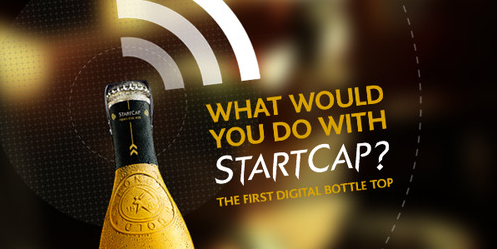
The world’s first digital bottle top
There have been some great technical innovations in recent years. The iPod, the iPhone, Wi-Fi, TiVo, Kinect… the list goes on and on. But surely they all pale into insignificance compared to the mighty, life-changing invention that is the digital bottle top.
Yes, it’s a real thing. Created by British cider brand Strongbow and marketing agency Work Club, the StartCap is a bottle top with built-in RFID. When you pop the top, exposing the tag, a signal is sent to a reader somewhere in the room (at a bar or club) causing some kind of action to occur.
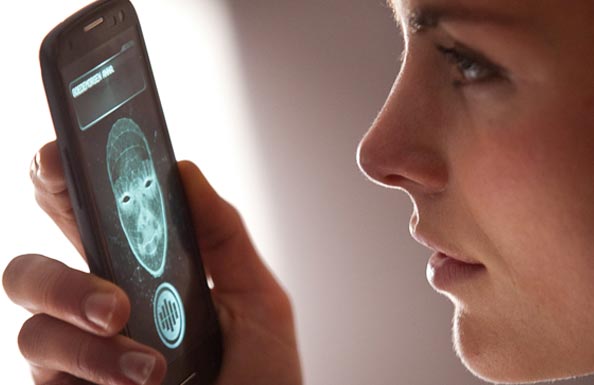
App -- the first movie that actually encourages you to get your phone out in the cinema
There’s nothing more annoying than someone playing on their mobile phone during a movie. Even if you’re sitting a good distance away, the glowing small screen lights up the cinema like a beacon, making it harder to focus on what’s happening on the big screen.
Forthcoming feature-length thriller App is set to turn what is usually seen as socially unacceptable behavior into a highly social act, encouraging everyone to use their iPhones and Android devices to follow a parallel storyline while the film is playing.

HP: Surface is 'slow and a little kludgey'
Our own Robert Johnson might love his Microsoft Surface tablet, but HP's head of PC, Todd Bradley, isn’t quite so keen. In an interview with IDG Enterprise, Bradley dismisses Microsoft’s foray into the PC hardware market claiming he doesn’t see the new tablet as a threat.
"I'd hardly call Surface competition", he says, before going on to explain his reasons. "One, very limited distribution. It tends to be slow and a little kludgey as you use it. I just don't think it's competitive. It's expensive." He also states that consumers haven't taken to the Windows RT tablet either. "Holistically, the press has made a bigger deal out of Surface than what the world has chosen to believe. If you want to go to any of the 30 Microsoft Stores in the United States to buy one, I think you should probably do that".
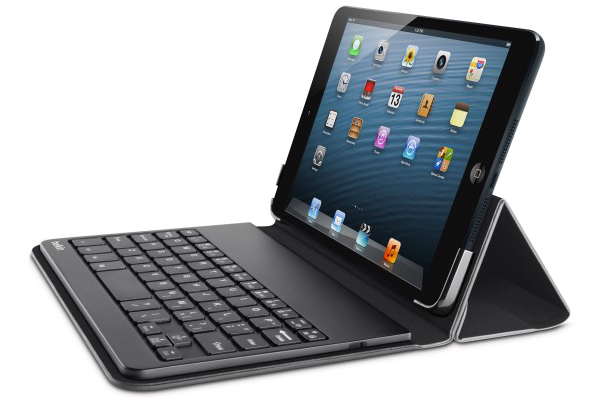
Turn your iPad mini into a really small laptop
If you’ve tried an iPad mini, or just seen one, you’ll know the screen is a decent size and well suited to using like a tablet. It’s not quite so good for using as a laptop/netbook replacement (unless you have really good eyesight or like peering at things in a hunched-over manner), but that hasn’t stopped Belkin from rolling out a portable keyboard folio for it.
The Portable Keyboard Case connects to Apple’s device via Bluetooth and is a scaled down version of the keyboard the company sells for the full-sized iPad. If you’re the sort of person who likes to pretend you’re a giant, you’re going to love it.
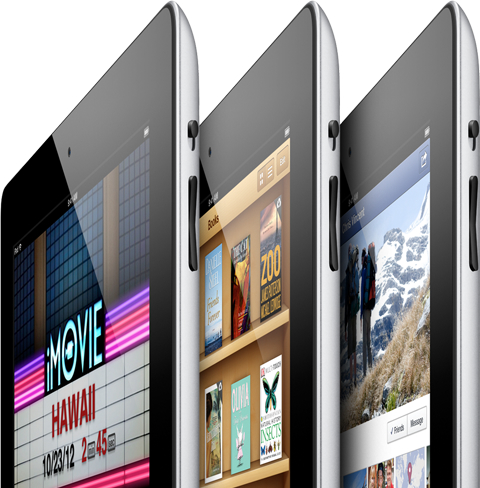
Apple iPad 4 review
I’ve been thinking about getting a new tablet for a while. Although there’s nothing physically wrong with my iPad 2, I’ve been itching for a bit of new tech in my life and there are some truly excellent choices available this year, including the newer "new" iPad, the iPad mini, Microsoft Surface, and the Google Nexus 7 and Nexus 10. All of which are definitely worth considering.
A friend let me borrow his Nexus 7 for a week, during which time I realized a small tablet was not for me, so that also ruled out the iPad mini. The Nexus 10 looked appealing, and so was on my shortlist. Microsoft Surface I discounted because even though I now use Windows 8 daily, I still don’t really like it and the current lack of great apps for Surface is a bit of a deal breaker. Maybe in the future…
Symantec predicts security 2013
Symantec asked hundreds of its experts for their thoughts and opinions on what the biggest security threats will be next year -- assuming we all survive the Mayan apocalypse on December 21, of course -- and boiled down the results into five predictions.
The first threat to make the list is cyber-conflict, which Symantec sees becoming the norm. "Conflicts between nations, organizations, and individuals will play a key role in the cyber world", it says, envisioning a lot of sabre rattling, and countries and hacktivist groups using cyber-tactics to make a point and "send a message".
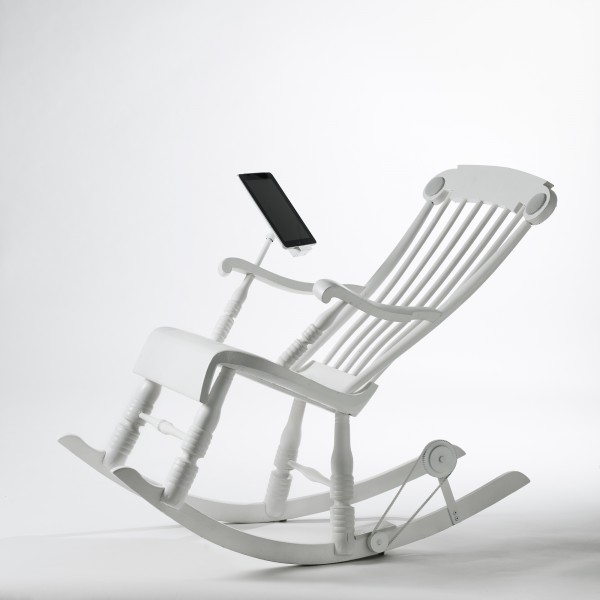
Charge your iPad with a rocking chair
Swiss furniture maker Micasa Lab designs some weird and wacky products. Cocoon 1, for example, is a customizable bubble -- a clear sphere with stackable plastic modules that let you relax, cook, and even wash up afterwards. But my favorite of its designs is the iRock -- a rocking chair that charges iPads.
It works, as you’d expect, by converting the rocking motion into energy, and as you’d probably also expect, it’s no match for just plugging your device into a mains charger. But if rocking’s how you roll, it will give your Apple device a little extra boost while you sit out on your porch reflecting on life (or playing Angry Birds Star Wars).

Apple's Samsung apology includes 'false material'
As expected, Apple has come in for some blistering criticism from the UK courts over its refusal to publish a straightforward apology stating that Samsung did not copy the iPad.
The full ruling of the court of appeal hearing, published today, pulls no punches, describing Apple’s compliance with the newspaper advertisement order (in which it was instructed to publish an apology in several UK newspapers and magazines) as "lackadaisical at best". The recent statement published on its website was found to be even more serious as it contained "false material" and made out the case as about Samsung copying the iPad, when it wasn’t. (It was actually about whether Samsung had copied Apple’s registered design.)

Edible iPhone 5 cases now on sale in Japan
Most phone cases are designed to protect your handset from being dropped, or accidentally scratched. The Survival Senbei iPhone 5 Case is designed to stave off hunger pains should you find yourself miles from anywhere and unable to dial for a pizza.
The hand-crafted cases, now on sale in Japan, are made entirely from lightweight brown rice and salt and baked into a senbei rice cracker that fits perfectly around your iPhone 5. They do take anywhere up to a month to be delivered though, as the creator, a middle-aged Japanese woman called Mariko, can only usually manage to make three good ones a day.

Play live music with friends online in Chrome
The only thing that ever stood in the way of my becoming a major international singer/songwriter was my inability to sing. Or write songs. I took guitar and piano lessons as a kid, and am pretty handy at Rock Band, but I’m not a great musician, so I never really get invited to jam with more musically-minded friends.
However, that might change, if I can persuade some of them to give Google’s latest interactive Chrome experiment a try.

RISC OS comes to Raspberry Pi
Raspberry Pi is, in many ways, a throwback to the past and not just in terms of performance. The uncased single-board ARM GNU/Linux computer was originally conceived as a way to get students programming again, like they did back in the 1980s and 90s, and now there’s even a 25 year-old OS available for it.
RISC OS is an operating system you’ll possibly be familiar with if you’re of a certain age, and come from the United Kingdom (like me). A descendant of the OS used in the BBC Micro, it was created by Acorn Computers for the First Reduced Instruction Set Computing (RISC) ARM chips, and made its debut in Acorn's 1987 Archimedes microcomputer.
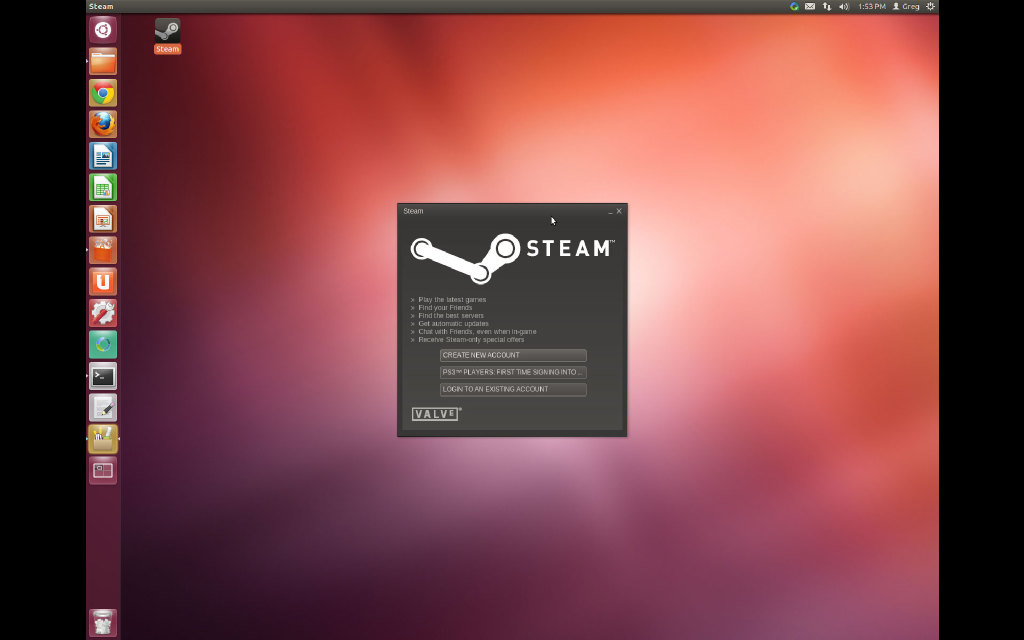
Steam for Linux goes live as a limited beta
Valve has announced the launch of its Steam for Linux client as a limited access beta. Testers of the invite-only service were chosen from a large pool of applicants (over 60,000 people applied within the first week), with priority given to experienced Linux users.
Initially only available for Ubuntu 12.04+, with more distros to be added in the future, the beta client gives testers access to the free-to-play Team Fortress 2, as well as two dozen additional Steam titles, including Serious Sam 3: BFE, Trine 2, World of Goo, and Darwinia. The beta also includes the Big Picture mode, which allows Steam to be viewed on a TV and interacted with using a game controller.

iPad-controlled street lights coming to London
London’s street lighting has come a long way since the days of gas lamps (although, interesting fact there are still some 1,600 of these old lights in use), but it’s about to be brought bang up to date with the introduction of smart lighting that can be controlled by iPad-wielding engineers.
Following a successful pilot scheme, Westminster City Council has announced that it intends to convert all 14,000 of its electric street lights over the next four years.
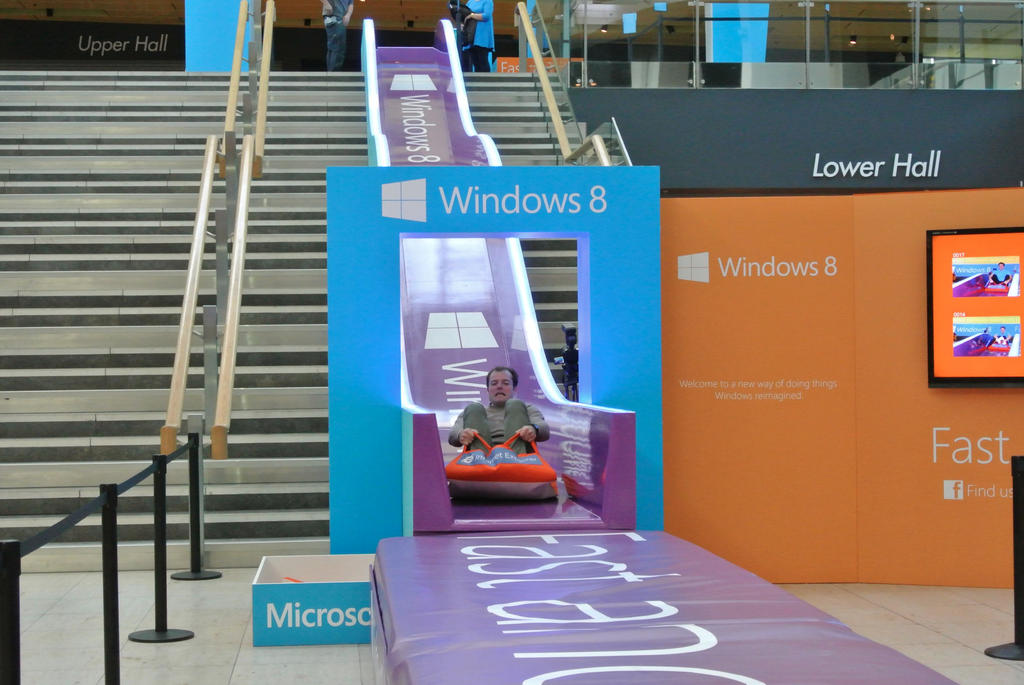
Microsoft promotes Windows 8 with 'fast and fun' slide
Whatever you think about Windows 8, there’s no arguing that Microsoft has pulled out all the stops when it comes to pushing it. Cut-price upgrades, pop-up Microsoft Stores, TV ads, and a $500 million global marketing blitz (the largest in the company’s 37 year history) means it’s all but impossible to miss the new operating system.
And Microsoft is getting creative with its marketing too. Over the weekend the tech giant set up a giant slide at the Bluewater shopping center in the UK, providing shoppers with a "fast and fun" alternative to taking the stairs.