

Microsoft Azure's Container Service now generally available
Microsoft Azure's Container Service in now available to help companies deploy and manage containers using their choice of software.
Users of the service will be able to move their container workloads to the cloud easily and can still run their operations using open-source tools. The two most popular tools -- Mesosphere’s Data Centre Operating System (DC/OS) and Docker’s Swarm and Compose -- will be both be supported by Azure Container Service and users will be able to continue running their operations using the one they prefer.

Stop using shortened URLs to share private content
Generating a shortened URL to share content may seem like a good idea, but it may also expose you to unnecessary security risks, a new research paper shows. Titled Gone in Six Characters: Short URLs Considered Harmful for Cloud Services, it explains how short URLs can be used by malicious players to plant malware, copy personal files, and retrieve all sorts of personal information, like your home address, among other things.
URL shorteners, as their name suggest, are meant to bring long links, that can contain dozens of characters, usually down to just a few letters and numbers. That has some clear benefits: shortened URLs suit SMS messages and tweets better, look nicer in conversations, and allow services to track the number of clicks for a specific link, among other things. But the fact that they only contain a handful of characters makes them susceptible to brute-force search.

Privacy in the spotlight: Microsoft sues Department of Justice for not allowing transparency about data access requests
In light of Edward Snowden's surveillance revelations, regular transparency reports from technology companies about the requests they have received from governments about data requests have become very common. But despite the name, transparency reports are not very transparent -- there are great restrictions on what companies like Microsoft are able to report. The company believes this is unconstitutional.
The restrictions are so strict that it is not even possible to precisely report the number of requests for user data that have been received. Instead, this data must be conveyed in bands such as 0-499, 500-999, and so on. Now Microsoft has had enough. There are privacy concerns, of course, but most disturbing is that in half of cases of requests for customer data, Microsoft has been gagged from letting those affected know about the governmental interest. As a result, Microsoft has decided to sue the Department of Justice in a bid to be more transparent.

Box customers can now choose where to store their data
Online file sharing company Box today announced a new service, allowing businesses to store their cloud data across Europe and Asia.
The service, announced at the Box World Tour Europe, is called Box Zones, and it will allow Box customers to choose whether they want to store their data in Germany, Ireland, Singapore or Japan.

Flexera extends software asset management to the cloud
While it's important for companies to manage their software licensing effectively, with the shift of many systems to the cloud doing so has become more difficult.
Software asset management specialist Flexera is riding to the rescue with the launch of a new solution addressing the management of cloud Infrastructure-as-a-Service.
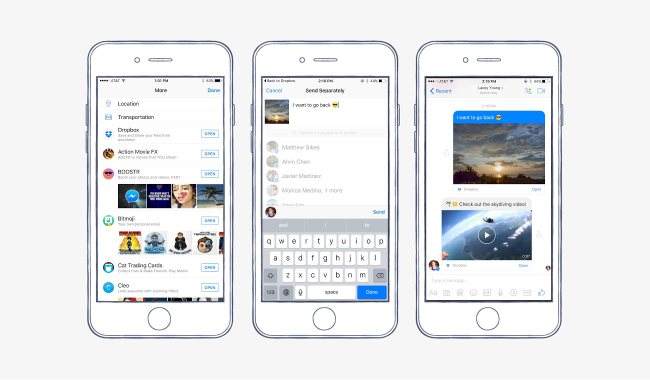
Facebook Messenger gains integrated Dropbox file sharing on iOS and Android
There are many cloud storage providers nowadays, but I choose to give Dropbox my money. While there are alternatives that are free, I'd rather spend money on quality, and to support a company that supports Linux. Not to mention, Dropbox is secure, available on many platforms, and the company is constantly introducing new features.
Speaking of new features, today, the company announces that its cloud storage is now officially supported by the wonderful Facebook Messenger. Users of the chat program can now directly share files from Dropbox on both Android and iOS. You must have both the latest version of the Dropbox and Facebook Messenger apps installed for it to work.

New cloud platform streamlines Android app development
Businesses have ever more demand from consumers to deliver services via mobile, so they're looking for ways to produce apps quickly and efficiently.
To address this need, Android solutions provider Genymobile is cloud-based platform that allows enterprises to build, test, show off and service Android applications across the entire application lifecycle while streamlining the development process.

Outlook gains Evernote, Facebook and Wunderlist integration on Android and iOS
Outlook is without a doubt one of the most powerful email apps available on Android and iOS. It supports all the major email providers, works with popular cloud storage services, gives you access to contacts, and integrates your calendars. On top of all this, Outlook is also optimized for use in the enterprise, so it can be a great app for work too.
Microsoft is now making Outlook even better as it launches Calendar Apps. This is a new feature that is designed to give you access to more calendar sources, with Evernote, Facebook and Wunderlist being the first available services.

IBM teams up with DocuSign to boost cloud services
Clients of IBM’s software and services will soon be capable of embedding eSignature and Digital Transaction Management through the IT giant’s new strategic global partnership with DocuSign.
DocuSign is working with IBM Cloud -- with a 47-data center footprint -- to provide customers with access to public, private, and hybrid cloud services. DocuSign’s APIs will also be available through Bluemix, which will be key to embedding eSignature and DTM functionalities within IBM’s Cloud platform.

Microsoft releases Cloud App Security to protect SaaS apps and data
Back in September of last year we reported that Microsoft had announced its purchase of cloud security firm Adallom to help its customers protect their cloud-based data and applications.
In February it teased that a new Cloud App Security offering based on Adallom's technology would be released in April. Well, today the wait is over and the product becomes generally available as a cloud-delivered service to help IT and security teams gain visibility and control over cloud apps.

The cloud revolution you probably haven't heard about yet
Like the PC, World Wide Web, and virtualization, the cloud is considered a revolutionary technology because it completely changes business processes, cost structures, and time to value. Volumes of information have been written about the benefits of the cloud, with most stories focusing on low-cost storage, reducing hardware costs, anywhere access to applications, and relocating and scaling compute resources.
But another cloud benefit, a cloud-based application integration framework, is just beginning to resonate in many c-suites. This framework has the potential to completely transform application economics by dramatically simplifying business processes, reducing costs and accelerating time to value. Best of all, this particular cloud revolution can be introduced into an organization incrementally, leveraging existing investments.

Tidal: one year and 3M subscribers later
April 1st marks my first-year anniversary subscribing to Tidal, which relaunched the same day last year, under new ownership of Jay Z. I love and loathe the music streaming service, which I cancelled at least five times and always renewed—typically before the billing cycle ticked over. But checking archived emails, I see that my sub completely expired thrice but not since July.
Gotta ask: What fool starts a business on April Fools, and what does the day foreshadow; if anything? Apple did it, 40 years ago today. Many commentators have called Jay Z the fool for buying Tidal, which competes against established players like Spotify and newcomer Apple Music. The service claimed to have 540,000 subscribers when acquired last year. This week, Tidal revealed globally there are now 3 million subscribers. Someone correct my math—456 percent increase, right? If Jay Z's the fool, gimme some of that foolishness.
Businesses want their infrastructure in the cloud, but it will take time
IT management software firm SolarWinds recently polled 166 IT practitioners, gaining valuable insights into business cloud adoption, security concerns and new and valuable skill sets. The results are quite interesting -- 92 percent said cloud adoption is important to their business, while 27 percent said it was "extremely important".
However, despite cloud technology growing rapidly, businesses are not eager to place their entire infrastructure in it -- 43 percent believe half or more of their infrastructure will be in the cloud within the next three to five years. Sixty percent believe their organization will never fully migrate.

How enterprises can benefit from archiving in the cloud
Most businesses have information they need to keep for compliance and other reasons. Traditionally this has been in the form of paper archives, but the availability of low-cost cloud storage offers an attractive alternative.
Data management company Solix Technologies has produced an infographic looking at the advantages of cloud archiving.

The benefits and challenges of building a hybrid cloud
The growth of cloud computing over the last decade has been unprecedented. From a relatively unheard-of concept, the cloud has become a key part of the boardroom conversation amongst CIOs and IT directors at companies across industries, sizes, and revenues for its promise of organizational transformation.
A large amount of enterprises have already built their own private cloud networks, hosting essential applications and providing anywhere, anytime access to mission critical data for employees scattered across the world. In many cases, the effort pays off, resulting in increased productivity, reduced costs and ease of access.



