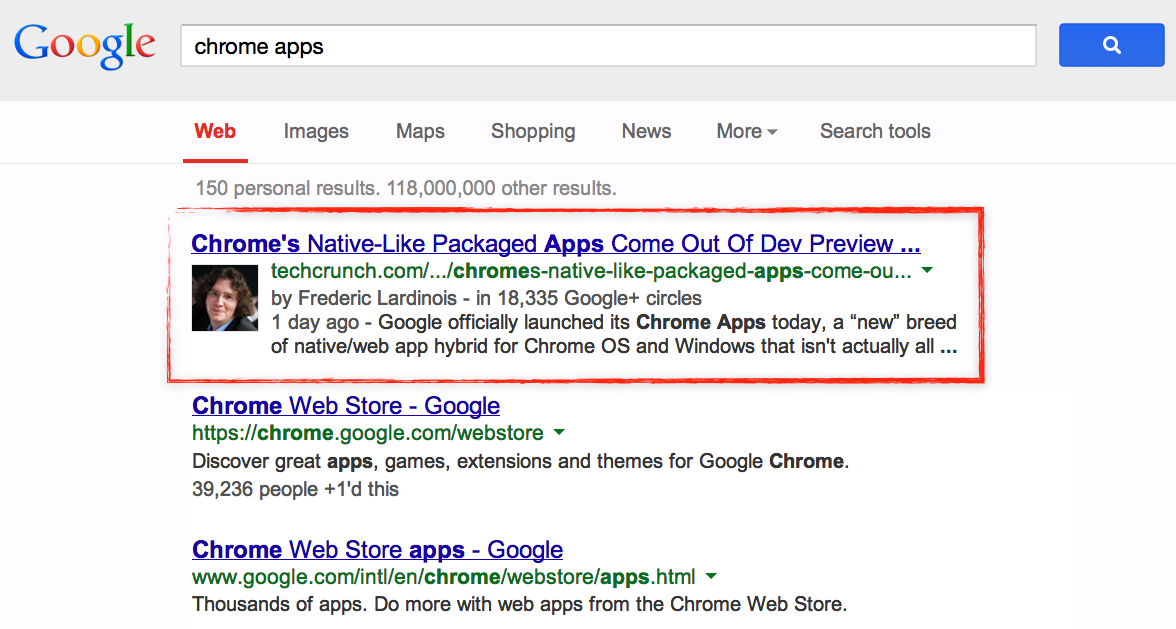
Google+ adds author attribution and embedded posts
Google+ is a great social media service for people to interact with friends and strangers alike. However, much like fellow social media sites Facebook and Twitter, it also serves as a great tool for bloggers and writers.
Yesterday, Google announced that it is bolstering its social media service with new features aimed at authors of blogs and news sites -- author attribution and embedded posts.

Five things I hate about Android
Android is my mobile operating system of choice. While I am unhappy with the new KitKat name for 4.4, I still generally enjoy the OS very much. I like that Android uses the Linux Kernel and is more open than iOS.
However, there are five aspects of the operating system that I simply hate or find unnecessary. Read on for my choices, which like all good lists, are presented in reverse order...

The most popular stories on BetaNews this past week
Looking at the biggest stories on BetaNews from September, 1 - 7, 2013. This was a week packed with news from IFA in Berlin -- lots of big announcements to whet our appetites for the coming months. LG's G Pad was revealed as a potential competitor to the Nexus 7 and iPad mini, while Acer was found to be proudly showing off its new R7 notebook complete with innovative Ezel hinge that allows for a range of working positions.
IFA was also where Samsung unveiled the Galaxy Note 3 as well as the Galaxy Gear smartwatch which will allow us all to live out our Star Trek dreams. It wasn't long before Note 3 pre-orders were being taken. If you've noticed that phones are getting bigger and bigger, the same is certainly true of tablets -- the Panasonic Toughpad 4K is a staggering 20 inches from corner to corner.

Jelly Bean speeds up, Gingerbread and Ice Cream Sandwich slow down
Unsurprisingly, Jelly Bean continues to increase its dominance in the green droid distribution charts, with the latest sweet in the family running on more than 45 percent of all Android devices visiting Google Play during the seven days ending September 4.
In the latest distribution charts, the first two Jelly Bean iterations -- Android 4.1 (36.6 percent) and Android 4.2 (8.5 percent) -- have a combined share of 45.1 percent, a number that is 4.7 percentage points higher compared to the previous data set that was released in early-August. A month ago, Jelly Bean had a 40.5 percent distribution level (34 percent for Android 4.1 and 6.5 percent for Android 4.2).

Aftermath of a tsunami -- Google Maps tells the tale
On March 11, 2011 a magnitude 9.0 earthquake struck off the coast of Japan, but despite the extremely high intensity of the tremor itself, it was the resulting tsunami that caused the real damage. Most notable, and scary, was the meltdown of three reactors at the Fukushima nuclear plant.
Now, two years after the tragedy that cost more than 15,000 people their lives, Google Maps, through Street View, takes users back into the teeth of this disaster.
Gimme a break Google! Android sells out
In 2004, Major League Baseball announced a Spiderman 2 promotion. The first, second and third bases would display the superhero's logo. As expected, baseball fans were livid and, as a result, the promotion was cancelled -- they did not want to cheapen the sport that they love. However, baseball is not just a game. It is an identity. Yes, people actually identify with the pastime, and the same can be said for Android. Sure, some may view it as just a mobile operating system, however, many geeks and nerds actually identify with the mobile OS. It is not just an operating system to them. Android is their stance against the establishment and a way to bond with other Google OS users.
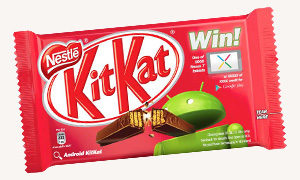
Today, the search giant announces that the next version of Android will be named KitKat, after the iconic Nestlé candy bar. Much like the way that candy bar can be broken into 4 pieces, the hearts of many geeks and nerds are broken too. You see, this is the first time that the operating system is named after a corporation's product. It is signaling that Android has "jumped the shark" and is no longer cool. What's next? L'Oréal? M&Ms? Nike?
Sweet! Google unwraps the next version of Android: KitKat
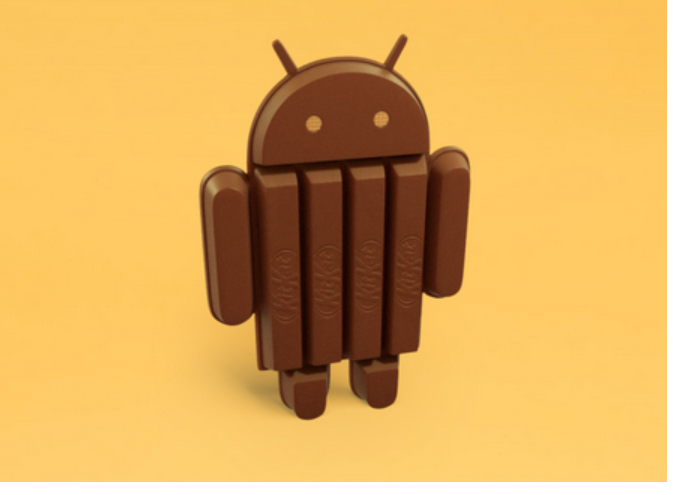
In something of a surprise move, Google announces that the successor to Jelly Bean will not be Key Lime Pie as everyone was expecting but… KitKat. There are no details of just what Android 4.4 will have to offer, or when we can expect to see it, but the new KitKat website promises to "make an amazing Android experience available for everybody".
The name might seem like something you would expect to hear announced on April 1, but this is no joke. The Nestlé website confirms that the next version of Google's operating system will be named after the "popular chocolate and wafer confectionery".

Google Chrome turns five -- Happy Birthday!
Kids and web browsers -- they grow up so fast these days. Seems like only yesterday that Google released its web browser to the public and set geek hearts aflutter with its speed and light footprint. Things have changed a bit, but many of us stick to the software as our browser of choice.
Google launched Chrome, in beta form, on September 2, 2008 for Windows only, and followed quickly with the source code as an open source project known as Chromium. The initial kickoff came in 43 different languages.

The most popular stories on BetaNews this past week
Looking at the biggest stories on BetaNews from August, 25 - 31, 2013. For the second week running, Microsoft managed to steal many of the headlines. After going gold, RTM, or however Microsoft now wants to refer to it, Windows 8.1 was released to OEMs. Depsite reaching this important milestone, developers were… irked, shall we say, to learn that they will not be able to get their hands on the completed code until it is released in October. At least that would be the case had the bits not leaked online very quickly. It was a Chinese version that was made available for unofficial download first, but an English version wasn't far behind.
I have previously pondered the popularity (or otherwise) of the Surface Pro, and this week Derrick stood firmly behind Windows RT positing five reasons it is destined to succeed.

Microsoft and Google (don’t really) want to tell you more about government data requests
Sounds nice, doesn't it? Two big names have listened to the concerns of the people that matter -- their customers -- in the wake of the NSA debacle, and want to share more information with the public about precisely what information the government is asking them to hand over. If only it were that simple.
In a blog post on TechNet, Microsoft General Counsel Brad Smith reveals that both Microsoft and Google filed lawsuits back in June to try to force the government to permit them to publish details of data requested under Foreign Intelligence Surveillance Act (FISA) orders. Smith says they [the two companies] believe they have a "clear right under the US Constitution to share more information with the public".

Linux environment Gnome fires Google over security concerns
I love Linux, it is no secret. Sure, I may stray to Mac and Windows every once in a while, and bash code-names, but I always come back to my first love; Linux. This week, I even had an argument with its creator Linus Torvalds over some measles, but even that can't stop my love.
My love for Linux, however, is very much focused on Fedora and Gnome3. And so, I am happy to see that Gnome has kicked Google to the curb as the default search engine for its Epiphany Web Browser (aka "Web"). Instead, it will use the privacy-focused DuckDuckGo.

Google grabs a third of online ad revenue
There is money to be made from online advertising, particularly if you happen to be Google. Research by Statista shows that in 2012, there was around $104b in advertising revenue sloshing around in the coffers of various companies. Projected figures show that 2013 is likely to even more profitable, with ad revenue expect to rise to $117.6b. This is not as great an increase as between 2011 and 2012, but it is still a climb.
It is the big names who are raking in the cash, with Google coming out on top. The search giant is expected to pocket $38.6b by the end of the year, equating to very nearly a third worldwide income from online advertisements.

I was, uh, wrong: Chromecast does what Google claims
A couple weeks ago when Google introduced its Chromecast HDMI dongle I wrote a column wondering whether it was really such a good product or simply good demoware? Now that I have my own Chromecast and have been playing with it for a few days I have to admit I was wrong. Chromecast appears to be every bit as good as Google claims. That’s not to say it’s perfect (more below) but pretty darned good.
What I really doubted was Google’s claim that the Chromecast could turn on your HDTV, switch the HDMI input, and throw content onto the big screen all in one seamless succession of events. It wasn’t that any of these tasks were especially difficult to do, but that to do them all on every HDTV would require more remote control capability than I knew existed in any current device.
Nexus 7 comes to Europe and Asia -- O2 reveals details of 4G model
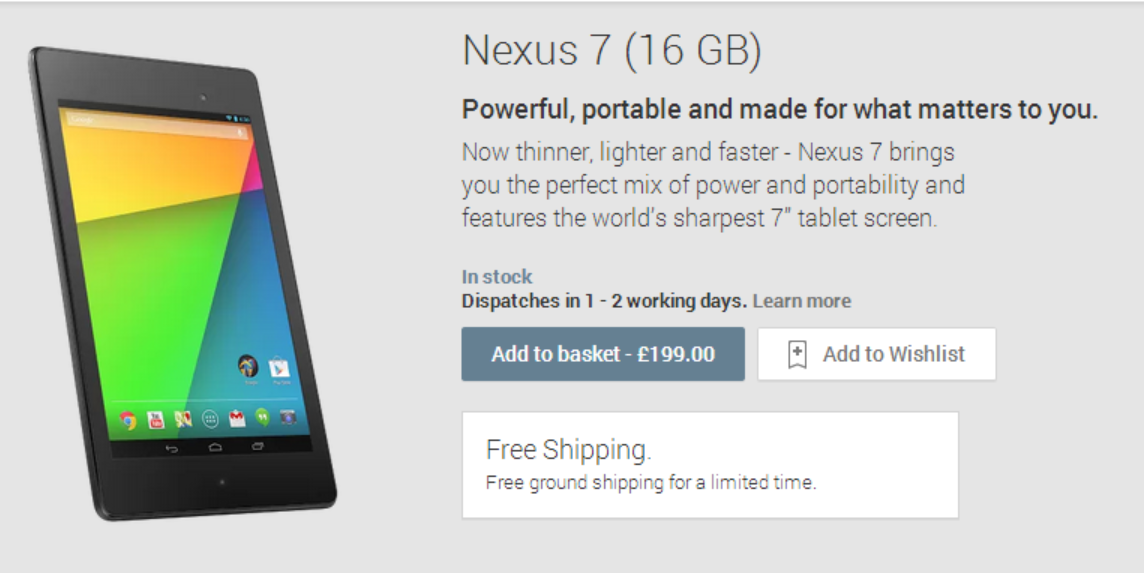
Some weeks after the US release of the Nexus 7, Google’s 7 inch tablet has found its way to eager customers in other countries. In Europe, the UK, France, Spain and Germany get a little bit of Nexus love, while in Asia it is Japanese tech-heads who can now get their hands on the 7-incher everyone is talking about. As has become the norm with many gadgets, prices are comparatively higher than in the US.
There are 16GB and 32GB Wi-Fi versions available and UK customers can expect to pay £199 and £239 respectively. In France, Germany and Spain, prices are pegged at €229 and €269, while Japanese Nexus fans can expect to be parted from ¥27,800 and ¥33,800 apiece.
Chromecast app comes to iOS
Apple users tend to like Apple things. Typically, the user's experience will be the best when all of their hardware is Apple. However, Google is hoping that iOS users will change course and shun the Apple TV in favor of its inexpensive Chromecast device.
Today, Google took a big step towards its goal by releasing a Chromecast app for iOS. Will it be enough to lure Apple users from the Apple TV?