
Cloud-based routing system optimizes web app performance
How well an online application or website performs has a strong influence on whether users become and remain customers.
With the rise of SaaS and market demand for rich content delivery, even milliseconds of latency -- or, worse, downtime -- can dramatically impact user experiences and loyalty, brand reputation, conversions, and, ultimately, the bottom line.

New standard brings stronger authentication to browsers
In a move to bring simpler yet stronger web authentication to internet users, the FIDO Alliance and the World Wide Web Consortium (W3C) are launching a new standard called Web Authentication (WebAuthn).
WebAuthn enables online service providers to offer FIDO Authentication through web browsers. FIDO Authentication makes web access more secure because it uses unique encrypted credentials for each site, eliminating the risk that a password stolen from one site can be used on another.

The space race is over and SpaceX won
The U.S. Federal Communications Commission (FCC) recently gave SpaceX permission to build Starlink -- Elon Musk's version of satellite-based broadband Internet. The FCC specifically approved launching the first 4,425 of what will eventually total 11,925 satellites in orbit. To keep this license SpaceX has to launch at least 2,213 satellites within six years. The implications of this project are mind-boggling with the most important probably being that it will likely result in SpaceX crushing its space launch competitors, companies like Boeing and Lockheed Martin's United Launch Alliance (ULA) partnership as well as Jeff Bezos' Blue Origin.
Starlink is a hugely ambitious project. It isn't the first proposed Internet-in-the-sky. Back in the 1990s a Bill Gates-backed startup called Teledesic proposed to put 840 satellites in orbit to provide 10 megabit-per-second (mbps) broadband anywhere on Earth. Despite spending hundreds of millions, Teledesic was just ahead of its time, killed by a lack of cost-effective launch services. Twenty years later there are several Teledesic-like proposals, the most significant of which may be OneWeb -- variously 882 or 648 or 1972 satellites, depending who is talking, offering 50 mbps. OneWeb has raised more than $1 billion, found a launch partner in Arianespace and even broken ground on a satellite factory in Orlando, Florida.

Privacy: Avast launches Chromium-based Secure Browser
The far-reaching tentacles of the likes of Google and Facebook have focused people's attention on online privacy, but for anyone looking to retain a modicum of confidentiality it can be hard to know what to do. There are VPN tools, but these are not for everyone, for anyone looking for a quick solution, Avast Secure Browser could be the answer.
This new Chromium-based browser is billed as being "private, fast, and secure" and it's designed to address the misconceptions many people have about privacy and security online. The browser is a renamed and updated version of SafeZone.

Facebook suspends pro-Brexit firm AggregateIQ for allegedly obtaining user data improperly
It's not all that long since Facebook suspended data firm Cambridge Analytica for harvesting personal information from millions of users. Now the social network has suspended AggregateIQ -- another data firm, this time linked to the pro-Brexit Vote Leave campaign -- because of possible connections to Cambridge Analytica's parent company.
AggregateIQ is thought to be linked to Strategic Communication Laboratories (SCL), and there are concerns that the firm may therefore have improperly obtained data from Facebook users.

Facebook users in Europe will soon have better privacy protection than those in the US
In a few weeks, privacy is set to improve for Facebook users -- at least this is the case for people in Europe. May 25 sees the implementation of General Data Protection Regulation (GDPR), and it means that European users will have the right to not only request details of the information stored about them, but also the right to demand its deletion.
While this will be a legal obligation within Europe, it would have been the perfect opportunity for Facebook to extend the same rights to its users around the world. But it's not going to. Mark Zuckerberg has confirmed that GDPR-style privacy protection is not going to be extended to the US and other parts of the world.

Shooter at YouTube headquarters was angry at demonetization of her videos
Nasim Aghdam walked into the YouTube headquarters in North California yesterday, shot and wounded three people, and then killed herself. While the precise motive behind the shooting is still under investigation, Aghdam's father has said that she was furious with YouTube for demonetizing her videos.
This is in line with posts made by her on her own website where she complained about YouTube only allowing certain channels to grow, alleging that her own videos were being filtered. In the wake of the shooting, technology executives including Twitter's Jack Dorsey renewed calls for gun control.

Google kicks cryptomining extensions from the Chrome Web Store
Amid growing concern about a disregard for Chrome Web Store policies, Google is slapping a ban on extensions that mine for cryptocurrencies.
With immediate effect, no more cryptomining extensions will be added to the Store, and as of July 2018, any existing mining tools will be removed. Google says that an astonishing 90 percent of mining extensions ignore rules that state cryptomining must be the extension's sole purpose, and users need to be fully informed about the mining.
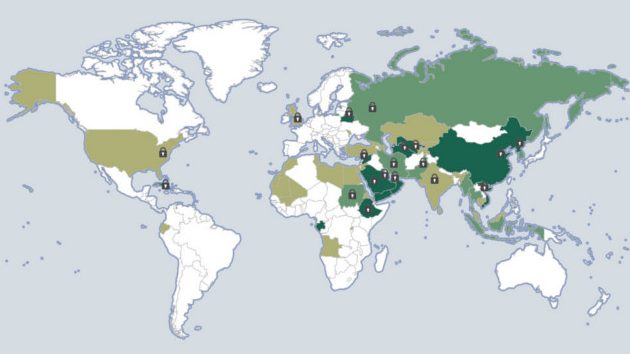
The best and worst rated countries for internet surveillance
We all know that some countries censor their citizens' access to the internet. But which are the most intrusive when it comes to online surveillance?
Consumer security site Security Baron has created an infographic showing the best and worst, along with those named by Reporters Without Borders as, 'enemies of the internet'.

Net neutrality repeal -- how will IT networks be impacted?
With Net neutrality in the midst of upheaval, there are significant changes afoot for both businesses and consumers in terms of internet access and control. New rules are expected to create differing service categories, allowing ISPs to prioritize access and bandwidth for certain customers. This will undoubtedly create confusion in the market leaving IT executives to make adjustments based on any new restrictions. To be ready, IT leaders would be well-served to keep the following in mind:
Threat factor #1: Internet fast lanes with potentially higher prices

Bookmark syncing service Xmarks to close on May 1
If you're a user of Xmarks, there's some bad news for you -- the service is closing down in a month's time. The bookmark syncing tool, which is available as an addon for Chrome, Firefox, Internet Explorer and Safari, is to be shuttered on May 1.
Very little fuss is being made about the closure by the company behind it -- something which is perhaps indicative of the level of interest there is in the service these days. A banner at the top of the Xmarks website reads: "LogMeIn is retiring Xmarks from its line of products as of May 1, 2018. After this date, you will no longer have access to Xmarks."

Ecuadorian embassy cuts off Julian Assange's internet connection
Still holed up in the Ecuadorian embassy in London, WikiLeaks founder Julian Assange has been given the snip. Ecuador took the decision to cut off the fugitive's internet connection, severing one of his lines of communication with the outside world.
Assange -- who a judge recently described as a man who "appears to consider himself above the normal rules of law" -- has been living in the embassy since 2012 when he was wanted for questioning in Sweden on sexual assault allegations. He has hidden away claiming he could be extradited to the US to face charges over WikiLeaks revelations, but he is also wanted by British police for skipping bail.

Facebook is testing self-destructing friend requests
Facebook is currently testing a new feature that would give users the chance to place time limits on friend requests. The idea is that requests that you ignore for a certain period of time would be automatically deleted.
While it's not a feature that will be of interest to everyone, it is something that could prove useful to anyone in the public eye who gets bombarded with endless requests to connect. Facebook has confirmed that automatically-expiring friend requests give users a way to more easily manage unwanted requests from people.

Facebook rolls out locally-focused News Feed globally
Facebook is constantly messing about with its News Feed, and it's only a matter of weeks since the social network said it was going to prioritize local news. Initially, this was only the case in the US, but now the change is rolling out around the globe.
The company says that "people around the world will see more news on Facebook from local sources covering their current city and other cities they may care about." Unfortunately for Facebook, however, it's unlikely to serve as too much of a distraction from the call/SMS logging controversy or the Cambridge Analytica debacle.

Google is beta testing a 'More results' button to reduce searches to a single, endless page
Google search results are, usually, multi-page affairs, but if a new test gets off the ground this could be set to change.
The search giant is conducting a limited test that sees the arrival of a "More results" button at the bottom of search results, replacing the "Next button" that is there at the moment. It's a variation on the idea of infinite scrolling, but a variation that grants the user more control.