

Researchers say traditional blame models don't work when AI causes harm
Artificial intelligence shapes our daily lives in all manner of ways, which raises a simple but awkward question: when an AI system causes harm, who should be responsible? A new study from South Korea's Pusan National University says the answer isn’t one person or one group, arguing instead that responsibility should be shared across everyone involved, including the AI systems that help shape the outcome.
The paper published in Topoi looks closely at the long-running responsibility gap. That gap appears when AI behaves in ways nobody meant, creating harm that can’t easily be pinned on the system or the people behind it.
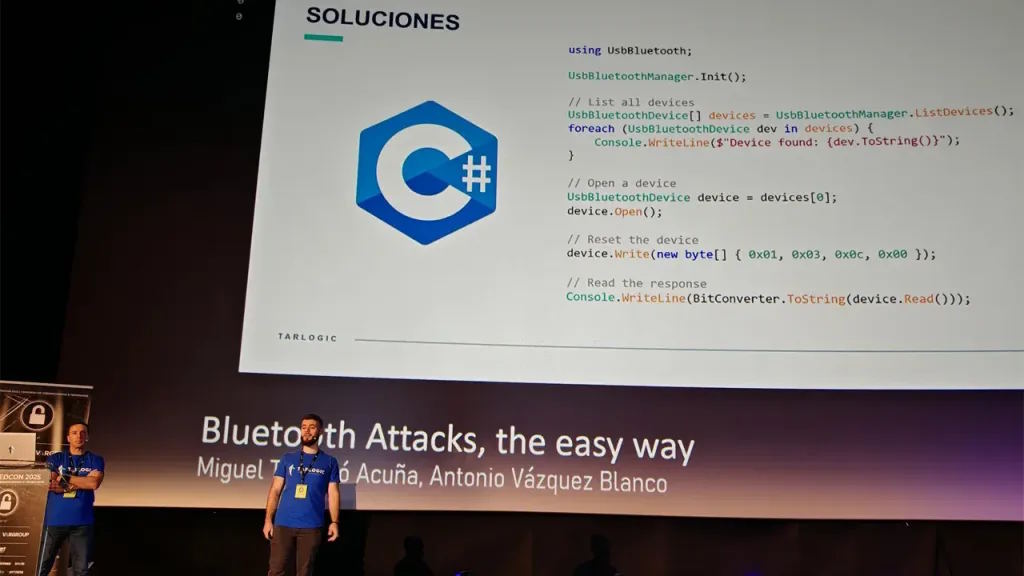
Attackers can use undocumented commands to hijack Chinese-made Bluetooth chips
Security researchers have shared details of newly discovered, undocumented commands in ESP32 Bluetooth firmware that can be exploited by an attacker. The Chinese-made chip is found in millions of devices, meaning the findings are significant.
Speaking at RootedCON in Madrid, researchers from Tarlogic Security, Miguel Tarascó Acuña and Antonio Vázquez Blanco, described the “hidden functionality” they have unearthed as a backdoor, but later conceded that this may be a misleading description. They warn that exploitation could allow “hostile actors to conduct impersonation attacks and permanently infect sensitive devices such as mobile phones, computers, smart locks or medical equipment by bypassing code audit controls”.
DeepMind dominates European AI research: What does this mean for researchers?
AI’s steady impact on the academic and research community is measurable through citation metrics, essentially showing how many times a study has directly influenced subsequent research. A recent analysis of AI-related citations showed beyond doubt the impact of AI. It also revealed another noteworthy statistic: Google’s DeepMind made up just under half of all AI-related citations from 2020-2024.
The company’s dominance is undoubtedly a testament to the importance of its work -- but it also serves as a starting point from which to probe further into the research landscape in Europe and how it’s been impacted by AI. Concentrated influences in academia and research can have long-lasting effects on funding distributions, channels of collaboration, and ultimately the potential for innovation. Add to this the powerful and relatively new tool of AI, and suddenly the future trajectory of scientific research on the continent looks a lot less clear.
New platform aims to enhance AI research accuracy
AI is making its way into more and more areas of life and work. In some areas though, particularly scientific research, it's vitally important to ensure the accuracy of results.
Norwegian company Iris.ai has developed a method to measure the factual accuracy of AI-generated content -- testing precision and recall, fact tracing, and extraction.

Researchers feel overwhelmed by errm… research
A new study finds that 66 percent of researchers are overwhelmed by the quantity of published work they have to review.
The survey, by research platform Iris.ai, of 500 corporate R&D workers shows that 69 percent spend at least three hours a week reviewing research documents, with 19 percent of those spending over five hours. AI could help to address this problem but is not being widely used.



