
Facebook's IPO is light on guarantees, heavy on risk
So Facebook is set to go public today. It's the most anticipated initial public offering since Google in 2004, and may net the Menlo Park, Calif. social network between $5 billion and $10 billion, according to estimates. That said, I am still lost as to how Facebook's going to be able to wow Wall Street from quarter to quarter, and we all know that's what investors (and the tech press) are looking for.
The IPO will cause pandemonium on the floor of the New York Stock Exchange, as investors attempt to cash in on one of the most successful Web companies in history. This type of market hysteria is prone to pitfalls: fellow social networking site LinkedIn saw its shares skyrocket to nearly $95 in the first day of trading from an IPO of $45, but it has since given back about half of those gains.
Google+ tops 100 million users
That will be the number by end of today, according to FamilyLink founder and unofficial Google+ statistician Paul Allen. The number has grown from 90 million since Google CEO Larry Page's official statement just two weeks ago.
Allen's announcement comes as rival Facebook announces its public offering, and quite possibly the largest one ever. Not since Netscape's IPO at the dawn of the World Wide Web era has a tech company generated so much interest going public. But Facebook has a new rival that's growing fast and leveraging hard existing Google assets. By year's end, Google+ could have half as many users as Facebook does today.
Google+ names policy goes just far enough
There are lots of places where you can be anonymous online. Google+ isn't one of them. Late today, Google announced a revision to the G+ names policy that doesn't change this, but it does allow people to use nicknames and established pseudonyms. If anonymity is your thing, go somewhere else. I don't want you on Google+. You can bully pulpit somewhere else. As for those folks whose lives might be at risk for using real names, please be safe someplace else -- Facebook, Reddit, Twitter, Tumblr or WordPress, for example. Those services have proven they can protect your identity.
But, of course, the griping will continue from the Internet rabble determined to hide their identities everywhere. They want more from Google than just nicknames. What are you afraid of? I use my real name everywhere, as I have always done. I see that as being in the very spirit of the open -- and transparent -- Internet. Be who you are, not someone else. And if that comment --- or other online interaction -- requires you to hide your identity, shut the frak up. Vent somewhere else. For everyone else, and this includes people who have built up alternative identities, Google+ welcomes you.

Koobface hackers are easily found on Facebook, elsewhere
The attackers behind the Koobface worm are not doing much to cover their tracks, say security researchers with Facebook and several security firms. Hackers are living a comfortable life in St. Petersburg, Russia, and have been posting freely to social networking sites such as Facebook and Foursquare.
Facebook and law enforcement have reportedly known their identities for several years. At least one of the members of the gang has repeatedly broadcast the location of the group's offices via Foursquare, including pictures of members at work -- presumably spreading Koobface around the world.

Murdoch on MySpace: 'We screwed up in every way possible'
While his wife's Twitter account was fake, News Corp CEO Rupert Murdoch's is indeed real -- and on Thursday evening his followers got some real talk on his feelings over the failures of MySpace. When the company bought MySpace for around $580 million in 2005, it was thought to be the gateway to expanding Murdoch's empire to the web. Remember at the time, MySpace was the leading social network and Facebook wasn't open to the public.
That was not to be. Almost immediately following the transaction, criticism began to build. Then upstart Facebook began to catch fire, eventually matching MySpace's traffic three years after the merger.

Privacy group demands FTC investigate Google search changes
The chorus of opposition to Google's recent search changes grows louder, with Electronic Privacy Information Center urging the Federal Trade Commission to launch an investigation into whether or not Google is violating users' privacy with the new feature.
Google settled with the FTC in March over its failed Buzz service, submitting to privacy audits for a period of 20 years as a result. EPIC is specifically concerned with personal data, photos, posts, and contact details being included in search results.
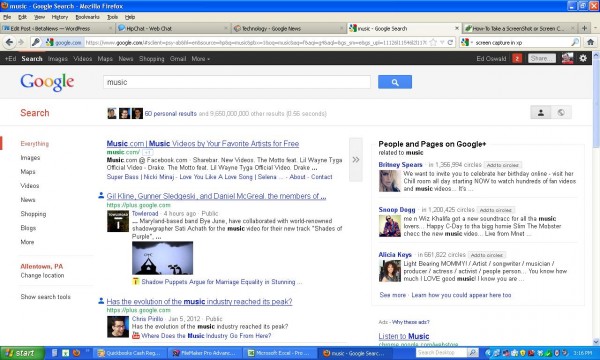
Google's new personalized search raises antitrust concerns
Google is diving deeper into personalized search results, debuting a feature called "Google Plus Your World". But the debut of the service, which pulls results from your own content plus social circles from Google-owned services may catch the ire of regulators.
The company is fighting off calls on Capitol Hill over antitrust claims, and in September found itself testifying in front of the Senate Judiciary subcommittee on Antitrust, Competition Policy and Consumer Rights. Senators wanted to gauge the power the Mountain View, Calif. company has over the search industry, and favoring Google's own service is sure to raise questions.
Android users love Facebook, Google+ not so much
This week, Nielsen listed the most popular Android apps by age group -- 18-24; 25-34; 35-44. Well, well, talk about age discrimination. Perhaps people 45 or older are considered to be iPhone users? For shame! The data is interesting not for what is there but what's not. Facebook tops all three age groups, when looking at actual apps. Android Market ranks higher. Google+ -- and Twitter, for the matter -- is nowhere in sight.
For all the buzz about Google+, and I am a big fan, it's not among the top-15 apps for each age group. That's no small thing. Mobile phones are by and far the most personal devices everyone uses. They're where people connect to other people and things that are important to them. Facebook clearly matters, Google+ and Twitter do not -- as measured by most-popular apps. I suppose some people could use browsers to access the services, but why would they?
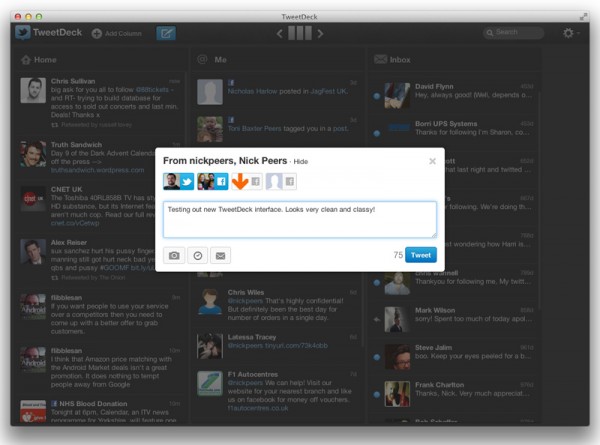
Twitter releases TweeDeck 1.0 -- get it now!
Twitter has released the first stable release of TweetDeck 1.0, its recently acquired, multi-columned Twitter client. TweetDeck 1.0, which runs on both Mac and Windows, is the first release to be written in native code as opposed to as an Adobe AIR application.
The release has proved controversial -- many users feel let down by the loss of a number of features that were present in earlier, beta releases of the software. Users must also register separately with TweetDeck before being able to use the new app -- in previous releases, registration was optional.

Gowalla shuts down as staff goes to Facebook
Location-based social network Gowalla announced on Monday that its service is shutting down at the end of January as its team "goes to California" to join the Facebook team.
Gowalla became known as something of an also-ran against location-based social networking leader Foursquare. For a brief period of time in 2010, the two services were in close rivalry and so-called "geosocial networks" were hot topics in the startup scene.

See where, when your ancestors lived with RootsMagic 5
RootsMagic has updated its popular family history software to version 5.0. RootsMagic 5, which can be road-tested as a cut-down Essentials version, adds a number of new features for those who purchase the full version. These include media tagging, a research manager and timeline view.
The software also benefits from around 80 non-specified improvements, a selection of which apply to RootsMagic Essentials 5 package too.

Can 'Buffy' slay Facebook Phone rumors?
Rumors persist over the mythical "Facebook Phone". This time it's Ina Fried and Liz Gannes of All Things Digital, claiming sources say the social network is working with HTC on an Android powered device -- codenamed "Buffy" -- to launch in about 12 to 18 months. It deeply integrates Facebook services into the experience, and relies on HTML5 as a platform for applications.
But Fried's and Gannes' report may not be accurate. In a "He Said, She Said" response, Inside Facebook followed up saying its own sources call Buffy a "trainwreck". Reporter Kim-Mai Cutler says that the phone would have a host of issues, including always being one step behind the latest version of Android due to the deep customization that Buffy would require.
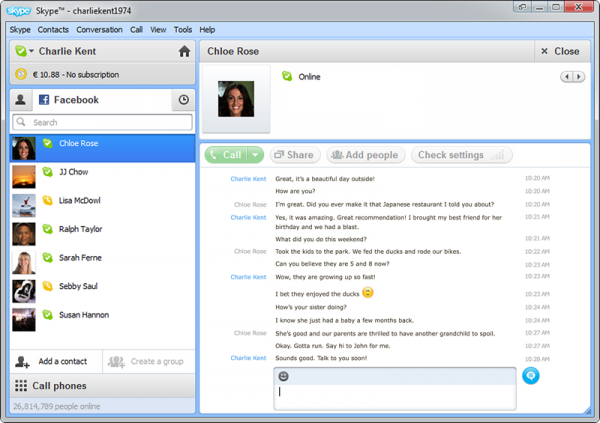
New Skype betas add Facebook video chat
Skype’s integration with Facebook is nothing new, but the latest beta version of the cross-platform chat and VoIP tool takes this to a new level. Skype for Windows 5.7 Beta and Skype for Mac 5.4 Beta bring further advantages to connecting your Facebook account with your Skype one. Now, as well as being able to make use of Facebook chat from within the app, it is now also possible to conduct Facebook video chats.
This can all be carried out from within Skype itself without the need to visit the Facebook web site -- just as it has been possible to conduct text-based chats with your Facebook contacts, the same is now possible with face-to-face VoIP calls. Improvements have been made to Skype’s video rendering, which helps to give a smoother overall experience, and there are a number of other new features to explore.
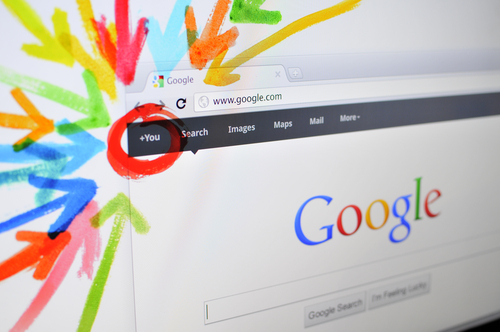
If you're a teacher, you're nuts not to use Google+
This week I gave a talk on Web 2.0 and teaching to a group of higher-education faculty ("cloud" isn't yet pervasive in academia). I won't bore you with the details, but I made the basic argument that using cloud-based tools could help educators create better learning environments for their students through the collaboration, mobility and engagement opportunities the cloud affords. I gave examples of several different tools that could help do this, like collaborative documents, mobile video broadcasting, and group citation indexes. Then I ended with what they all really wanted to talk about: social media.
In addition to being the hottest iteration of cloud computing to the general public, social media holds much potential for education. Social media allows for effortless individual and collective communication between teacher and student(s). It breaks down the walls of the traditional classroom, allowing for conversation and active learning to exist 24/7, in real time and asynchronously, right in the palm of a student's hand.

Facebook users make their personal data easy to retrieve, researchers say
Here's a story that will make you think twice about what you share on Facebook. Researchers with the University of British Columbia's NetSysLab let loose what are called "socialbots" on Facebook, and came away with 250 gigabytes of personally identifiable data. The results of the study show that Facebook users need to be much more cognizant of exactly what they share, and who they add as friends.
A socialbot is a bot that comes in the form of a faked user profile. The bot friend requests users on the site, and then once the requests are accepted, it downloads the personal information on the profile. NetSysLab researchers report a success rate of up to 80 percent in tricking Facebook users into adding the fake profiles and making matters worse, Facebook's protective measures did little to detect or prevent the researcher's infiltration.