PC market continues to shrink -- can Windows 10 change that?

2014 was an interesting year for PC vendors. It was the year when Microsoft’s Windows XP -- a 14-year old operating system with more than one-third of market share then -- went out of support. The Redmond-based company announced that it won’t be providing any further security patches to the veteran desktop operating system, leaving hundreds of millions of computers vulnerable. PC vendors saw an uprise in their computer shipment figures, as a large chunk of users, as well as companies, upgraded their computers to Windows 7 or higher.
But things have started to wither once again for PC OEMs. These companies are having a hard time selling their new computers to people. While the individual figures from Lenovo and HP still point upwards, Dell and Acer seem to be having a bad time, so bad that they are dragging the entire community a little backward. Up to five to seven percent decline has been observed in the shipment figure in last one year.
Millennials prefer to shop using mobiles


A new survey carried out by application delivery company Instart Logic looks at the shopping habits of millennials in order to help retailers set their ecommerce priorities as the holiday season approaches.
The results show that millennials -- those born between the early 1980s and early 2000s -- are more likely to use mobile devices to shop, with 55 percent doing so. They still like to use browsers, however, with 57 percent preferring them over native apps.
The tracks of my bargains – sacrificing privacy for a good deal

The increased popularity of smartphones means that, unless we specifically opt not to, most of us leave a record of our location wherever we go.
This information is of course valuable to marketers and a new study by customer engagement specialists PunchTab reveals that consumers are concerned about how location data is used.
New software platform looks to open up the internet of things
We're only just beginning to see the potential of the internet of things. A wide range of devices able to exchange information over the web presents many opportunities for companies to deliver new products and services.
According to Gartner estimates, the IoT will include 26 billion units by 2020, and by that time, IoT product and service suppliers will generate incremental revenue exceeding $300 billion, mostly in services.
Lenovo continues to dominate Chinese and Indian PC markets

We're constantly being told that the PC market is in terminal decline, but sales figures from different parts of the world continue to defy the predictions.
The latest figures from market intelligence provider IDC for the Asia/Pacific region show a two percent rise over last quarter and a total market for the second quarter of 2014 at 24.3 million units, slightly up on predictions.
The PC: A companion device for your smartphone


New in stores: It’s the "Personal Computer" -- the ultimate companion device for your smartphone or phablet!
Ever wished your mobile device had a larger screen? Or that there was a better way to input long documents than tapping tiny little virtual keys on a slab of glass (or sapphire)? Well, then you’re a perfect candidate for PC ownership.
PC shipments show strong growth in USA -- global decline slows


The most popular computers nowadays, mobile devices such as smartphones and tablets, are full of compromises. Sure, they are sexy and fun to use, but hardly ideal for true work and creation. Hell, the "smart" in smartphone is starting to feel like a misnomer. A true desktop operating system coupled with a laptop, desktop or hybrid form factor will offer the most functionality and success.
Consumers have overlooked these mobile shortcomings as they have been mostly consuming content at home. However, the tides may be changing -- it feels like the consumer love-affair with mobile devices is starting to wane. Smart-watches may be the straw that breaks the camel's back. People are tired of retrofitting their desired computing to small screens. How about using an actual PC, rather than try to get PC functionality from a mobile device? Crazy concept, I know. Today, IDC announces that PC shipments are showing strong growth in the USA for Q2 2014, year-on-year.
The future of IT spending is bright(ish)

Worldwide IT spending is on track to reach $3.7 trillion, an increase of 2.1 percent in 2014, according to new figures released by research specialists Gartner. However, this is down on earlier projections which put this year's growth at 3.2 percent.
The slower growth outlook is down due to a reduction in growth expectations for devices, data center systems and to some extent IT services. The value of the devices market -- which includes PCs, mobile phones, tablets and printers -- is predicted to grow by 1.2 percent over last year. This is partly due to lower prices. As tablet adoption reaches 50 percent in US households, Gartner forecasts sales of high-end tablets dropping as new buyers are attracted by lower priced units.
Microsoft is cooler than Apple


Third in a series. In business perception is everything. Many companies succeed or fail not because their products are great but their brands are perceived to be that way. Apple is a remarkable perception manager. Consider iPhone 5s, which features and benefits fall far behind many competing devices. Rather than innovate, the fruit-logo launches an evocative marketing campaign -- "You're more powerful than you think" -- that makes the smartphone look better. Improved. The ads are compelling because they communicate: Your life will be better, you shall achieve your dreams, by buying iPhone 5s.
Meanwhile, competitors like Microsoft truly innovate and take the kind of risks that once defined Apple. Last year I asked: "Will 2013 be another year of Apple iteration masquerading as innovation?" Yes, and halfway into another year, little is changed. The answer is the same. Last month I explained "Why Apple no longer innovates". OS X Yosemite and iOS X 8 are prettier, but so what? Meanwhile, Windows 8/8.1 is a radical rethinking of the platform -- as is Surface, which delivers refreshing change to computing. What's that long-forgotten Yellow Pages tagline? Let your fingers do the walking. They do on Surface.
The new industrial revolution -- machines rise up to become our equals


The Internet of Things is just the latest buzzword that is being used to push all manner of products. Let's cut to the chase -- it's just about "stuff" (other than obvious things like computers and phones) connecting to the internet. Nothing more than that. But this dismissive-sounding definition is not meant to undermine the importance or the significance of the IoT. We've spent the last 20 years or so getting used to the idea of accessing the web, harnessing what it has to offer, exploiting it in various ways and finding all manner of methods of using it to make life easier, more entertaining, and more profitable. The evolution of the Internet of Things sees this taken to the next level.
We are on the cusp of a new industrial revolution. Many would say that the wheels are already in motion. The tired -- very, very tired -- example of what the Internet of Things is about, is the prospect of owning a fridge that will be aware of when you run out of milk, and then either alert you or place an order on your behalf. This is a very simplistic view of things, but it is the communication between devices that will be the hallmark of things to come. Inter-device communication, or machine-to-machine (M2M) connectivity. Devices that can be left to their own devices (ahem) are approaching in ever-growing numbers, and there are advantages to be gained.
Technology and politics -- two paths that need to cross to enable progress

In the world of politics, the wheels of change move slowly; very slowly indeed. Parties and those in power have a vested interest in maintaining the established order, and any attempts to buck the status quo are usually fairy fiercely opposed. Contrast this with the technological world where there are new innovations made every single day -- even at the weekend! Technology doesn’t run out of money and leave an entire nation on the verge of collapse. Technology is not interested in race, class, sex, sexuality or other characteristics. It is certainly true that technology is largely driven by a desire to generate profit -- we are, for the time being, living in a capitalist world, after all -- but it is profit born of fulfilling people's needs and desires.
Can the same be said of politics? To a large extent politics is self-serving. There's still an interest in generating a profit, but it is for the benefit of the few. Technology serves the masses, and has the potential to serve and benefit all. Of course, the term "technology" is rather broad. For the purposes of this article, I'm going to use it to refer to computers, the internet, smartphone, the cloud, electronic/connected devices, robots and the like. For all the gestures to democracy and choice, politicians are, for the most part, interested in serving certain sections of society. There are of course those parties and politicians who are able to take a wider view, have an interest in helping those at the bottom as much as those at the top, and value all people equally.
With Surface Pro 3 and no Mini, Microsoft delights and disappoints

Today's Microsoft event in New York City was something of a mixed bag with its fair share of highs and lows. There was an obvious highlight -- the Surface Pro 3. It was a highlight for two reasons. Firstly, despite expectations to the contrary, this was in fact the only device to be announced today. Secondly, at least in terms of looks and specification, it's bloody amazing. But there were at least a couple of low points. No Surface Mini, and the frankly bonkers, nuts, crazy, mad Surface Pro 3 pricing.
The Pro side of Microsoft's Surface range has long been criticized for being a little on the pricey side, but the third generation takes things to the extreme. At the top end of the scale -- a rather juicy sounding Intel Core i7 device packing 8GB RAM and 512 GB of storage -- you'll need to save up an astonishing $1,949. Panos Panay made a great deal of noise about how this is the tablet that can replace your laptop. For that price, I should flippin' well hope so. For that price I can buy a top of the range laptop and still have enough left over to buy a decent tablet. I could even venture into Apple territory if I was feeling a little saucy...
The connected car -- AVG warns of security and privacy concerns

The "internet of things" is one of those catch-all terms that has become one of the latest buzzwords to be bandied about hither and thither. It is often used to conjure up images of an online oven, connected kettles and web-enabled waffle makers, and is referred to as something that is yet to be. So used is this term, that it's easy to forget that it's something that already exists -- just ignore the absurd name and you simply have a collection of devices that connect to the internet for a variety of reasons. But having any device connected to the internet has advantages and disadvantages, and this is something that security experts AVG recognize only too well.
Take cars for instance. Things have advanced in leaps and bounds in recent years, to the point that the traditional key is no longer needed, and apps can be used to check vehicle stats -- who needs dials and in-car displays, eh? Just as owning a car has changed dramatically in the past couple of decades, so has the problem of car security. Numbered are the days of a brick through the window, a screwdriver or coat hanger slipped down the side of the window, and touching together a couple of wires to make a getaway in just a few minutes.
Windows XP end-of-life boosts PC shipments

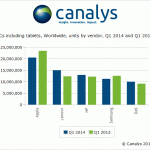
PC shipments have been boosted by the demise of Windows XP with shipments up by five percent compared to the previous year.
Figures from Canalys showed that 123.7 million PCs were shipped worldwide in Q1 2014 and Lenovo was one of the biggest beneficiaries of this growth as its PC shipments totaled 15 million and increased its market share from 10 percent to 12 percent.
Windows XP upgrades give global PC shipments a (small) boost


IDC and Gartner have released their worldwide PC shipment estimates for the first quarter of 2014 (1Q14), and as expected they once again show a year on year decline, but the severity of the drop has eased compared with the past seven quarters -- thanks, in part, to XP users upgrading their aging systems.
"The end of XP support by Microsoft on April 8 has played a role in the easing decline of PC shipments," says Mikako Kitagawa, principal analyst at Gartner. "All regions indicated a positive effect since the end of XP support stimulated the PC refresh of XP systems. Professional desktops, in particular, showed strength in the quarter. Among key countries, Japan was greatly affected by the end of XP support, registering a 35 percent year-over-year increase in PC shipments. The growth was also boosted by sales tax change. We expect the impact of XP migration worldwide to continue throughout 2014".
© 1998-2025 BetaNews, Inc. All Rights Reserved. About Us - Privacy Policy - Cookie Policy - Sitemap.